

Culver City’s average Walk Score is 76, but that “Very Walkable” rating can’t tell you whether a specific home makes your daily errands easy on foot. The culver city walk score is a useful starting point, not a verdict on every block. A nearby market, café, or bus stop can make one address feel very different from another.
If a citywide summary leaves you wondering how a neighborhood would fit your routine, focus on the routes from the exact home you’re considering. Walk Score estimates access to nearby destinations, but it doesn’t capture every part of the experience, including hills, weather, or street conditions. A strong score may also reflect errands you rarely make rather than the places that matter most to you.
This guide explains what Walk Score measures, what it leaves out, and how to compare Culver City addresses against your priorities. It also puts the city’s average Transit Score of 48 and Bike Score of 71 in context, so you can consider walking alongside transit, biking, driving, and the home itself.
Key Takeaways
- Use the culver city walk score to compare locations, then check whether nearby destinations match the errands you actually make.
- Compare walk, transit, and bike metrics as separate clues. Convenience in one mode doesn’t guarantee an easy full trip.
- Choose a few addresses and map routine trips, such as groceries, parks, and work, before deciding which location fits your day-to-day life.
- Visit the routes you expect to use and consider street conditions, mobility needs, and your preferred ways to get around.
- Balance location convenience with property priorities. Neighborhood-specific buyer guidance can help you assess those trade-offs.
What the Culver City Walk Score measures, and what it cannot tell you
Two homes in Culver City can offer very different walking convenience, even if they’re only a short drive apart. Walk Score estimates how practical nearby errands may be on foot from a particular address. The citywide average is 76, but that figure is a broad snapshot, not a description of every block or every resident’s routine.
Walk Score is an address-based estimate of access to nearby destinations on foot, not a complete review of what living in a neighborhood will feel like. Use it to compare locations, then consider your own errands, mobility, and route preferences.
For a visual introduction to one of the city’s best-known destinations, take a look at this tour of Downtown Culver City:
How to interpret a Walk Score number
Walk Score uses a 0-100 scale. Its current categories are 90-100, “Walker’s Paradise”; 70-89, “Very Walkable”; and 50-69, “Somewhat Walkable.” Lower scores indicate greater car dependence for most errands. The What is Walk Score overview provides background on the metric and its calculation.
The calculation considers walking routes to nearby amenities in 13 categories. Destinations within a five-minute walk receive the maximum points, and the method also factors in population density and road measures such as block length and intersection density. A nearby grocery store or café may contribute to a score, while the same type of destination farther away may contribute less. For a home search, compare address-level results rather than assuming the Culver City average applies to every property.
Why a score is not a complete livability rating
The culver city walk score can’t know whether the listed destinations match your routine, how often you walk, or what mobility needs shape your route. It also doesn’t measure every real-world condition, including hills, weather, crime, shade, crossing comfort, or accessibility. A short mapped route may still feel inconvenient if it involves a crossing you’d rather avoid.
Use the number as a prompt for closer investigation. Map the places you’d actually visit, then experience those routes when practical. Your observations of current street conditions add context that an estimated score alone can’t provide.
How Culver City Walk Score varies by address and everyday destinations
A home’s walkability depends on what’s nearby and whether the routes work for you. One address may have a grocery store, café, and pharmacy along straightforward walking routes, while another may be closer to parks or services you use more often. Even within the same part of Culver City, a few blocks can change which errands feel practical on foot.
Walkability is address-specific, not a single citywide experience. Treat an area-wide description as a starting point, then compare actual properties against the same everyday destinations.
Compare errands from the exact property address
Start with each property’s street address, not a neighborhood label or nearby landmark. Make a short list of destinations that reflect your routine, such as groceries, cafés, pharmacies, parks, schools, or other services. Then map walking routes to the same types of places for every address.
Pay attention to the route, not just the distance. A destination may look close on a map but require a longer path because of the street layout or crossings. For frequent errands, consider whether the route seems realistic at the times you’d usually go. A weekend coffee stop and a grocery run after work may involve different schedules and conditions.
- Record each destination and its estimated walking route from every address.
- Note crossings or route details you’d want to experience firsthand.
- Mark which regular errands feel convenient, occasional, or impractical on foot.
Look beyond a single Culver City label
Downtown Culver City can be a useful place to investigate for nearby dining, services, and other destinations. But don’t treat it as a stand-in for the whole city, or assume every nearby home offers the same day-to-day convenience. The property’s precise location and the routes from its front door matter.
For a fair comparison, use the same destination categories and route-search method for every candidate home. Check that businesses shown on maps are still operating, and look for anything that could affect the route. Online maps can help narrow your options; visiting a route can reveal details a map doesn’t make clear.
This side-by-side approach helps you separate your priorities from what a broad score suggests. A higher rating may reflect destinations you rarely use, while another address could offer easier access to the places that anchor your week. If you’re weighing neighborhood fit alongside property priorities, neighborhood-specific homebuying guidance can help bring those trade-offs into focus.
Culver City Walk Score vs. transit and bike access: compare the full trip
A location can be convenient for walking errands yet less practical for a transit commute or a bike trip. Walk Score, Transit Score, and Bike Score describe different parts of getting around, so compare them as separate clues rather than treating one as a substitute for the others. The reported Culver City averages are 76 for Walk Score, 48 for Transit Score, and 71 for Bike Score. Address-level results and your actual travel needs matter more than any citywide average.
What Walk Score, Transit Score, and Bike Score each indicate
Walk Score estimates how accessible nearby everyday destinations are on foot. Transit Score indicates the availability and usefulness of nearby public transportation, while Bike Score reflects how bikeable an area is. Culver City’s average Transit Score of 48 indicates some public transportation is available; its Bike Score of 71 falls in the “Very Bikeable” range. These measures aren’t interchangeable, and none promises a particular commute time or service experience.
Use the comparison to identify what you need to check for the full trip:
| Metric | What it suggests | What to verify |
|---|---|---|
| Walk Score | Access to nearby destinations on foot | Routes to the errands you make regularly, including crossings and accessibility |
| Transit Score | Nearby public transit access | Current stops, schedules, transfers, and walking connections |
| Bike Score | How practical cycling may be in the area | Your actual route, comfort, and connections to key destinations |
Check Culver City routes against your actual routine
For a commute, map the whole trip from the candidate home to your destination, including the walk to transit, any transfers, and the final connection. Check the return trip too. An outbound option may not fit your schedule later in the day.
Check current Metro E Line and Culver CityBus routes, stops, and schedules using their official transit information before relying on a route. Culver CityBus service increased by 7% across routes effective July 13, 2026, but that citywide change doesn’t tell you how a particular trip will work at the times you travel. Confirm the relevant schedule and connections directly.
When comparing the culver city walk score with transit and bike access, ask how well the combination supports your everyday routine. A strong score in one category can’t guarantee convenience in another. Compare the complete trip, not just the headline number.
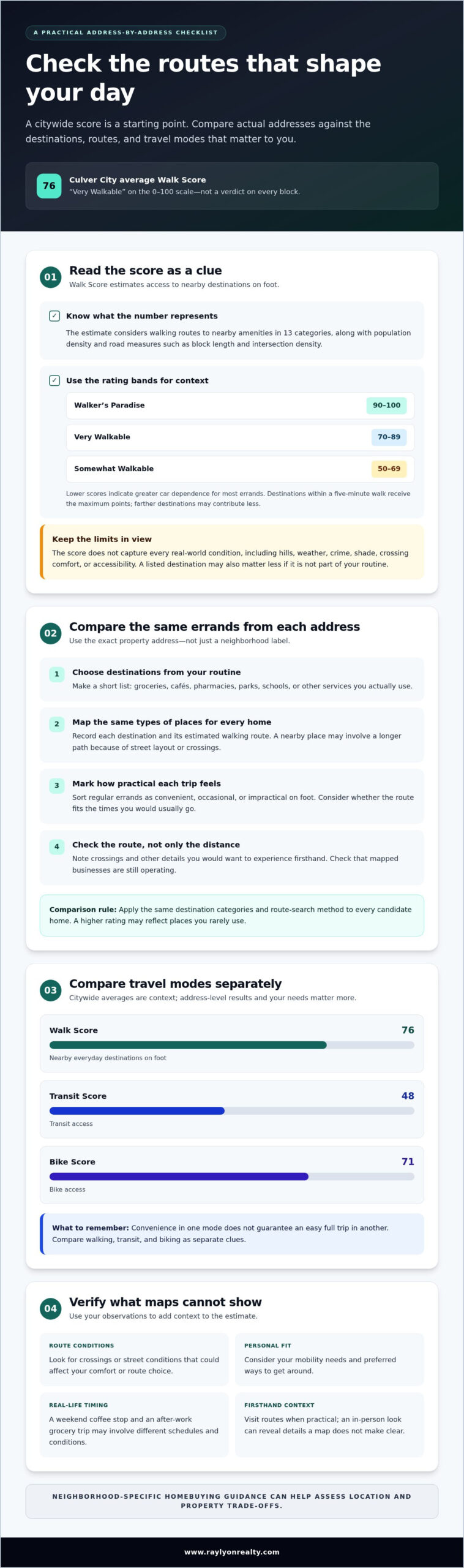
A practical checklist for evaluating Culver City walkability before choosing a home
A repeatable comparison makes walkability easier to judge than a headline score alone. Use the same steps for each property, and keep measured data separate from what you notice on the street. Shape your shortlist around your household’s routine, mobility needs, commute, and preferred mix of walking, transit, biking, and driving.
Build an address-by-address comparison
- Choose candidate addresses. Compare specific properties rather than broad neighborhood names.
- Record the metrics. Note each address’s Walk Score, Transit Score, and Bike Score, along with when you checked them.
- Map routine trips. Use the same destinations for every home, such as groceries, school, work, parks, and regular services. Consider weekday and weekend needs.
- Visit key routes. Walk priority routes at realistic times when practical, then add your observations to the comparison.
A simple table keeps the details straight. Add a row for each address and use the notes column for firsthand observations rather than estimates.
| Address | Key destinations | Walking route and crossings | Transit options | Personal notes |
|---|---|---|---|---|
| Candidate A | Groceries, work, park | Distance, crossings, sidewalk condition | Relevant routes and schedule checked | Observed comfort, lighting, accessibility |
| Candidate B | Same destinations | Distance, crossings, sidewalk condition | Relevant routes and schedule checked | Observed comfort, lighting, accessibility |
Keep score results in a separate field or column. They’re estimates, while details such as sidewalk quality, crossing comfort, lighting, shade, and accessibility are things to assess for yourself. Comparing the same destinations and similar travel times makes the results more useful.
Test whether the location fits your lifestyle
Try a route you’d use regularly, such as the walk to a grocery store or transit connection. Notice whether crossings feel manageable, sidewalks are continuous, and the route suits your mobility needs. Consider how those impressions might change at the time you’d actually travel. A high culver city walk score may still be a poor fit if its nearby destinations don’t match your routine.
Consider how often your household would still need to drive, and whether that works for your budget and schedule. If you’re comparing nearby Westside options, the Mar Vista neighborhood guide can add context to your search. For help weighing neighborhood fit alongside home priorities, explore homebuying guidance.
Use Culver City Walk Score as one part of a smarter home search
A useful home search brings several pieces together: the exact address, routes to your regular destinations, available transportation options, and the property priorities that matter to your household. The culver city walk score can help you compare locations, but it can’t decide whether a home’s setting fits your life. Check the routes and destinations behind the number, then weigh what you learn against your daily routine.
Bring your walkability priorities into a buyer conversation
Before comparing homes, outline what convenience means for you. Think about essential errands, commute needs, mobility considerations, and whether you expect to walk, bike, use transit, drive, or combine modes. A buyer who walks to shops several times a week may judge a location differently from someone who mainly needs a dependable commute connection.
Ray Lyon Realty guides buyers through Westside neighborhood and property decisions, including the trade-offs between location and home priorities. For broader context on representation, see this Los Angeles real estate agent guide. Connect your neighborhood research with the details of the properties you’re considering instead of relying on a rating alone.
Take the next step with a clear location brief
A short location brief helps focus the search. Note the areas you’re considering, the places you visit regularly, and the transportation options you’d like nearby. Include practical constraints, such as routes that need to work for a particular schedule or destinations you want to reach without driving. These details make it easier to compare homes on the things you’ll notice after moving in.
Use current address-level scores as one input, and verify routes, destinations, and transit information against current sources. Scores and service details can change, so record when you checked them and revisit the information as your shortlist develops. Then balance location fit with the home itself, including layout, condition, and other priorities.
A neighborhood-focused search is more useful than choosing by score alone. If you’re considering a move in Culver City, talk with Ray Lyon Realty about your home-buying priorities and the locations that may fit them.
Make your next home search fit the way you live
The culver city walk score can help you compare locations, but a sound decision comes from looking beyond the number. Check the exact address, map routes to the places you use, and consider how walking, transit, biking, and driving fit your daily routine. The score is a starting point; your priorities and experience on the ground complete the picture.
Residential buyer representation across the Los Angeles Westside can help connect neighborhood fit with property priorities. Ray Lyon Realty represents buyers and provides localized knowledge of Westside communities, including Santa Monica, Mar Vista, and Venice, to help clients compare their options.
Ready to turn your walkability priorities into a focused home search? Talk with Ray Lyon Realty about your home-buying priorities and start shaping a search around the locations and property features that matter to you.
Frequently Asked Questions
What is the Walk Score for Culver City?
Walk Score reports a citywide average of 76 for Culver City, in the “Very Walkable” range. That’s a broad indicator, not a score for every home or block. The culver city walk score for a specific address may differ based on nearby destinations and walking routes. Check the property’s address-level result and treat the city average as context, not a substitute for evaluating your own errands.
Is Culver City a walkable place to live?
Culver City’s average Walk Score suggests that many errands may be possible on foot, but the experience depends on where you live and what you need nearby. Check routes from a specific home to places you’d visit regularly, such as groceries, cafés, parks, or pharmacies. Consider crossings, sidewalks, accessibility, and how comfortable the routes feel at the times you’d use them.
How do I find the Walk Score for a Culver City address?
Enter the complete property address in Walk Score’s address lookup to see its current result. Compare candidate homes using the same approach, then review the nearby destinations and walking routes behind each score. Confirm that the places shown are open and relevant to your routine. A mapped route and an in-person visit can add practical context that a score alone won’t provide.
Can Walk Score tell me whether I can live without a car in Culver City?
No, Walk Score alone can’t determine whether a car-free lifestyle will work for you. It estimates access to nearby destinations on foot, but it doesn’t account for all your commuting needs, schedules, mobility requirements, or preferred destinations. Map your regular trips and check current transit routes and schedules, including connections to and from home. Consider which trips you’d still need to make by car.
What is the difference between Walk Score, Transit Score, and Bike Score?
Walk Score estimates how accessible nearby destinations are on foot. Transit Score reflects nearby public transportation access, while Bike Score indicates how practical cycling may be in an area. They measure different travel options, so a high result in one category doesn’t guarantee convenience in another. Compare all three for the specific address, then look at the routes and services that match your routine.
Does a high Walk Score mean a Culver City home is a good investment?
No, a high Walk Score by itself doesn’t establish whether a home is a sound investment. Walkability can be one factor in location appeal, but it doesn’t assess the property’s condition, asking price, or how well it fits your goals. Consider the home and its location together, alongside relevant market information and your intended use. A residential buyer’s representative can help you weigh those factors.
Can Culver City Walk Score change over time?
Yes, an address’s Walk Score may change as nearby destinations, walking routes, or the data used in the calculation change. The score is an estimate, so a past result may not reflect current local conditions. Check the address again during your home search, confirm that key destinations are still operating, and review actual routes. For transit details, consult current information from the relevant transit agencies.