

What if a low offer is less a verdict on your home’s value and more useful information about the buyer and the negotiation? If you’re deciding what to do when you get a lowball offer on your house, it’s natural to feel frustrated or worry that a response could scare the buyer away. But an offer is a starting point, not a final answer.
A low price can feel personal, especially after preparing your home and choosing an asking price. It may also prompt you to question whether your expectations match the market. Buyers sometimes open low to leave room for discussion, test a seller’s flexibility, or stay within a budget. The number alone doesn’t tell you which explanation applies.
To assess the offer, compare it with relevant sales, your home’s condition, competing listings, and the terms that affect your bottom line. Then decide whether a counteroffer, a firm response, or more time to review makes sense. For sellers on LA’s Westside, property-specific local insight can help distinguish a weak offer from one worth negotiating.
Key Takeaways
- To decide what to do when you get a lowball offer on your house, assess it against evidence about your property and its market, not just your asking price.
- Review the full offer, including financing, contingencies, requested credits, deposit, and proposed dates, before judging its strength.
- Countering, declining, or continuing the discussion can each make sense. Choose based on your priorities, timeline, and comfort with uncertainty.
- Keep your response professional and organized: pause, review the details, clarify what matters, then choose and document your next step.
- A local seller representative can help interpret comparable sales and offer terms, then shape a response around your goals.
What counts as a lowball offer on your house, and what it may mean
A lowball offer is substantially below a reasonable, evidence-based view of what your property may be worth. Your asking price alone doesn’t prove that an offer is too low. The list price is a starting point for negotiation; comparable sales, your home’s condition, and current competition provide useful context. If you’re weighing what to do when you get a lowball offer on your house, separate your reaction to the number from the evidence behind it.
Look beyond the headline price. Financing, contingencies, requested credits, the deposit, proposed timing, and other closing terms can affect the offer’s overall appeal. A lower price with workable terms may deserve a different response from a lower price paired with substantial concessions or unclear details. One low offer is a negotiating signal, not a definitive market valuation.
Price discussions are part of bargaining or haggling, where buyer and seller negotiate toward terms they can both accept. The first offer may open that conversation rather than reveal the buyer’s final position.
For a quick overview of one way to approach a low offer, watch this video:
How do you tell whether an offer is genuinely too low?
Compare the offer with recent sales of similar nearby homes, then account for meaningful differences. A renovated home may not be a fair comparison for a property that needs work. Location, layout, features, and condition all matter. Review current competing listings and your home’s listing history for more context. Online estimates can be a starting point, but may not reflect the details that set your property apart.
Why might a buyer make a low offer?
A buyer may be testing your flexibility, responding to perceived competition, or accounting for the property’s condition. Time on the market may also shape what a buyer thinks the seller will consider. Check whether requested credits or other terms help explain the low headline price. Don’t assume the offer is personal or that the buyer won’t negotiate. Look at what the proposal tells you, then decide whether its price and terms leave room for a useful discussion.
Before responding to a lowball offer, assess its price and terms
Before deciding what to say, evaluate the offer against market evidence and your own priorities. Review recent comparable sales, competing listings, your home’s condition, and its listing history. Then assess the entire proposal, not just the number at the top. This gives you a clearer basis for deciding what to do when you get a lowball offer on your house.
Which comparable sales are relevant to your home?
Start with recent sales that resemble your property in type, location, size, condition, and features. A broad neighborhood average can hide important differences: nearby homes may have different layouts, updates, lots, or settings. For homes in Santa Monica, Mar Vista, Venice, and elsewhere on LA’s Westside, check that the comparisons reflect a genuinely similar location and property, not simply the same general area.
Current competing listings show what buyers may consider as alternatives, while listing history adds context about how your home has been presented and how the market has responded. Neither a list price nor an online estimate proves value on its own. Weigh these sources together and note where a comparison is imperfect.
Which non-price terms could change the offer’s value?
Review the proposed financing, contingencies, deposit, requested credits, closing date, and any other terms. A higher price may come with conditions or timing that add uncertainty; a lower headline price may come with terms that better fit your plans. Decide what matters most to you, whether that’s net proceeds, timing, a smoother path to closing, or flexibility.
Use this table to organize your review. It’s a starting point, not a substitute for professional advice about contract language.
| Offer area | Potential strength | Risk or question to check |
|---|---|---|
| Price and credits | Fits your goals after requested credits are considered | What are the expected proceeds after concessions? |
| Financing and deposit | Terms appear clear and support the buyer’s proposed plan | What needs clarification about financing or deposit terms? |
| Contingencies | Conditions and deadlines appear workable | Which conditions could affect timing or certainty? |
| Dates and other terms | Proposed timing suits your next steps | Do the contract details need review by a qualified California professional? |
A residential seller representative can help you compare property-specific market evidence and offer terms with your priorities. For sellers considering support on the Westside, learn about seller representation with Ray Lyon Realty.
Counter, reject, or wait: compare your options after a low offer
There’s no single right response to a low offer. The best choice depends on how it compares with market evidence, what you need from the sale, and how much uncertainty you’re prepared to accept. Before deciding what to do when you get a lowball offer on your house, set your priorities and consider what each response could mean. Neither a counter nor a rejection guarantees another offer or a better outcome.
When does a counteroffer make sense?
Consider countering if the buyer seems engaged and the offer leaves room for discussion. Set a target you can explain using relevant property evidence, and decide in advance which terms are essential. A clear rationale keeps the conversation focused on the property and proposal rather than frustration with the opening number.
Price isn’t the only term you can discuss. You might explore whether a different closing date, fewer requested credits, or another workable adjustment better fits your priorities. Review the full counter carefully, and seek qualified guidance if you’re unsure how contract language affects your choices.
When might declining or waiting be reasonable?
Declining may make sense if the offer falls short of a firm requirement or includes terms you aren’t willing to accept. You can also keep the conversation open by asking whether the buyer has flexibility, rather than treating the first number as the only possible proposal. Let your limits guide your response, not just the desire to avoid losing a buyer.
Waiting for another offer is a choice with uncertainty, not a promise of a better one. Before you pause, consider current buyer interest, your listing history, your timeline, and the costs or obligations of continuing to own the home. If activity has been limited, consider whether a pricing or presentation adjustment may be appropriate before deciding to wait.
Use this quick comparison to clarify your next step:
- Counter: Consider it when there’s room to negotiate and you can support your position with evidence.
- Decline: Consider it when the offer or terms don’t meet your essential requirements.
- Continue the discussion or pause: Consider this when you need clarification or time to assess your options, while keeping relevant deadlines and obligations in view.
Whichever route you choose, make it a deliberate decision. A well-reasoned counter can invite a conversation, while a firm decline can protect your priorities. Waiting may leave room to consider other interest, but the timing and outcome remain uncertain.
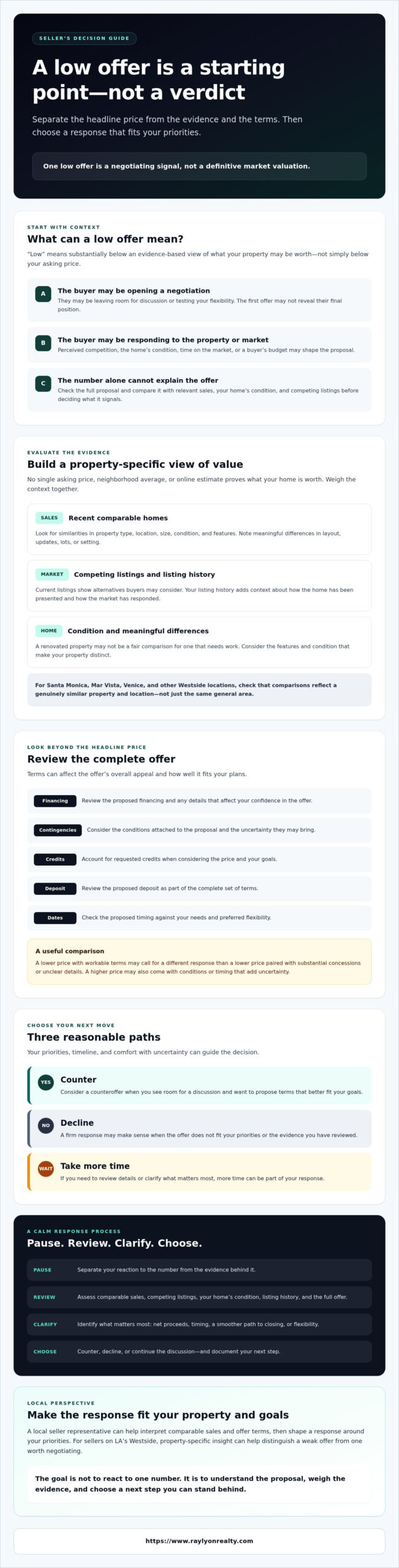
How to Respond to Lowball Offers Without Losing Leverage
A calm, structured reply keeps the conversation focused on the home and the terms, not the frustration a low number can trigger. If you’re weighing what to do when you get a lowball offer on your house, use this sequence before responding:
- Pause. Avoid replying while emotions are running high. Note any deadlines in the offer so you can review it without overlooking them.
- Review. Compare the offer’s price and terms with property evidence and your priorities. Identify what works, what doesn’t, and what needs clarification.
- Clarify. Ask focused questions about unclear terms, such as the buyer’s proposed timing or requested credits. Don’t guess at the buyer’s intent.
- Choose a response. Decide whether to counter, decline, or continue the discussion. If you counter, state a position you can support and consider whether adjusting other terms could help.
- Document next steps. Keep a clear record of communications and agreed follow-up. Ask a qualified representative to review messages or documents that could affect your contractual rights.
What should you say when replying to a low offer?
Keep your message courteous and specific. A simple framework might be: “Thank you for the offer. We’re reviewing the price and terms. Could you clarify [specific item]? Based on [brief property-specific reason], we’d like to discuss [your proposed change].” Use only details that accurately reflect your situation. This is a communication example, not contract language; have a qualified representative review any formal response.
For broader preparation beyond the offer itself, see the guide to selling a Los Angeles home.
What should you avoid during negotiations?
Don’t answer in anger, make claims you can’t support, or volunteer your minimum acceptable terms unless you’ve decided that disclosure serves your interests. Keep the focus on evidence and workable changes. Don’t assume an informal text or email changes the obligations or deadlines in a written agreement. California contract procedures can depend on the documents and circumstances, so verify questions with an appropriate licensed real estate professional or an attorney.
Clear communication can protect your position, but it can’t guarantee a buyer will agree or that negotiations will succeed. Ray Lyon Realty offers seller representation for homeowners who want help evaluating an offer and planning a response: learn about seller representation.
When local seller representation can help you handle a lowball offer
A local seller representative can help turn an emotionally charged offer into a practical decision. They can compare the buyer’s complete terms with relevant sales and competing listings, then weigh the proposal against your priorities, such as timing or expected proceeds. That context can help you decide what to do when you get a lowball offer on your house without treating one buyer’s number as the final word on value.
What can a local agent add to your offer review?
Property comparisons are most useful when they reflect meaningful details, not just a nearby address. A representative familiar with the Westside can help assess whether a sale or listing is a fair comparison for your home’s location, condition, size, and features. They can also review the buyer’s financing, contingencies, requested credits, and proposed dates against your goals, then help plan and communicate a response. Direct contract interpretation and legal questions to qualified counsel.
Ray Lyon Realty represents residential sellers across Santa Monica, Mar Vista, Venice, and the wider Westside of Los Angeles. Seller support includes pricing strategy, marketing, offer negotiation, staging, and coordinating minor upgrades. For more neighborhood context, explore the Mar Vista neighborhood guide.
What should you prepare before asking for advice?
Bring the written offer and relevant listing details, including known updates or features that may help explain how your property compares with other homes. Be ready to describe your preferred timing, essential terms, and where you may be willing to negotiate. Clear priorities help a representative focus on the choices that matter to you.
It’s also reasonable to ask how the representative will explain the market evidence, compare the offer’s terms, and keep you informed as you consider next steps. A useful conversation should make the reasoning clear, including where comparisons are uncertain and when a question calls for legal guidance.
If you’re considering your options as a seller, review your selling options with Ray Lyon Realty. A grounded review can help you see the evidence, your priorities, and the choices ahead more clearly.
Make your next move with a clear plan
A low offer can be frustrating, but it doesn’t have to dictate your next step. Judge the price against relevant property evidence, and weigh financing, contingencies, credits, timing, and other terms together. Then choose whether to counter, decline, or keep talking based on your priorities and comfort with uncertainty.
If you’re deciding what to do when you get a lowball offer on your house, pause before replying. Keep your response professional, specific, and focused on workable terms. A local perspective can help you understand how comparable properties and buyer conditions fit your situation, without promising a particular outcome.
Ray Lyon Realty represents residential sellers across Santa Monica, Mar Vista, Venice, and the wider Westside of Los Angeles. Seller support includes pricing strategy, marketing, and offer negotiation, helping you assess your options with relevant local context.
Talk with Ray Lyon Realty about your selling options. With a thoughtful plan and clear priorities, you can respond with greater confidence and decide what works best for you.
Frequently Asked Questions
Should I reject a lowball offer on my house?
Not automatically. If you’re deciding what to do when you get a lowball offer on your house, first compare the price and terms with relevant property evidence and your priorities. A counteroffer or request for clarification may keep a useful conversation open, while declining can make sense if the proposal falls below your essential requirements. No response guarantees another offer, so weigh the opportunity in front of you against the uncertainty of waiting.
How do I know if a home offer is too low?
Compare it with recent sales of similar homes, accounting for location, property type, size, condition, and features. Consider current competing listings and your home’s listing history, too. Then assess the full offer, including requested credits, financing, contingencies, and timing. A broad neighborhood average, list price, or online estimate alone may not capture your property’s specific value. A local real estate professional can help identify the most relevant comparisons.
Can I counter a lowball offer on my house?
Yes, you can consider a counteroffer if you want to continue negotiating and the buyer appears open to discussion. Set a position you can support with relevant property evidence, and decide which terms matter most before responding. You may be able to discuss timing or requested credits as well as price. Review the proposed response carefully, since counteroffer documents and contract terms can affect your choices. Ask a qualified professional about language you’re unsure of.
What should I say when I get a low offer on my house?
Keep your reply calm, brief, and focused on the offer. You might say, “Thank you for the offer. We’re reviewing the terms. Could you clarify [specific item]? We’d like to discuss [proposed change] based on [property-specific reason].” Use only accurate details, and don’t disclose negotiating limits unless you’ve considered the implications. If your message could affect contractual rights or deadlines, have a qualified representative review it before sending.
Does a low offer mean my house is overpriced?
No, one low offer by itself doesn’t establish that your asking price is too high. Treat it as one piece of information, then compare the price with recent, similar sales, competing listings, property condition, and buyer feedback. If multiple offers or limited interest point in the same direction, reviewing your pricing and presentation may be useful. Ask a local real estate professional to explain the evidence rather than relying on one buyer’s opinion.
Should I accept a low offer if I need to sell quickly?
Not necessarily. A tight timeline makes the certainty and timing of an offer especially relevant, but it doesn’t automatically make the price acceptable. Compare the buyer’s terms, requested credits, and proposed dates with your needs, and consider the consequences of continuing to market the home. There’s no guarantee another offer will arrive sooner or at a higher price. If deadlines or contract terms are involved, get qualified guidance before deciding.
Can a real estate agent help negotiate a lowball offer in California?
Yes. A real estate agent representing a seller can help review comparable sales, assess the buyer’s terms, identify your priorities, and communicate a negotiation strategy. In California, an agent can offer real estate guidance, but legal questions about contract interpretation or your rights should go to a qualified attorney. Ray Lyon Realty represents residential sellers across Santa Monica, Mar Vista, Venice, and the wider Westside of Los Angeles, with support that includes pricing strategy and offer negotiation.