

Could the right Venice house be the wrong fit for your plans? Buying here means weighing a home’s condition and price alongside its specific block, property type, and potential coastal considerations. If you’re researching how to buy a house in venice ca, a clear plan can help you ask the right questions before making an offer.
It’s normal to have questions about financing, offer terms, and California escrow. Comparing a canal home, a walk-street property, and a home east of Lincoln Boulevard takes more than looking at list prices. Insurance, permits, and the condition of an older home can also affect your decision and future costs.
This 2026 guide explains how to prepare your budget, compare Venice locations and property types, and move from offer to closing with fewer surprises. It also covers what to discuss with your real estate agent, lender, inspector, insurance professional, and other specialists before committing. The goal is a purchase plan grounded in both the home and the place you’ll call home.
Key Takeaways
- Follow a clear sequence from setting your budget and priorities to closing, so every decision has a place in your plan.
- Compare detached homes, condos, and townhomes by ownership responsibilities, upkeep, and fit with your daily routine.
- Before making an offer, organize questions about disclosures, inspections, title, insurance, and permit history for the appropriate professionals.
- Learn how to buy a house in venice ca by understanding offer terms and discussing contract-specific contingencies with your agent and legal adviser.
- Local buyer representation can connect property-specific questions with your search, offer preparation, negotiation, and escrow coordination.
How to buy a house in Venice, CA: start with your budget and priorities
Look beyond polished listing photos when assessing a Venice home. Consider how it fits your budget and daily routine, what ownership will involve, and what its condition reveals. A buyer’s agent can help you compare properties and prepare for decisions along the way. For more on choosing representation, see this Los Angeles real estate agents guide.
Venice has distinct surroundings and a rich local history. Read this overview of Venice, Los Angeles for background, then assess how specific streets and home types match what you want from the neighborhood. A broad impression is a starting point, not a substitute for evaluating a particular property and block.
For a visual look at the area, watch this Venice real estate video:
What should you decide before searching for a Venice home?
Rank your non-negotiables, such as home type, bedroom needs, commute, and outdoor space. Mark each as a must-have or a preference. A private yard may be essential for one buyer, while another may trade it for a shorter commute or a different layout. Revisit your list as you view homes, so attractive photos don’t shift your priorities without a reason.
Consider your daily routines and the responsibilities you’re willing to take on. A condo, townhouse, or detached home can differ in upkeep, shared spaces, and ownership considerations. Decide what you’re comfortable maintaining and note what you’ll need to investigate before making an offer.
How do pre-approval and a realistic budget help?
Pre-approval can help you plan your search, but it doesn’t guarantee final loan approval or establish a specific purchase price. Ask a lender about pre-approval, loan options, cash needed for the purchase, and the terms and timing of any rate lock. Direct eligibility and financing questions to the lender.
Keep your purchase budget separate from the broader cost of ownership. Leave room in your planning for property taxes, insurance, ongoing maintenance, and possible repairs. Lender estimates may not capture all these expenses, so seek independent estimates from the appropriate professionals.
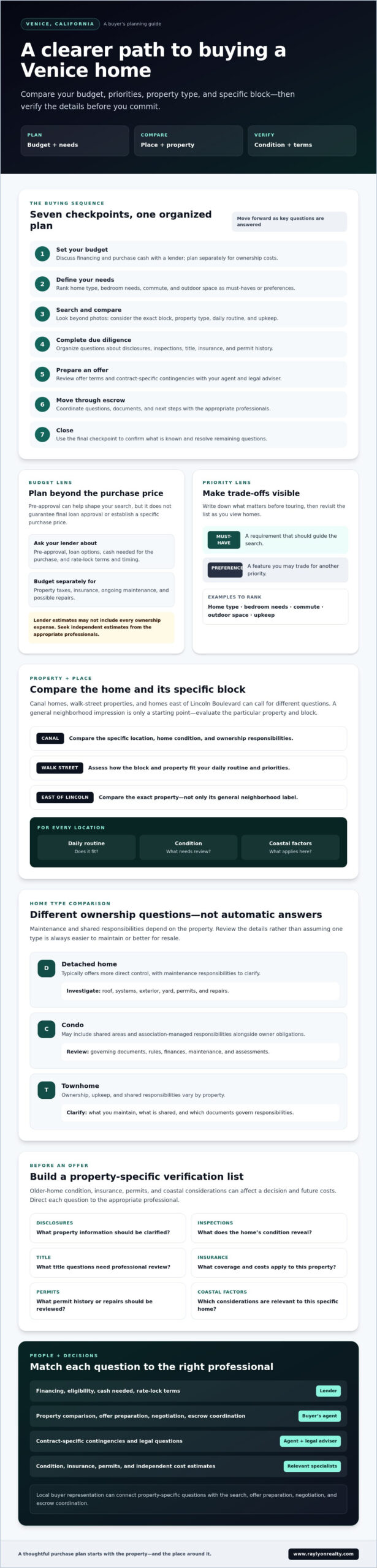
A practical sequence keeps the process manageable: budget, define needs, search, complete due diligence, make an offer, move through escrow, and close. If you’re learning how to buy a house in venice ca, treat each step as a checkpoint. Confirm what you know, identify what still needs investigation, and consult the right professional before moving forward.
Compare Venice locations and home types before choosing a property
Two homes in Venice can offer very different day-to-day experiences, even when they’re close together. Compare ownership responsibilities with the property’s exact location, not just its photos or general neighborhood label. As you learn how to buy a house in venice ca, use the questions below to focus your search on homes that fit your routine and comfort with upkeep.
Which Venice home type may suit your plans?
Detached homes, condos, and townhomes differ in how maintenance and shared responsibilities are handled. The details depend on the property and, for attached homes, its governing documents. Review relevant association rules, finances, meeting records, and information about any assessments. Match the home to your household’s needs instead of assuming one type will automatically be easier to maintain or better for resale.
| Home type | Ownership and upkeep to consider | Questions to investigate |
|---|---|---|
| Detached home | Typically offers more direct control over the home, with maintenance responsibilities to clarify. | What condition are the roof, systems, exterior, and yard in? Are there permits or repairs to review? |
| Condo | May include shared areas and association-managed responsibilities, alongside owner obligations. | What do the governing documents say about rules, finances, maintenance, and assessments? |
| Townhome | May combine private spaces with shared property or association responsibilities. Arrangements vary. | Which areas are owner-maintained, and which are shared? What rules and costs apply? |
How can you assess a Venice location beyond the listing?
Visit the property at different times of day, if possible. Notice noise, parking, traffic routes, access to transit and services, and whether the surroundings work for your routine. A location that seems convenient during one visit may feel different at another time. If you’re weighing nearby Westside options, this Mar Vista neighborhood guide can help you compare another area.
Don’t assume that proximity to the coast means every property has the same flood exposure or insurance considerations. Check mapped flood and coastal information for the specific parcel using authoritative sources, then discuss what you find with the appropriate professionals. Verify school assignments, zoning, transit service, and local services directly with the responsible agencies. For property-tax information, consult the Los Angeles County Property Tax portal.
Local context can help you assess location and ownership details. If you’d like support comparing Venice homes and nearby options, explore local buyer representation as you continue your research.
What to inspect and verify before making a Venice home offer
Investigate more than what’s visible during a showing. Disclosures, inspections, title information, insurance options, and permit records answer different questions. Their findings may affect your plans, budget, and the terms to discuss before making an offer. As you consider how to buy a house in venice ca, keep a written list of open questions and the professionals qualified to answer them.
Which property records and disclosures should buyers review?
Ask your real estate agent or escrow professionals which seller disclosures, reports, and review deadlines apply to the transaction. Requirements and documents can vary, so confirm current California guidance with qualified real estate professionals instead of relying on a general checklist. Review title information with the appropriate title or escrow professional, and ask about recorded matters that could affect ownership or use.
If a property has additions or major renovations, check available permit and property records with the relevant City of Los Angeles department. Records can help identify questions to follow up on, but may not answer every concern about the home’s present condition.
- Disclosures: Review the forms and reports provided, and ask about unclear or incomplete information.
- Inspections: Arrange for qualified professionals to evaluate the home and any areas of concern.
- Title: Ask the title or escrow professional to explain relevant title documents and exceptions.
- Insurance: Confirm availability, coverage, exclusions, and property-specific underwriting with an insurance professional.
- Permits and hazards: Check relevant property records and applicable flood, coastal, and hazard information for the exact address.
How should you investigate condition, insurance, and coastal exposure?
Inspection scope depends on the property. A qualified inspector can assess visible conditions and relevant systems, and recommend further evaluation if something needs specialist attention. Inspection findings don’t guarantee that hidden or future problems won’t arise. Discuss the inspection plan and results with the professionals involved, especially if the home’s age, alterations, or visible condition raises questions.
For location-specific research, enter the address in the FEMA Flood Map Service Center and consult relevant California Coastal Commission resources. Treat maps as useful starting points, not a substitute for confirming parcel-level information with the appropriate agencies. Ask whether coastal rules apply to the property and could affect planned work, then verify requirements with the relevant authorities.
Your agent can help organize questions and coordinate the transaction, but doesn’t replace inspectors, attorneys, insurance professionals, or government agencies. Get answers from the right source before deciding how to proceed.
How to make a competitive Venice offer and navigate escrow
A strong offer is more than a number. It combines terms you can meet, protections you understand, and a timeline that works with your financing and readiness. As you learn how to buy a house in venice ca, remember that no offer strategy can guarantee acceptance or a particular negotiation result. The goal is a well-informed proposal that fits the property and your limits.
What makes an offer well-prepared without overreaching?
Work with your agent to assess relevant comparable information, the home’s condition, your financing, and the maximum you’re comfortable committing. Before submitting, read each term and ask what it means for your obligations. Common offer components include:
- Price: The amount offered, considered alongside comparable properties and the home’s features and condition.
- Deposit: Funds specified in the agreement, including when and how they must be delivered. Confirm instructions with the appropriate escrow professional.
- Contingencies: Contract-specific terms that may provide protections related to matters such as financing, appraisal, or inspections. Their scope and deadlines depend on the signed agreement.
- Timing: Proposed dates for key steps, coordinated with your lender and other transaction participants.
- Included items: Clearly identify any appliances or other items you expect to remain, and confirm how the agreement treats them.
Contingencies involve important choices and potential risks. Discuss available options with your agent and, when needed, a legal adviser before submitting an offer. Waiving a protection isn’t universally necessary or advisable. Understand the consequences of each term before agreeing to it.
What happens after a seller accepts an offer?
Acceptance begins the next stage, not the finish line. The signed agreement sets out responsibilities and dates. Your agent can help coordinate communication, while your lender and escrow professionals explain their respective requirements. Track requests and follow up promptly if a document or decision is outstanding.
- Review the signed agreement and note its dates, deliverables, and any conditions.
- Coordinate with your lender on loan documentation, underwriting requests, and remaining financing steps.
- Work with escrow on transaction documents, deposit and funds instructions, and the steps required before closing.
- Complete agreed inspections or other reviews, and raise questions with the relevant professionals.
- Confirm final requirements and funding instructions directly with your lender and escrow professionals before closing.
Escrow details and timing vary by transaction, so don’t rely on a generic schedule. Use the signed agreement to track deadlines, and ask your agent to clarify who to contact with questions. For support preparing an offer and coordinating the purchase process, connect with a local buyer’s agent.
Choose local buyer representation and move toward a Venice purchase
Online listings can help you spot homes, but photos and descriptions can’t answer every property-specific question. They may not show how a block feels at different times of day, clarify ownership details, or explain how an offer term affects your next decision. A local buyer’s agent can add context, help you prepare an offer, support negotiation, and coordinate communication through escrow. That guidance can make the process clearer, but it can’t guarantee a particular home or outcome.
Ray Lyon Realty represents residential buyers across Los Angeles’ Westside, including Venice, and brings local neighborhood knowledge to the search. An agent can help connect your priorities with available properties and organize questions for the appropriate professionals. Lending, legal, inspection, and insurance advice should still come from qualified specialists.
What should you ask a Venice buyer’s agent?
Use an initial conversation to see whether the working relationship fits your needs. Ask about the agent’s experience with the property types and Venice locations you’re considering, and how they approach local search, offer preparation, negotiation, and escrow coordination.
- How will we communicate, and how often should I expect updates?
- What support do you provide when preparing and negotiating an offer?
- How do you coordinate questions for lenders, inspectors, escrow professionals, and other specialists?
- How are agency relationships, written agreements, and any potential conflicts explained?
Review any proposed representation agreement carefully. Ask questions about its terms and discuss legal concerns with an appropriate adviser before signing. Clear expectations can help you understand each person’s role as the search progresses.
What is a useful first-week plan for a Venice home search?
Keep the first steps focused. Confirm your lender conversations and budget assumptions, and make sure everyone involved in the decision understands your priorities. Then prepare a short list separating must-haves from preferences, including home type, location, commute, and any property features you want to investigate.
- Clarify readiness: Gather lender questions and identify what you still need to confirm about financing.
- Set search criteria: Write down your preferred locations, essential features, and acceptable trade-offs.
- Discuss next steps: Arrange a buyer conversation to review the search approach, representation, and how offers would be handled.
With those pieces in place, you can move from browsing to a more deliberate search. If you’re ready to discuss how to buy a house in venice ca, talk with Ray Lyon Realty about your Venice home search. Bring your priorities and open questions to help decide what to explore next.
Take Your Venice Home Search Forward With a Clear Plan
A confident purchase starts with more than finding a home you like. Set a budget that accounts for ownership costs, compare property type and location against your daily needs, and investigate the specific home before settling on offer terms. These steps help turn a broad search into a decision grounded in what matters to you.
Knowing how to buy a house in venice ca also means knowing when to involve the right professionals. A local buyer’s agent can support you through the search, offer negotiation, and escrow, while lenders, inspectors, legal advisers, and insurance professionals address their areas of expertise. Ray Lyon Realty brings Westside Los Angeles experience, including Venice, to buyer representation.
Ready to talk through your priorities, financing readiness, and questions about the process? Talk with Ray Lyon Realty about your Venice home search. Take the next step at a pace that feels right, with a clearer plan to guide you.
Frequently Asked Questions
How do I start buying a house in Venice, CA?
Start by setting a realistic budget and speaking with a lender about pre-approval and loan options. Then rank your must-haves, such as home type, bedrooms, commute, and outdoor space, and compare properties and locations. Before making an offer, investigate the home’s condition, disclosures, title, insurance questions, and relevant records. A local buyer’s agent can help organize the search and offer process, while lenders and inspectors provide specialized advice.
Is Venice, California, a good place to buy a house?
Venice may be a good fit if its location, character, and housing options match your lifestyle and budget. The experience can vary by block, so consider noise, parking, access to services, transit, and your preferred surroundings. Research the individual property’s condition, insurance availability, and applicable flood or coastal information as well. A thoughtful decision weighs these details against your priorities rather than relying on a general neighborhood reputation.
How much money do I need to buy a house in Venice?
The amount depends on the purchase price, loan terms, down payment, closing costs, and funds you want available for repairs and ongoing ownership. Redfin reported a $2 million median sale price for Venice for the three months ending August 2026, but that figure isn’t a quote for a particular home. 805 Title reports buyer closing costs commonly range from 2% to 5% of the purchase price. Ask a lender and escrow professional to estimate your specific cash needs.
Can I buy a house in Venice with a conventional mortgage?
Possibly, but a lender must assess your finances, the property, and the loan terms to determine eligibility. Ask about conventional loan options, required cash, pre-approval, and any rate-lock terms. Pre-approval can guide your search, but it doesn’t guarantee final approval or establish the price you should offer. Confirm financing details directly with your lender, especially before agreeing to offer terms or deadlines tied to your loan.
What should I check before buying a home in Venice?
Review applicable seller disclosures, available property and permit records, title information, and inspection findings. Ask qualified inspectors to assess relevant systems and visible conditions, and discuss insurance availability, coverage, and exclusions with an insurance professional. Check applicable flood, coastal, and hazard information for the exact address, then confirm parcel-level questions with the appropriate agencies. Inspection scope and findings depend on the property, so use qualified professionals to investigate concerns rather than relying on listing photos.
How long does it take to buy a house in Venice, CA?
There isn’t one reliable timeline for every purchase. The search may take time, and the transaction schedule depends on the signed agreement, financing, inspections, title and escrow work, and any issues that arise. Once an offer is accepted, use the agreement to track dates and outstanding requests. Ask your lender and escrow professionals to confirm requirements and timing for your transaction, rather than relying on a general estimate.
Do I need a real estate agent to buy a house in Venice?
You aren’t required to use an agent, but buyer representation can help you assess local options, prepare and negotiate an offer, and coordinate questions through escrow. Ray Lyon Realty represents buyers across Los Angeles’ Westside, including Venice, and brings local neighborhood experience to the search. Before relying on representation, ask about relevant property experience, communication, agency relationships, written agreements, and how potential conflicts are handled.