
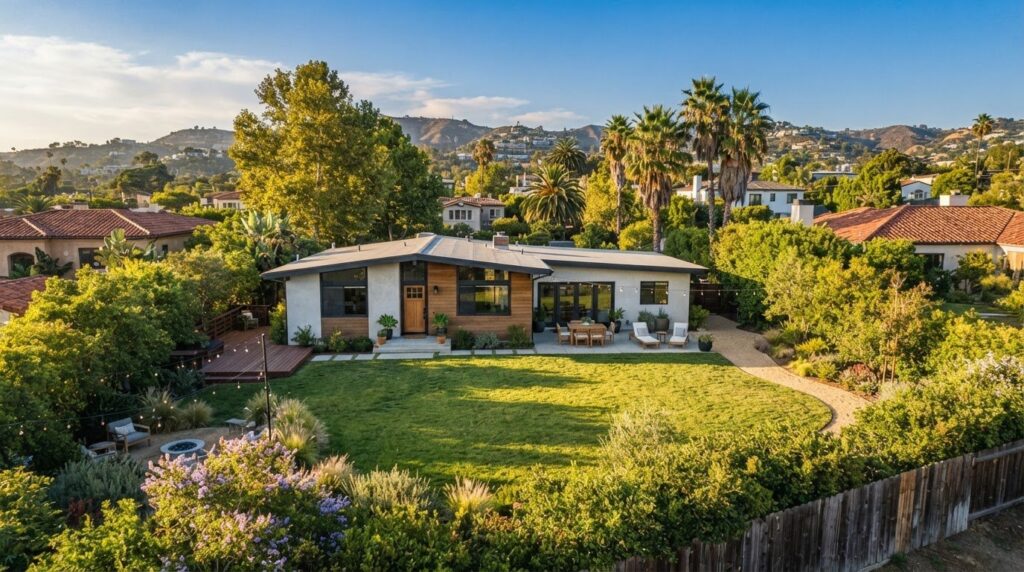
In the land-starved Westside, a sprawling backyard isn’t just a luxury; it’s a high-yield asset that most buyers assume has already been snapped up by developers. You’ve likely spent months scrolling through listings only to find postage-stamp lots or homes where the neighbor’s window is five feet from yours. It’s frustrating to watch inventory sit at just 114 homes while you compete against cash-heavy flippers who move faster than the average family. Finding culver city homes with large lots feels like searching for a needle in a haystack, especially when median single-family prices have reached $1.6 million and competition remains fierce.
I understand that frustration because I’ve been on both sides of these transactions as both a renovator and a realtor. This guide is designed to give you the insider edge you need to win in 2026. You’ll discover the hidden pockets like Blanco-Culver Crest and Blair Hills where spacious parcels still exist. We’ll also dive into the strategic ROI of the 1,200-square-foot ADU rules and how to tell the difference between Culver City zoning and L.A. City regulations. You’ll learn exactly how to identify high-value land and how to leverage off-market opportunities to beat the crowd.
Key Takeaways
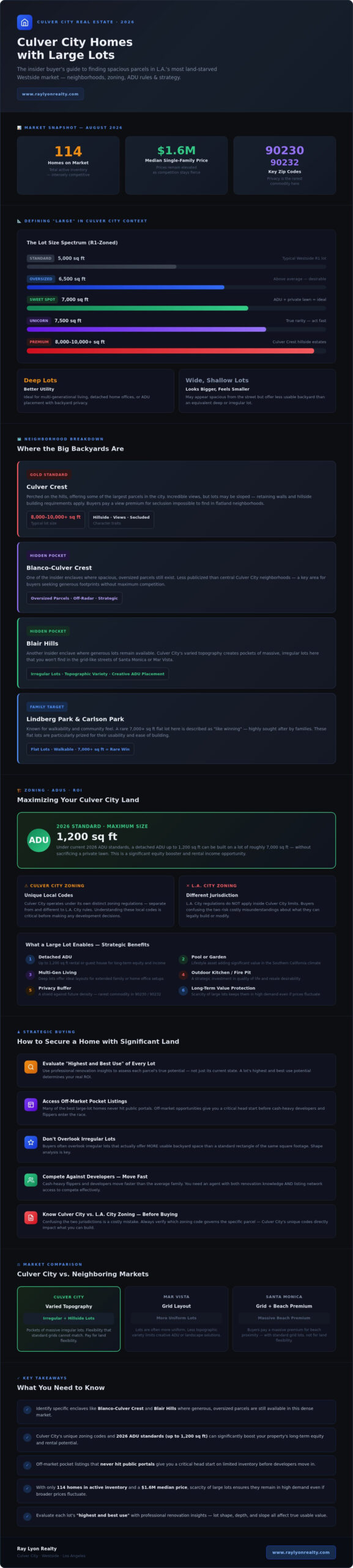
- Identify specific enclaves like Blanco-Culver Crest and Blair Hills where generous, oversized parcels are still available in a dense market.
- Understand how Culver City’s unique zoning codes and 2026 ADU standards can significantly boost your property’s long-term equity and rental potential.
- Learn the insider strategies needed to secure culver city homes with large lots in a market where developers often have the upper hand.
- Discover how to access off-market pocket listings that never hit public portals, giving you a head start on limited inventory.
- Evaluate a lot’s “highest and best use” potential using professional renovation insights to ensure your investment pays off.
The Quest for Space: Defining Large Lots in Culver City
In the heart of the Westside, Culver City offers a unique urban-suburban blend, but finding significant yard space is becoming a specialized hunt. While many buyers focus on the interior square footage, savvy investors know that the real value lies in the dirt beneath the foundation. In 2026, the market has shifted. Interior volume is no longer the sole king. With inventory hovering around just 114 homes as of August 2026, the competition for these parcels is intense. Buyers are increasingly trading an extra bedroom for a larger footprint that allows for a pool, a garden, or simply room to breathe. Finding culver city homes with large lots requires understanding that “large” is a relative term here compared to the sprawling estates of the Valley.
The 5,000 Sq. Ft. Benchmark vs. Oversized Parcels
Most R1-zoned properties in the Westside sit on a standard 5,000-square-foot lot. In the context of Culver City, anything exceeding 6,500 square feet is considered an oversized parcel, while a 7,500-square-foot lot is a true unicorn. The “sweet spot” for most families is roughly 7,000 square feet. This size provides enough depth to build a detached ADU, which can be up to 1,200 square feet under current standards, without sacrificing a private lawn. It’s not just about the total area, though. Lot shape matters immensely. A wide, shallow lot might feel spacious from the street, but a deep lot often provides better utility for multi-generational living or detached home offices. We often see buyers overlook irregular lots that actually offer more usable backyard space than a standard rectangle.
Why Land is the Ultimate Westside Luxury
Privacy is the rarest commodity in the 90230 and 90232 zip codes. As developers maximize building envelopes, “elbow room” has become a literal luxury. When you own a larger lot, you aren’t just buying grass; you’re buying a buffer from the neighbors and a shield against future density. This land acts as a long-term value protector. Even if home prices fluctuate, the scarcity of culver city homes with large lots ensures they remain in high demand. The psychological value of outdoor living is also undeniable in our climate. Having a yard that accommodates an outdoor kitchen or a fire pit isn’t just a lifestyle choice; it’s a strategic investment in your quality of life.
In neighboring Mar Vista, lots are often more uniform, but Culver City’s varied topography creates pockets of massive, irregular lots that you won’t find in the grid-like streets of Santa Monica. While Santa Monica buyers often pay a massive premium for proximity to the beach, Culver City buyers are paying for the flexibility that comes with land. This variety allows for creative landscaping and unique ADU placements that standard 5,000-square-foot lots simply cannot accommodate. If you want a property that can evolve with your family, the land is your most important asset.
Where the Big Backyards Are: Culver City Neighborhood Breakdown
Finding culver city homes with large lots isn’t just about filtering by acreage on a map. You have to understand the micro-markets. While some neighborhoods are characterized by dense, historic bungalows, others offer the expansive footprints that allow for ADUs or private retreats. Each pocket has its own personality and physical constraints that listing portals simply won’t explain. If you’ve been looking at our Mar Vista neighborhood guide, you’ll find that Culver City offers a distinct hillside variety that its neighbors lack.
Culver Crest: Hillside Views and Expansive Acreage
If your priority is privacy and scale, Culver Crest is the gold standard. This enclave is perched on the hills, offering some of the largest parcels in the city. Many lots here exceed 8,000 or even 10,000 square feet. You’ll get incredible views, but there’s a trade-off. Much of that land might be sloped. Navigating retaining walls and hillside building requirements is part of the process here. Buyers often pay a view premium for these larger parcels, but the payoff is a secluded feel that’s impossible to find in flatland neighborhoods. It’s a strategic choice for those who value a dramatic backdrop over a perfectly level lawn.
Lindberg Park and Carlson Park: The Classic Flat Lot
For families, Lindberg Park and Carlson Park are the primary targets. These areas are known for their walkability and community feel. Finding a rare 7,000+ square foot flat lot here is like winning the lottery. Most parcels follow the standard 5,000-square-foot grid; when a larger one hits the market, competition is fierce. The draw is the utility. A flat backyard is much easier to develop into a turn-key outdoor oasis. Reviewing the Culver City General Plan and Zoning Code reveals how these areas preserve their residential character, making every extra foot of land highly valuable. The scarcity of culver city homes with large lots in these flat pockets drives prices upward.
Sunkist Park: Suburban Feel with Spacious Parcels
Sunkist Park feels like a true suburban retreat. Developed primarily in the 1950s, these tract homes were built with wider frontages and deeper yards than many older Westside neighborhoods. You’ll often find more curb appeal here because the houses aren’t crammed together. When comparing these values to Santa Monica real estate, Sunkist Park often provides more value in terms of raw land. If you’re struggling to find the right footprint, connecting with a local expert can help you uncover off-market opportunities in these specific blocks before they reach the public portals.
Zoning, ADUs, and ROI: Maximizing Your Culver City Land
Owning one of the rare culver city homes with large lots isn’t just a lifestyle win; it’s a sophisticated investment play. In our local market, the dirt is often worth more than the structure sitting on it. To truly capitalize on your purchase, you need to understand the concept of Highest and Best Use. Highest and Best Use is the legal use of a residential lot that is physically possible, financially feasible, and results in the highest property value. In 2026, this usually means looking beyond the current single-family home and analyzing what else the land can support under California Senate Bill 9 (SB 9) or the transit-oriented standards of SB 79, which took effect July 1, 2026.
The ADU Advantage: Turning Dirt into Income
A large lot changes the math on Accessory Dwelling Units (ADUs). On a standard Westside lot, a detached ADU often eats up the entire backyard. With an oversized parcel, you can build a unit up to 1,200 square feet while keeping a usable lawn for the main house. Culver City Municipal Code Section 17.400.095 outlines these standards, including a $341 address assignment fee for new units. From an ROI perspective, a detached ADU can generate significant rental income or serve as a high-value guest house that boosts resale appeal. With typical detached ADU costs ranging from $135,000 to $360,000, the equity gain on a large lot often outweighs the construction price. My experience in property flipping shows that buyers in 90230 and 90232 will pay a significant premium for this “turn-key” income potential.
Understanding Setbacks and Lot Coverage Limits
Size alone doesn’t dictate how much you can build. Culver City enforces specific “Floor Area Ratio” (FAR) limits and setbacks that determine your building envelope. Standard ADU setbacks are four feet from side and rear property lines, but the main residence has much stricter requirements. A large lot gives you the breathing room to maximize your FAR without making the property feel overcrowded. If your renovation plans don’t include expanding the footprint, you can use that extra land for high-end hardscaping. Outdoor kitchens, pergolas, and fire pits offer a massive lifestyle return without the permitting headaches of a full home expansion. Strategic use of yard space ensures you aren’t just paying property taxes on “dead” space, but rather utilizing every square foot to protect your long-term value.
Strategic Buying: How to Secure a Home with Significant Land
Securing culver city homes with large lots isn’t just about having the highest bid; it’s about outmaneuvering developers who view these parcels as blank slates for “mansionization.” In a market where 54.4% of homes sold above list price in July 2026, you need a strategy that protects your interests while appealing to sellers who often have deep emotional ties to their gardens. Winning here requires a combination of speed, granular local data, and the right professional network.
Identifying Off-Market Opportunities
Most of the premier land-heavy properties in the 90232 and 90230 zip codes sell before they ever hit a public portal. I rely on deep networking with local builders and long-term residents to uncover “pocket listings” that aren’t visible to the average buyer. A specialized real estate agent in Los Angeles CA doesn’t just wait for the MLS to update. They actively hunt for owners who are considering a move but haven’t yet committed to a public marketing campaign. “Coming Soon” statuses are also vital, providing a narrow 48 to 72-hour window to prepare a clean offer before the general public is even aware the property exists.
Navigating Bidding Wars for Land-Heavy Listings
Lot size is the primary driver of multiple offer scenarios in Culver City. When a rare 7,500-square-foot flat lot hits the market, you’ll likely face five to ten competing bids within the first week. To win, your offer needs to be “clean.” This means shortening inspection contingencies and providing rock-solid proof of funds upfront. I use my personal history in property renovation to help clients see the specific value others miss, such as a lot’s drainage patterns or ADU orientation. This “Founder’s Edge” allows us to bid with confidence because we’ve already calculated the renovation math that a developer would use.
Due diligence is non-negotiable when land is the main asset. You must confirm property lines through a professional survey and check for utility easements that could block a future pool or ADU. Soil reports are particularly critical in hillside enclaves like Culver Crest to ensure the land can support your expansion plans. If you’re ready to find a property that offers both space and long-term equity, contact our team today to access our exclusive list of culver city homes with large lots and off-market opportunities.
The Ray Lyon Realty Advantage for Culver City Buyers
Ray Lyon Realty isn’t just about showing houses; it’s about evaluating potential. When you’re hunting for culver city homes with large lots, you’re looking at more than just a backyard. You’re looking at a future ADU site, a potential pool, or a land-split opportunity. My personal background in property renovation and flipping means I don’t just see the current state of a property. I see the structural possibilities and the financial hurdles that others might miss. This hands-on history gives our clients a massive trust builder, especially when navigating the complexities of the Westside market.
Experienced, Strategic, and Deeply Knowledgeable
Having a realtor who has personally renovated homes is a total game-changer. I’ve spent years managing property portfolios and overseeing renovations. This means when we walk onto a large lot, I can immediately spot if the drainage will be an issue for a new build or if the utility lines are positioned to make an ADU project easier. Our “insider” approach focuses on finding exclusive Westside opportunities that aren’t available to the general public. We’ve helped numerous clients secure large lots in highly competitive cycles by identifying the “highest and best use” before the bidding war even starts. Our network of architects and contractors is available to you the moment you close, ensuring your post-purchase development stays on track. We don’t just help you buy; we help you build equity.
Your Next Step Toward a Culver City Home
We start every search with a detailed consultation and a “wish list” audit. This isn’t just about bedrooms and bathrooms. It’s about your lifestyle goals and long-term equity plans. In a fast-moving market where homes can sell in under 40 days, we make you a top priority. We understand the stress of these transactions, so we aim to reduce it by projecting competence and genuine care. We’ll guide you through the 90230 and 90232 zip codes with the precision that only a local expert can provide. If you’re ready to find your Culver City oasis, contact Ray Lyon Realty today. We’ll help you secure one of the rare culver city homes with large lots that others are still just dreaming about.
Secure Your Westside Oasis Today
Finding significant space in the Westside doesn’t have to be a series of compromises. You now know that specific pockets like Blanco-Culver Crest and Sunkist Park hold the key to oversized parcels, and that these lots offer massive equity potential through smart ADU development. It’s about looking past the current structure to see the land’s highest and best use. Whether you want a private pool or a high-yield rental unit, the right lot makes all the difference in your long-term return.
I use my personal experience in property flipping and renovation to help you evaluate that potential before you ever sign a contract. As Westside LA market specialists, we bring granular local knowledge of the 90230 and 90232 zip codes to every search. We’re here to help you find culver city homes with large lots that aren’t even on the public market yet. You can View Current Culver City Listings & Off-Market Opportunities right now to see what’s available. Let’s work together to make your vision for a spacious Southern California lifestyle a reality.
Frequently Asked Questions
What is the average lot size in Culver City?
The standard R1 lot size in the area typically sits at 5,000 square feet. However, finding culver city homes with large lots often means looking for parcels that exceed 6,500 or 7,000 square feet. While these oversized footprints are rare, they provide the necessary space for detached ADUs and private yards. If you’re searching in 90230 or 90232, these larger lots represent a significant portion of the area’s long-term equity potential.
Can I split a large lot in Culver City under SB 9?
Yes, California Senate Bill 9 allows homeowners to split a single-family residential lot into two separate parcels. This effectively doubles the development potential of larger lots, though you must follow specific Culver City objective design standards. The law is designed to increase housing density while preserving neighborhood character. It’s a strategic move for investors looking to maximize the “highest and best use” of their land in the Westside market.
How much does a large lot add to a home’s price in Culver City?
Land is the primary driver of value in the 90232 and 90230 zip codes. While a standard home might sell near the $1.6 million median, a significantly larger lot can command a premium of 15% to 25% or more. This value comes from the added flexibility for ADUs, pools, or future expansions. Because inventory is so low, with only 114 homes available in August 2026, buyers are often willing to pay a high price just to secure the extra square footage.
Are there specific height restrictions for ADUs on Culver City lots?
Culver City follows specific height and setback standards for Accessory Dwelling Units. Generally, a detached ADU can reach up to 16 feet in height, though certain transit-oriented locations may allow for more flexibility under new standards effective July 1, 2026. You’ll also need to maintain a minimum four-foot setback from the side and rear property lines. These rules ensure that your new unit doesn’t negatively impact the privacy of your neighbors while maximizing your property’s utility.
Which Culver City school district zone has the largest lots?
The Blanco-Culver Crest and Blair Hills neighborhoods, which fall within the highly rated Culver City Unified School District, typically feature the city’s largest hillside parcels. If you prefer flat land, Sunkist Park offers 1950s tract homes with deeper yards and wider frontages than other central pockets. These areas are primary targets for families who want the district’s educational benefits paired with the lifestyle luxury of a spacious, private backyard.
What should I look for in a land survey before buying?
A professional land survey is essential to confirm legal property lines and identify any hidden utility easements. You should look for encroachments from neighboring fences or structures that could complicate your development plans. In hillside areas like the Crest, a soil report is equally important to ensure the land is stable enough for future construction. Identifying these details during your due diligence period prevents expensive surprises after you’ve already closed escrow.
How do I find off-market homes with large lots in Culver City?
Finding culver city homes with large lots often requires access to “pocket listings” that never hit public portals. We use our deep roots in the Westside community to network with local builders and long-term residents who are considering a sale. By tracking “Coming Soon” listings and leveraging our renovation expertise, we help you identify opportunities before the general public. This insider access is the only way to beat the heavy competition in this market.
Does Culver City have different zoning rules than the City of Los Angeles?
Yes, Culver City is an independent municipality with its own unique zoning code, separate from the City of Los Angeles. This means the Floor Area Ratio (FAR), setback requirements, and ADU permitting fees are specific to Culver City Hall. For example, the $341 ADU address assignment fee is a local requirement. Understanding these distinctions is vital for any buyer who plans to renovate or expand, as L.A. City rules don’t apply here.