

The most profitable way to approach investing in Santa Monica real estate 2026 isn’t by chasing simple appreciation, but by mastering the new density laws. You likely feel that the barrier to entry is becoming nearly impossible. With the median single-family home price sitting at $3,850,000 and mortgage rates hovering around 6.8%, it’s natural to wonder if the math still works. You’re probably also wary of the new rental registration ordinance and the 5.6% “Mansion Tax” on high-value transfers.
I’ve spent my career in the Westside market, and I’ve seen that these hurdles are actually filters that leave the best opportunities for strategic investors. This guide will show you how to navigate these regulatory shifts to find high-yield opportunities that others are missing. We’ll explore how to identify under-valued micro-pockets, use SB 79 transit-oriented zoning to your advantage, and leverage ADU laws for immediate yield. You’ll also learn how to execute a tax-efficient 1031 exchange to protect your equity. From neighborhood micro-trends to finding off-market gems, here is your roadmap to winning in Santa Monica this year.
Key Takeaways
- Learn how to navigate the new SB 79 housing laws to maximize density and floor area ratios near transit corridors.
- Discover how to leverage Accessory Dwelling Units (ADUs) to generate immediate rental yield and offset high entry costs.
- Identify the specific neighborhood micro-trends when investing in Santa Monica real estate 2026 to ensure long-term equity preservation.
- Master the mechanics of a tax-efficient 1031 exchange to move your capital into high-performing coastal assets without a heavy tax burden.
- Find out how to spot off-market fixer-upper opportunities by using localized insider knowledge to find value where others see hurdles.
The Santa Monica Real Estate Landscape in 2026
Santa Monica’s coastal market is currently defined by a sharp tension between relentless demand and a constrained supply. Despite shifting interest rates, the city remains the “blue chip” cornerstone of the Los Angeles Westside. Much of this stability stems from Santa Monica’s economic profile, which successfully blends a world-class tourism engine with a high-density tech corridor. Investing in Santa Monica real estate 2026 requires looking past the high entry costs to see the wealth preservation that only a supply-locked coastal city can offer.
The 2026 Santa Monica market functions as a low-volatility, high-equity environment where limited inventory acts as a natural hedge against broader economic fluctuations.
To better understand the current market dynamics, watch this market update:
Market Drivers: Tech, Tourism, and Talent
The “Silicon Beach” label has matured into a permanent, self-sustaining tech ecosystem. We’re seeing a steady influx of high-earning executives who prioritize proximity to major employment hubs like the Water Garden or the Colorado Center. This demographic keeps executive rental demand high and creates a very “sticky” tenant base. Beyond tech, the tourism recovery has revitalized the short-term rental market. People want to be here, and they’re willing to pay a premium for the zip code. The demographics are shifting toward younger, affluent professionals who value walkability and proximity to the beach over sprawling suburban lots. This concentration of talent ensures that even during market cooling elsewhere, Santa Monica maintains its floor.
Inventory Challenges and Pricing Trends
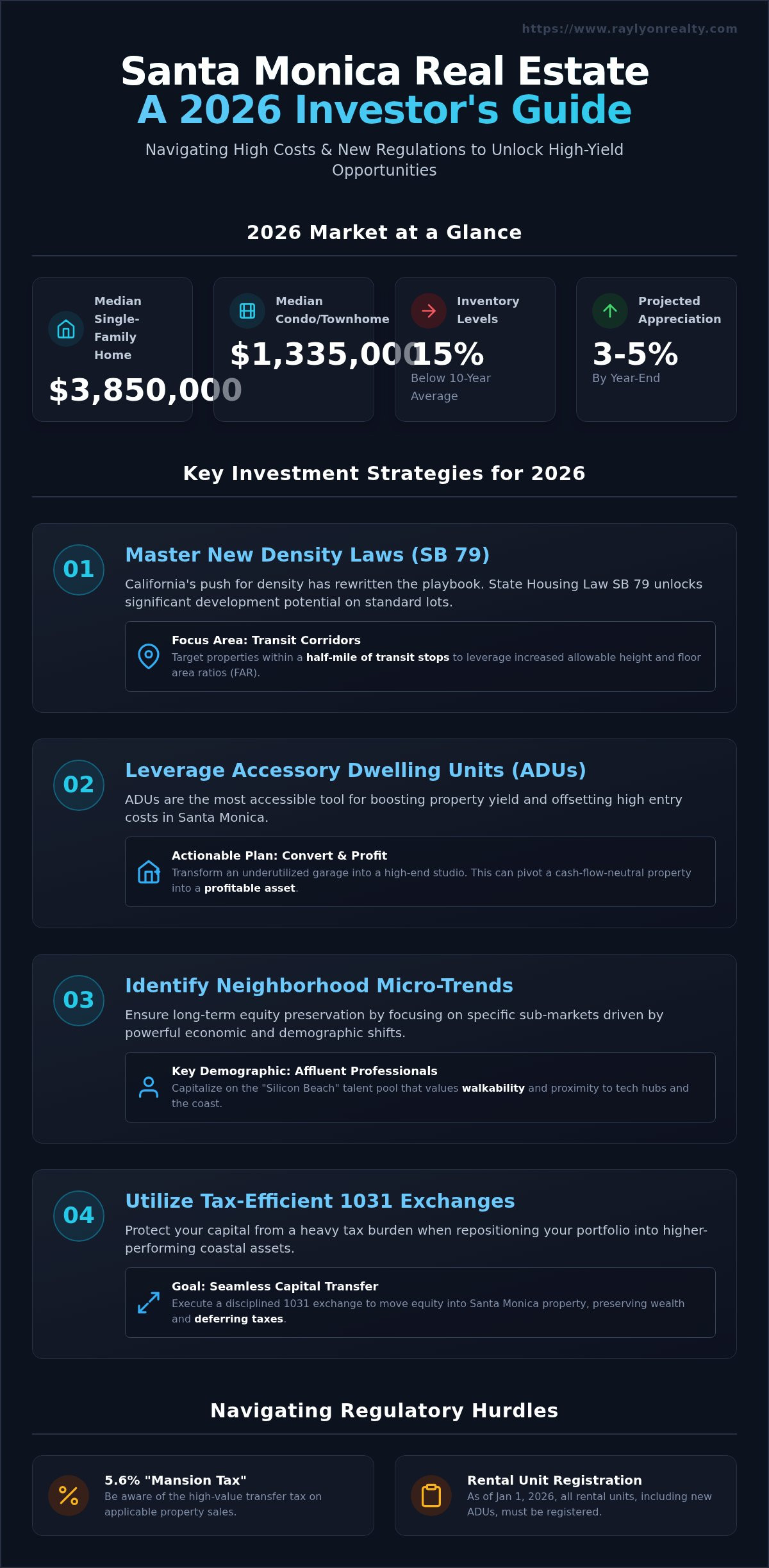
Scarcity is the primary driver of current pricing. With inventory levels sitting 15% below the 10-year average, buyers are often competing for a pool of just 256 available units. Median prices for single-family homes have hit $3,850,000, while the condo and townhome market offers a median entry point of $1,335,000. If you’re looking for the investment “sweet spot,” it’s currently found in the $1.5 million to $2.2 million range for condos in prime walkability zones. Homes are moving in an average of 29 to 48 days; this shows that despite higher prices, the appetite for Santa Monica dirt hasn’t cooled. You won’t find many bargains on the MLS, but you will find assets that are historically resilient and projected for 3% to 5% appreciation by year-end.
Leveraging 2026 Housing Laws and Zoning Shifts
Success in the current market isn’t just about finding the right house; it’s about mastering the underlying dirt. California’s legislative push for density has fundamentally rewritten the investment playbook. State Housing Law SB 79, which took effect July 1, 2026, is the most significant driver for those investing in Santa Monica real estate 2026. This law increases allowable height and floor area ratios for projects within a half-mile of transit stops. For a strategic investor, this means a standard lot near a transit corridor now holds significantly more development potential than it did just a few years ago. You can track these specific changes through Santa Monica’s official planning and zoning documents.
The ADU Strategy: Maximizing Square Footage
Accessory Dwelling Units (ADUs) remain the most accessible tool for boosting property yield. While the city’s new Rental Unit Registration Ordinance now requires all units to be registered as of January 1, 2026, the income potential still justifies the administrative effort. Converting an underutilized garage into a high-end studio can pivot a cash-flow-neutral property into a profitable asset. Construction costs in Santa Monica are notoriously high, but the value added to a coastal zip code usually provides a healthy return on equity. If you’re looking for an insider perspective on which parcels hold the most hidden potential, my team is experienced in navigating Westside investment opportunities.
Transit-Oriented Opportunities
The skyline along major boulevards is changing as “Builder’s Remedy” projects and state-mandated housing goals take shape. We’re seeing a clear trend toward multi-story residential towers near Expo Line stations. These developments don’t just create new units; they revitalize the surrounding blocks and increase foot traffic for local amenities. Increasing the allowable residential density on a parcel effectively lowers the per-unit land cost, significantly boosting the property’s intrinsic value for future development. Identifying these parcels early is key to capturing the next wave of equity growth.
Navigating Tenant Protections in 2026
Investing here requires a clear-eyed understanding of local and state tenant protections. Beyond the new registration requirements, investors must account for the 5.6% “Mansion Tax” on any transaction over $8 million. This cliff tax makes precise valuation and deal structuring more important than ever. While Santa Monica is known for its complex rental laws, the 2026 landscape provides more clarity for landlords who stay compliant. The city’s focus on registration is designed to help enforce existing protections, making it easier for professional investors to operate within a transparent, well-regulated market.
Santa Monica Neighborhood Micro-Markets: Where to Allocate Capital
Choosing the right neighborhood in 2026 is a matter of matching your financial goals with the specific DNA of each pocket. The city isn’t a monolith; a block-by-block analysis reveals distinct opportunities for equity preservation versus immediate rental yield. Much of this localized growth is being fueled by Santa Monica’s 2026 Economic Revitalization Strategy, which has funneled resources into commercial corridors and improved public spaces. If you’re serious about investing in Santa Monica real estate 2026, you need to know where the capital is flowing before the rest of the market catches up.
North of Montana vs. Ocean Park
North of Montana remains the gold standard for equity preservation. This area is characterized by estate-sized lots and a prestigious reputation that acts as a fortress for your capital. It’s an equity play, not a cash-flow play. The draw here is the school district, which ensures a permanent floor for property values and attracts long-term tenants who prioritize stability. Conversely, Ocean Park offers a more dynamic rental market. With its high concentration of luxury condos and proximity to Main Street, it’s the primary target for investors seeking higher monthly yields. The “beach lifestyle” here commands a premium, and the high demand for family-oriented rentals keeps vacancies at historic lows.
The Pico District: Emerging Value-Add
For investors looking for “fixer-upper” opportunities or parcels with ADU potential, the Pico District is the place to watch. It has historically been overlooked, but new transit-oriented zoning and city-led revitalization efforts are changing its trajectory. This is one of the few remaining pockets where you can find properties that haven’t yet reached their full potential. It’s a classic value-add play where smart renovations and density increases can lead to significant forced appreciation.
The “Spillover” Effect: Mar Vista and Venice
Many savvy investors are looking just outside the city limits to maximize their returns. While Santa Monica offers unmatched stability, comparing yields to Mar Vista los angeles reveals why capital is spilling over. Mar Vista has transformed into a premier residential hub with slightly lower entry costs and higher cap rates. Venice Beach remains a high-risk, high-reward coastal market, but Mar Vista offers a more consistent family-oriented demographic. About 35% of transactions in these spillover zones are happening off-market. Accessing these exclusive opportunities is often the only way to secure a deal that makes financial sense when investing in Santa Monica real estate 2026 and its surrounding neighborhoods.
Strategic Investment Vehicles: 1031 Exchanges and Value-Add Flips
While identifying the right neighborhood is a crucial first step, the vehicle you use to acquire and manage your asset determines your final ROI. In a high-stakes environment like the Westside, sophisticated tax strategies and renovation playbooks aren’t just options; they’re requirements. Investing in Santa Monica real estate 2026 requires a move away from passive holding toward active equity management. Whether you’re looking to defer a heavy tax bill or force appreciation through a strategic flip, you need a plan that accounts for the city’s unique pricing floor and regulatory hurdles.
Executing a Perfect 1031 Exchange
The 1031 exchange remains the most powerful tool for building wealth in coastal California. It allows you to defer capital gains taxes by reinvesting the proceeds from a sale into a “like-kind” property. In Santa Monica, where the 5.6% “Mansion Tax” (Measure GS) applies to transactions of $8 million or more, the stakes for tax deferment have never been higher. You must strictly follow the federal timelines: you have exactly 45 days from the close of your sale to identify a replacement property and 180 days to close on it. Many investors look to the broader Westside LA ecosystem, including Mar Vista or Venice, to find replacement assets that offer better cash flow while staying within the like-kind requirements. Missing these deadlines by even a single day can trigger a massive tax event, so having your replacement property identified before you even list your current asset is the only way to ensure a seamless transition.
The Value-Add Flip: Renovation Strategy
In a market where the median single-family home price is $3,850,000, you can’t afford to over-improve a property. Success in flipping here depends on what I call the “insider’s math.” This means focusing on high-impact, cosmetic upgrades that yield the highest return without requiring years of permitting. Strategic staging, updated lighting, and modern curb appeal can shift a property’s perception and drive multiple offers. My personal history in property ownership and flipping has taught me one universal truth: “The profit is made on the buy, not the sell.” This is why finding exclusive, non-public opportunities like trust sales or probate listings is so vital. These deals often bypass the MLS, allowing you to secure a fixer-upper without the typical bidding war. By leveraging a trusted network of specialists and vendors, you can execute minor upgrades quickly to maximize your sale value. If you’re ready to identify your next 1031 replacement property or find an off-market flip, contact Ray Lyon Realty today to access our exclusive Westside inventory.
Securing Your 2026 Portfolio with Ray Lyon Realty
The complexity of the 2026 market means that general real estate advice is no longer enough to protect your capital. When the barrier to entry is as high as it is in the Westside, you need an advocate who understands the granular details of local zoning, tenant law, and the math of a successful flip. Investing in Santa Monica real estate 2026 is a high-stakes endeavor that rewards those with insider access. I don’t just facilitate transactions; I partner with you to build a portfolio based on the same strategies I use for my own property ownership and development projects.
The Ray Lyon Advantage: From Strategy to Negotiation
My approach is built on transparency and a deep personal history in property renovation. I’ve spent years getting my hands dirty on job sites and navigating the city’s permitting offices, which gives me a unique perspective that most agents lack. This hands-on experience allows me to spot the difference between a “money pit” and a genuine value-add opportunity before you even step inside. For sellers, this means I know exactly how to stage and market your asset to attract the most qualified buyers. For buyers, my reputation among real estate agents in los angeles ca gives you a distinct edge in bidding wars. We use a client-centric model that prioritizes your peace of mind, making sure you feel supported through every inspection and contractual clause.
Accessing exclusive, non-public opportunities is the only way to beat the low inventory levels we’re seeing this year. As mentioned earlier, about 35% of transactions are happening off-market. My network of specialists and local insiders allows me to find these “quiet” listings, from trust sales to probate opportunities, before they hit the MLS. This access is a non-negotiable advantage if you want to avoid the frenzy of public competition.
Building Your Westside Legacy
Investing in Santa Monica real estate 2026 is about more than a single closing; it’s about securing your financial future in one of the world’s most resilient coastal markets. We view every client relationship as a long-term partnership. Whether you are executing your first 1031 exchange or expanding an existing portfolio of luxury rentals, we provide the strategic, business-savvy guidance you need to win. The market will continue to evolve, but localized expertise and a resourceful team remain the best hedges against uncertainty. Now is the time to move from research to execution. Partner with Ray Lyon Realty for your next investment and let’s schedule a strategic consultation to review your 2026 goals.
Take Your Next Strategic Step in Santa Monica
The transition toward transit-oriented density and the expansion of ADU potential have fundamentally changed how we calculate ROI on the Westside. Investing in Santa Monica real estate 2026 is no longer about waiting for simple appreciation; it’s about actively leveraging new housing laws and finding value in neighborhood micro-trends before the wider market catches on. Success in this high-barrier environment requires more than just capital. It requires a partner who understands the “insider’s math” of a property flip and the strict timelines of a 1031 exchange.
With over 20 years of experience on the Westside and a personal background in property development, I offer more than just a listing service. I provide a hands-on, strategic partnership designed to find those exclusive, off-market opportunities that define a successful portfolio. Whether you’re navigating a complex trust sale or looking to maximize the yield on your next coastal asset, my team is ready to help you execute with confidence. The opportunities are there for those who know where to look. Contact Ray Lyon Realty to discuss your Santa Monica investment strategy and let’s start building your Westside legacy today.
Frequently Asked Questions
Is Santa Monica real estate a good investment in 2026?
Santa Monica remains a premier “blue chip” investment due to its supply-locked coastal geography and the mature Silicon Beach tech ecosystem. While entry costs are high, the market offers exceptional equity preservation and projected appreciation of 3% to 5% by the end of the year. Investing in Santa Monica real estate 2026 is less about rapid speculation and more about long-term wealth building in a low-volatility environment where demand consistently outstrips available inventory.
How do new transit-oriented housing laws affect property values in Santa Monica?
State Housing Law SB 79 significantly increases the intrinsic value of parcels located within a half-mile of transit corridors. By allowing for greater height, density, and floor area ratios, the law effectively lowers the per-unit land cost for developers. This shift makes properties near the Expo Line particularly attractive for those looking to maximize future development potential. These zoning changes turn standard residential lots into high-density opportunities that didn’t exist a decade ago.
What is the average ROI for a residential flip in Santa Monica?
Average ROI for a residential flip varies based on the acquisition price and the scale of renovations. In this market, successful investors focus on the “insider’s math,” where profit is primarily secured at the time of purchase rather than through extensive construction. By targeting properties that need cosmetic upgrades or have underutilized square footage for ADUs, you can force appreciation without the long timelines of major structural overhauls. Finding the right “fixer-upper” is the critical variable.
Can I still use a 1031 exchange for a Santa Monica investment property?
Yes, Section 1031 remains a vital tool for deferring capital gains taxes when reinvesting in like-kind real property. You must identify a replacement property within 45 days of your sale and close within 180 days to stay compliant. This strategy is especially effective for managing the impact of the 5.6% “Mansion Tax” on high-value transfers. It allows you to roll your equity into higher-performing coastal assets while keeping your investment capital fully at work.
What are the best neighborhoods in Santa Monica for rental income?
Ocean Park and Sunset Park are currently the top choices for consistent rental income due to their high demand from young professionals and families. These areas offer a mix of luxury condos and single-family homes that command premium rents. If you’re looking for value-add opportunities with higher potential yields, the Pico District is emerging as a strong contender. It benefits from new transit-oriented zoning and ongoing city revitalization efforts that are driving up desirability.
How does the ADU law work for Santa Monica homeowners in 2026?
The 2026 ADU laws allow homeowners to convert garages or underutilized land into income-generating units, which significantly boosts overall property yield. A key update is the Rental Unit Registration Ordinance, which requires all residential rental units, including ADUs, to be registered with the city as of January 1, 2026. This administrative step is now a requirement for legal operation, but the ability to add square footage remains the fastest way to increase a property’s cash flow.
What should I look for in a Santa Monica investment property realtor?
You should prioritize a realtor who has personal experience in property ownership and flipping rather than just a standard sales background. Look for a specialist who understands the technical mechanics of 1031 exchanges and trust sales. A true local expert will have deep roots on the Westside and a network of specialists to help you navigate complex California tenant laws. Most importantly, they should provide access to exclusive, off-market opportunities that aren’t visible on the MLS.
Are there many off-market investment opportunities in Santa Monica?
A significant portion of the most lucrative deals in this market happen before they ever reach the public eye. Approximately 35% of transactions in the area are currently off-market, often involving trust sales, probate, or private negotiations. Accessing these exclusive opportunities requires a realtor with a deep local network and a reputation for closing complex deals. For those investing in Santa Monica real estate 2026, these “quiet” listings are often the only way to avoid bidding wars.