

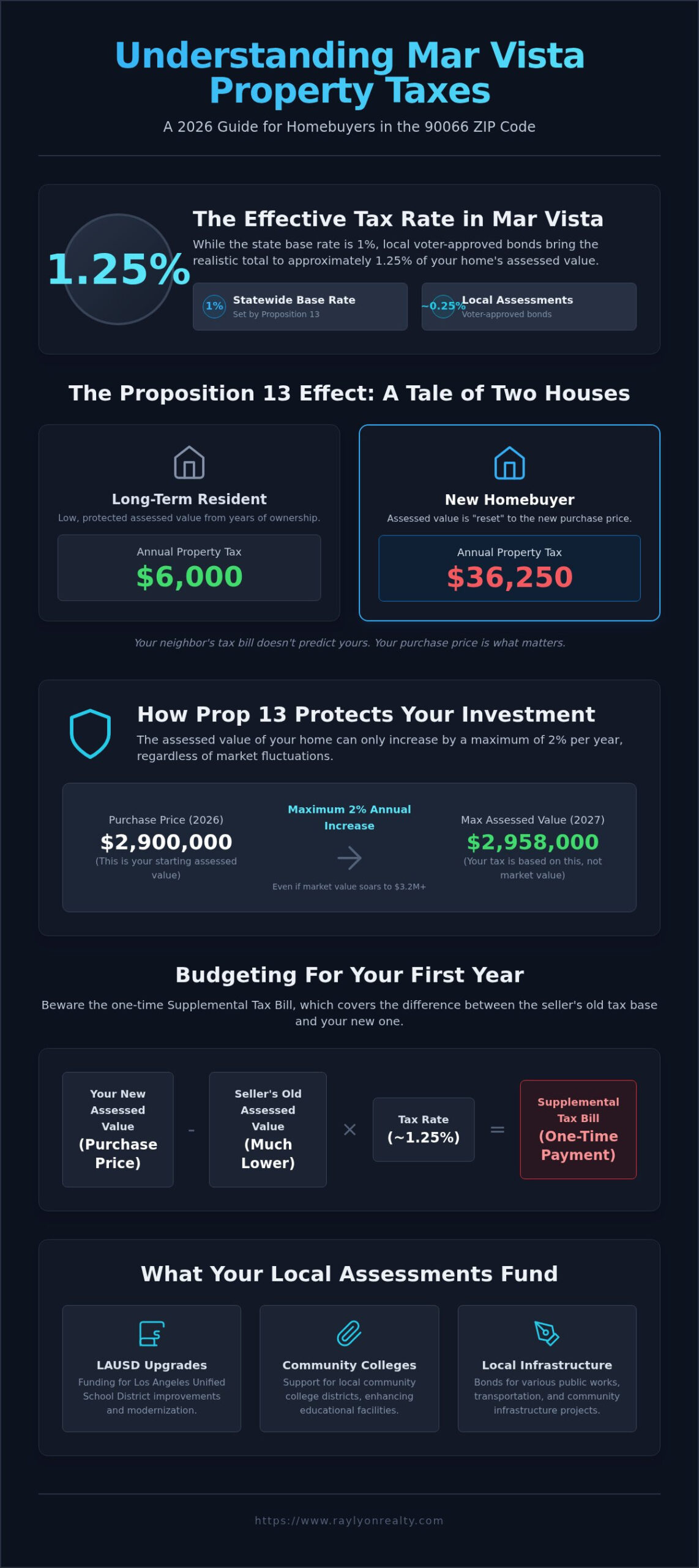
Why does a long-term resident on your street pay $6,000 in annual taxes while the newly sold home next door faces a bill of $36,250? It’s a jarring reality of the Westside market that often leads to “supplemental bill” sticker shock for new homeowners. You’re likely asking the same question as many of my clients: 26. What Is the Average Property Tax in Mar Vista? Understanding this figure is about more than just a simple percentage. It’s about knowing how your specific purchase price resets the tax clock in a Proposition 13 landscape.
It’s completely normal to feel frustrated by the lack of transparency in local assessments or fear hidden Mello-Roos fees. I’m here to help you master these complexities, from local school bonds to those unexpected supplemental bills, so you can budget for your Westside home with total confidence. In this 2026 guide, we’ll dive into the 1.25% effective tax rate for the 90066 zip code, explain how the 2% assessment cap protects your investment, and highlight the specific local bonds that will appear on your upcoming tax statement.
Key Takeaways
- While the base rate is 1%, asking “26. What Is the Average Property Tax in Mar Vista?” usually reveals a realistic effective rate of 1.25% once local voter-approved bonds are included.
- Understand how Proposition 13 protects your investment by capping annual assessment increases at 2%, ensuring your taxes don’t skyrocket even if home values do.
- Identify the specific LAUSD and local infrastructure assessments unique to the 90066 zip code to avoid surprises on your annual tax statement.
- Learn how to calculate and set aside funds for the one-time supplemental tax bill that covers the gap between the seller’s old assessment and your new purchase price.
- Discover why partnering with a Westside specialist helps you identify properties with lower direct assessments and more predictable long-term carrying costs.
The Baseline: Calculating Mar Vista’s Property Tax Rate in 2026
For 2026, the answer to the question 26. What Is the Average Property Tax in Mar Vista? starts with a specific number: 1.25%. While California law sets a firm foundation, local variables often push the final bill higher than many first-time buyers expect. In Mar Vista real estate, Ad Valorem tax is a levy based on the assessed value of your property, literally meaning “according to value.”
The Los Angeles County Assessor plays the most critical role in your first year of ownership. They establish your home’s initial valuation based on the purchase price, which then serves as the permanent foundation for your future tax obligations. This isn’t a guess or a neighborhood average; it’s a direct reflection of what you paid for the asset. Understanding this baseline is the first step toward budgeting for your Westside lifestyle without any nasty surprises in the mail.
To better understand this concept, watch this helpful video:
How the 1% Base Rate Works in Los Angeles County
Every homeowner in California begins with the same fundamental starting point. Thanks to Proposition 13, the general property tax is capped at 1% of the property’s assessed value. This base rate is remarkably stable and funds essential county-wide services like public health, law enforcement, and social programs. Because it’s a constitutional limit, this portion of your bill won’t fluctuate wildly based on market trends, providing a level of predictability that’s rare in the high-stakes Westside market.
Voter-Approved Bonds: The “Extra” Percentage
If the base rate is 1%, you might wonder why 1.25% is the standard for 26. What Is the Average Property Tax in Mar Vista? The difference comes from voter-approved bonds and special assessments. In the 90066 zip code, these typically add between 0.20% and 0.25% to your total bill. These funds are earmarked for local infrastructure, such as Los Angeles Unified School District (LAUSD) upgrades and community college improvements. These rates can vary slightly from one street to the next depending on the specific benefit districts your property occupies.
The Proposition 13 Effect: Why Assessment Matters More Than Averages
If you’re trying to figure out 26. What Is the Average Property Tax in Mar Vista?, looking at your neighbor’s tax bill will only lead to confusion. California’s property tax system is highly individualized. While two homes might look identical from the curb, their tax liabilities could be tens of thousands of dollars apart. This disparity exists because of Proposition 13, which fundamentally changed how assessments work in the Golden State. Instead of focusing on 26. What Is the Average Property Tax in Mar Vista?, you should focus on your specific purchase price, as that becomes the “base year” value for your future bills.
Proposition 13 provides a level of financial predictability that is rare in high-demand markets like the Westside. It ensures that as long as you own your home, your tax burden won’t skyrocket just because the neighborhood becomes more popular. This protection is a cornerstone of long-term homeownership in Los Angeles. If you want a detailed look at a specific property’s potential tax profile, you can always reach out to our team for a strategic analysis.
Understanding the 2% Assessment Cap
The most powerful feature of Proposition 13 is the 2% annual assessment cap. Regardless of how fast Mar Vista home values rise, the Assessor can only increase your property’s assessed value by a maximum of 2% per year. This creates a massive “decoupling” between market value and taxable value over time. For example, if you buy a home for $2,900,000 in 2026, your year-two assessment won’t exceed $2,958,000, even if the market value jumps to $3,200,000. For families planning to stay in the 90066 zip code for a decade or more, this cap translates into hundreds of thousands of dollars in cumulative tax savings compared to states with frequent market-rate reassessments.
The Reset: Buying in a High-Value Market
When you purchase a home, the “reset” mechanism kicks in. The Los Angeles County Assessor establishes a new base year value equal to your purchase price. If the previous owner held the home since the 1990s, they were likely paying taxes on an assessment far below today’s market reality. You must prepare for a significant jump in the annual tax bill compared to what the seller was paying. This transition often triggers Supplemental Secured Property Taxes to cover the difference between the old and new assessments for the remainder of the fiscal year. Understanding these nuances is part of mastering the local market, which you can explore further in our Mar Vista, Los Angeles: A Complete Neighborhood Guide.
Beyond the 1%: Direct Assessments and Local Bonds in Mar Vista
While the base rate is fixed by state law, the true answer to 26. What Is the Average Property Tax in Mar Vista? depends heavily on the “Direct Assessments” section of your tax bill. These are specific charges for services that benefit your property directly or fund voter-approved local projects. Unlike the base rate, these assessments aren’t always a percentage of your home’s value. Many are flat fees or based on the square footage of your lot. When you review your 2026 tax statement, you’ll see a list of line items that can add several thousand dollars to your annual obligation.
The most significant portion of these assessments typically comes from the Los Angeles Unified School District (LAUSD) bonds. These funds pay for modernizing local campuses and improving technology in classrooms. Beyond schools, your Mar Vista bill will include levies for county-wide services such as trauma centers, flood control systems, and the regional library network. Learning to read these line items is essential for any homeowner who wants to understand exactly where their money is going.
Common Levies in the 90066 Zip Code
In the 90066 zip code, you’ll notice specific charges like the Safe Clean Water parcel tax, also known as Measure W. This fee is calculated based on the “impermeable” surface area of your lot, such as your roof and driveway, to fund projects that capture and clean local stormwater. You might also see Landscape and Lighting District charges, which maintain the public greenery and streetlights that keep Westside neighborhoods safe and attractive. One advantage of buying in Mar Vista is that it’s an established neighborhood. This means you generally won’t encounter the heavy Mello-Roos taxes often found in newer, master-planned developments in other parts of Southern California.
Mar Vista vs. Santa Monica: The Municipal Difference
Location matters immensely when calculating your final bill. Because Mar Vista is part of the City of Los Angeles, its bond obligations differ from those in the neighboring City of Santa Monica. Living just a few blocks across the border into Santa Monica can change your tax liability because that city has its own set of voter-approved bonds for local parks and municipal services. This is why having a strategic partner is so valuable during your search. If you are evaluating different Westside pockets, consulting with the best Real Estate Agents in Los Angeles CA can help you identify which side of the municipal line offers the best long-term financial fit for your goals.
Budgeting for Your First Year: Navigating Supplemental Tax Bills
The biggest shock for new Westside homeowners often isn’t the mortgage payment; it’s the arrival of the supplemental tax bill. When you ask, “26. What Is the Average Property Tax in Mar Vista?”, you’re usually looking at the annual rate of 1.25%. However, the supplemental bill is a separate, one-time payment that bridges the financial gap between the previous owner’s tax base and your new purchase price. It exists because the county assessor’s office cannot update their records instantly on your closing day.
Timing is where many buyers get tripped up. You won’t see this bill at the escrow table. Instead, these bills typically arrive four to nine months after you move in. Because the county takes time to process the change in ownership, your first standard annual tax bill might still reflect the seller’s much lower assessment. If the previous owner held the home for twenty years, that difference can be massive. You must be ready to pay this “catch-up” amount directly, as your mortgage impound account is rarely set up to handle it in the first year.
The Supplemental Bill Calculation
Calculating this amount isn’t guesswork; it’s a specific formula. You take your new purchase price, subtract the seller’s old assessed value, and multiply that “gap” by the local tax rate. Finally, you multiply that number by a proration factor based on how many months are left in the fiscal year. Supplemental tax bills are essentially a one-time catch-up mechanism designed to collect the tax revenue owed on the increased value of a property from the date you took ownership until the start of the next full tax year. If you close in April, your supplemental bill will be smaller than if you closed in August because you are only paying for the remainder of the current tax cycle.
Avoiding Post-Closing Financial Stress
The most effective way to handle this is to set the funds aside during escrow. Don’t assume your lender has it covered. Most mortgage companies base your monthly tax impounds on the *current* tax bill available. If that bill is still based on the seller’s $800,000 assessment, but you bought the home for $2.9 million, your impound account will be significantly underfunded. Communicating with your lender early can help, but many homeowners find it simpler to keep a separate “tax reserve” in a high-yield savings account. Remember, this is a one-time hurdle. Once the assessor officially updates your base year value, your regular annual bills will reflect your actual purchase price. To ensure you have the most accurate projection for your specific property, consult with our team of Westside investment specialists today.
Strategic Buying: How Ray Lyon Realty Minimizes Tax Surprises
Data alone won’t protect your bottom line in the Westside market. While anyone can look up a rate, truly answering 26. What Is the Average Property Tax in Mar Vista? requires a deep dive into the specific history of a parcel. At Ray Lyon Realty, we view ourselves as financial strategists as much as real estate experts. We don’t just look at the current list price; we analyze the “tax DNA” of a property to ensure your investment remains profitable for years to come. This granular approach allows us to identify potential red flags, such as upcoming bond expirations or unusually high direct assessments, before you ever enter escrow.
Our team leverages a robust network of specialized tax professionals and assessors to handle complex transactions. Whether you are looking at a luxury listing or a potential new construction project, we ensure your pro forma accounts for every cent of tax liability. This level of preparation turns property tax data into a powerful negotiation tool. If a home is currently over-assessed compared to its true market value, we can use that information to justify a lower purchase price or prepare an immediate assessment appeal post-closing.
The Insider Advantage in Mar Vista
The “insider advantage” means having access to information that isn’t always obvious on a standard listing sheet. We recently helped a client identify a miscalculated assessment on a Mar Vista renovation project where the previous owner had been overcharged for square footage that didn’t exist. By catching this early, we saved the buyer thousands in recurring annual costs. We look for these discrepancies in every deal. Our goal is to ensure that when you ask 26. What Is the Average Property Tax in Mar Vista?, you are getting a number that reflects a lean, optimized tax profile rather than a bloated county estimate.
Securing Your Westside Future
Tax planning is not an afterthought in our buyer representation; it’s a core component. We provide personalized tax estimates for your target home that account for the 2026 effective rates and the specific bonds tied to that block. This foresight is critical for long-term ROI, especially for clients building a local portfolio. We take the stress out of the “reset” mechanism by providing a clear roadmap of what your bills will look like in years one, five, and ten. Ready to find your Mar Vista home? Contact Ray Lyon Realty today.
Mastering Your Mar Vista Investment
Owning a home on the Westside is a significant financial milestone, but it shouldn’t come with tax-related anxiety. By understanding the 1.25% effective rate and the long-term protections of Proposition 13, you’re already ahead of the curve. You now know that the answer to 26. What Is the Average Property Tax in Mar Vista? is less about a neighborhood average and more about your specific purchase price and the “reset” that follows.
Preparation is your best defense against supplemental bill surprises. My team and I use our granular knowledge of Westside neighborhoods and my personal experience in property ownership and flipping to help you navigate these costs with ease. We take a strategic approach to maximizing your sale value while minimizing hidden liabilities. Whether you’re buying a luxury estate or an investment property, we’re here to ensure every dollar is accounted for.
Get a Professional Market Analysis for Mar Vista to start your journey with a clear financial roadmap. Your Westside future is bright, and we’re ready to help you secure it.
Frequently Asked Questions
Is the average property tax in Mar Vista higher than in Santa Monica?
No, Mar Vista property taxes are typically slightly lower than those in Santa Monica. While both areas share the same 1% base rate, Santa Monica often passes more local municipal bonds for parks and its independent school district. When you ask, 26. What Is the Average Property Tax in Mar Vista?, you’ll find the 1.25% effective rate is a bit more conservative than Santa Monica’s, which can sometimes push closer to 1.3% depending on the specific tax district.
Can I appeal my property tax assessment in Los Angeles County?
You can absolutely appeal your assessment through the Los Angeles County Assessment Appeals Board. This is common if the market value of your home drops below its current assessed value, known as a Proposition 8 appeal. You must file your application between July 2 and November 30. Having a professional market analysis can provide the necessary evidence to prove your home’s value is lower than the assessor’s current records, potentially saving you thousands in annual payments.
What is the California Homeowners’ Exemption and does it apply in Mar Vista?
The California Homeowners’ Exemption is available to all Mar Vista residents who use their property as a primary residence. It reduces your assessed value by $7,000, which typically results in a modest annual saving of about $70 on your tax bill. While the amount hasn’t changed in decades, it’s a simple way to slightly lower the answer to 26. What Is the Average Property Tax in Mar Vista? for your specific household. You only need to file once.
How often do property taxes increase in Mar Vista?
Your property’s assessed value is reviewed annually, but Proposition 13 limits any increase to a maximum of 2% per year. This cap stays in place as long as you own the home and don’t perform major construction. However, the total tax rate can fluctuate slightly each year if local voters approve new bonds or if existing debt obligations are paid off. This ensures your tax bill remains predictable and decoupled from the volatile Westside real estate market.
Are there special taxes (Mello-Roos) in the Mar Vista neighborhood?
Mello-Roos taxes are extremely rare in Mar Vista because the neighborhood’s infrastructure was established decades ago. These special assessments are typically found in newer, master-planned communities where developers need to fund fresh roads and utility lines. In the 90066 zip code, you’ll primarily see “direct assessments” for services like flood control or street lighting, which are generally much lower than the heavy Mello-Roos fees found in newer, developing Southern California suburbs or gated communities.
When are property tax payments due in Los Angeles?
Los Angeles County property taxes are paid in two installments each year. The first installment is due on November 1 and becomes delinquent if not paid by December 10. The second installment is due on February 1 and becomes delinquent after April 10. It’s vital to mark these dates on your calendar to avoid the 10% late penalty, which can be quite substantial given the high property values and tax bases common throughout the Mar Vista area.
Does a major renovation trigger a property tax reassessment in Mar Vista?
A major renovation will trigger a partial reassessment, but it won’t reset your entire home’s tax base. The Los Angeles County Assessor will value the “new construction” portion, such as an added bedroom or a new ADU, and add that specific value to your existing assessment. Your original base year value for the rest of the home remains protected by Proposition 13. I often help clients estimate these “blended” tax bills before they break ground on projects.
What happens to my property taxes if I inherit a home in Mar Vista?
For homeowners moving forward with these improvements, coordinating site logistics is just as important as the tax planning; local services like LA Dumpster Bins can assist with residential roll-off rentals to keep your renovation project organized and on schedule.
Under current California law (Proposition 19), tax basis transfers for inherited properties are more restrictive than they used to be. You may only keep the deceased parent’s lower tax base if the home becomes your primary residence and the market value doesn’t exceed the original assessment by more than $1 million. If the home is used as a rental or investment property, it will be reassessed at current market value, which can lead to a significant tax increase.