

Did you know that Measure GS has already generated over $79 million for Santa Monica as of early 2026? While these funds support local renter aid, for a buyer looking at luxury real estate, that “mansion tax” is a 5.6% cliff tax that applies to the entire purchase price for properties $8 million and up. It is a substantial figure that can catch even the most experienced investors off guard. I know that when you are already paying a premium for our beautiful coastal location, the last thing you want is an unexpected bill at the finish line. It is completely normal to feel some stress about how tiered taxes and coastal property inspections might affect your final budget.
This guide is here to give you total peace of mind regarding closing costs for home buyers in Santa Monica. I will provide a line-item breakdown for your escrow budget, covering everything from the multi-tiered city transfer taxes to the specific fees for beachside foundation checks. We will also look at which costs are negotiable and which are set in stone by the city or county. You will finish this article with the confidence to manage your total cash-to-close without any last-minute surprises.
Key Takeaways
- Establish a realistic budget by using a 3% baseline for total fees, which ensures you aren’t caught off guard by the local 2% to 5% range.
- Understand how tiered local transfer taxes and Measure GS impact the total closing costs for home buyers in Santa Monica, especially for properties over $5 million.
- Identify the essential coastal inspections and luxury appraisal requirements that protect your investment in Santa Monica’s unique beachside environment.
- Learn how to strategically negotiate seller credits and lender options to reduce the amount of cash you need to bring to the closing table.
Santa Monica Closing Costs: The 2% to 5% Reality Check
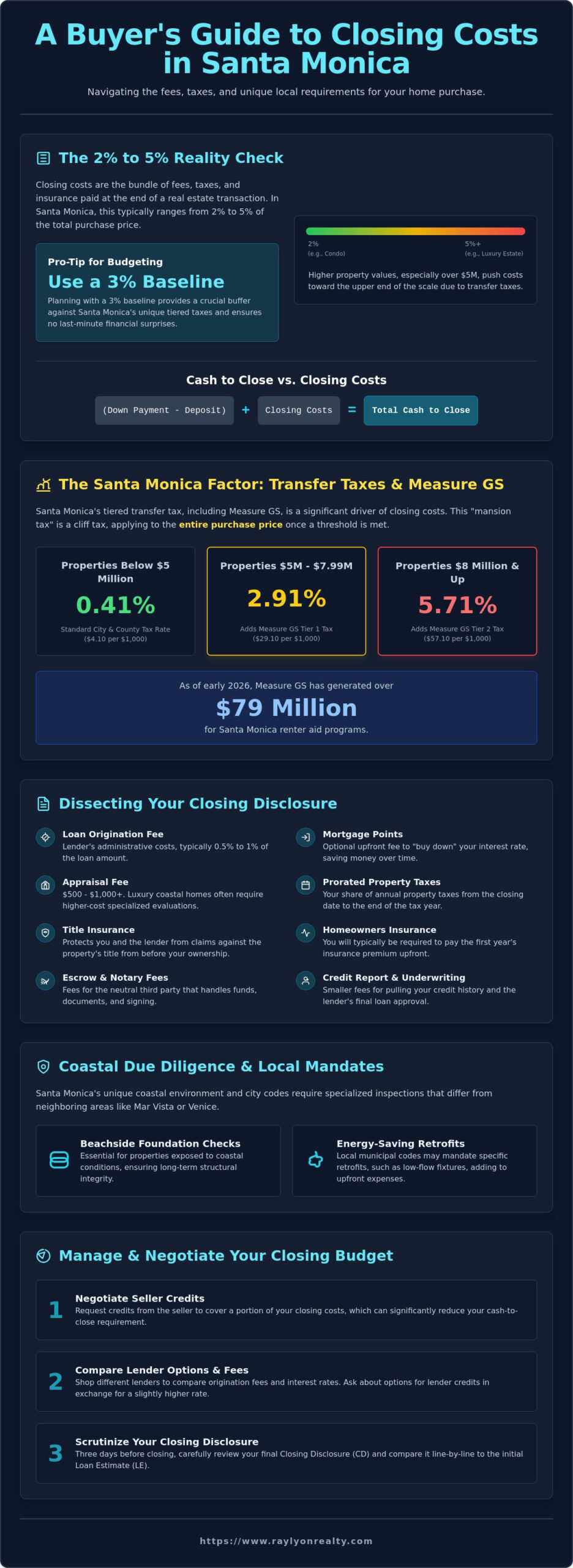
Think of closing costs as the final hurdle before you get the keys to your new home. They represent the bundle of fees, taxes, and insurance premiums paid at the end of a real estate transaction. While many sources suggest a range of 2% to 5% of the purchase price, the 2026 benchmark for closing costs for home buyers in Santa Monica should really be set at a 3% baseline for your planning. This gives you a buffer against the city’s unique tiered taxes and ensures you aren’t scrambling for funds at the last minute.
Purchase price significantly affects this percentage. If you are buying an entry-level condo, your costs might sit closer to the 2% mark. However, as you move into luxury estates over $5 million or $8 million, the tiered transfer taxes known as Measure GS push that percentage toward the higher end of the scale. You should also distinguish between your total “cash to close” and your actual “closing costs.” Closing costs are the specific administrative and legal fees, while your cash to close is the grand total you wire to the title company, which includes your down payment minus any deposits you’ve already made.
To better understand the specific fees you might encounter in California, watch this helpful overview:
The Components of Your Closing Disclosure
Your lender will provide a Loan Estimate (LE) early in the process, but the final, binding numbers appear on your Closing Disclosure (CD). You’ll see one-time charges, like Closing costs related to title insurance and notary fees, alongside recurring “prepaid” items like prorated property taxes and homeowners insurance. Escrow acts as the neutral third party that manages the exchange of funds and documents in a Santa Monica transaction. Understanding these line items early helps you spot errors and ensures the final closing costs for home buyers in Santa Monica align with your initial expectations.
Why Santa Monica Costs Differ from Mar Vista or Venice
Santa Monica has its own set of rules that differ from nearby Mar Vista or Venice. Local municipal codes often mandate specific inspection requirements or energy-saving retrofits that can add to your upfront expenses. Within the 90401, 90403, and 90405 zip codes, escrow companies also follow specific local norms for how certain administrative fees are split between the buyer and the seller. These subtle differences in local practice can change your bottom line by thousands of dollars. If you are curious how these totals stack up against neighboring areas, explore our Mar Vista neighborhood guide for a cost comparison.
Loan-Related Fees and Administrative Expenses
Lenders play a significant role in the total closing costs for home buyers in Santa Monica. Most buyers start with the loan origination fee, which covers the administrative work of processing your mortgage. This fee typically ranges from 0.5% to 1% of the total loan amount. In 2026, we see many buyers choosing to pay mortgage points. By paying this upfront fee, you can “buy down” your interest rate. It is a strategic move that can save you thousands over the life of the loan, especially if you plan to hold the property for a long period.
Appraisals are another area where Santa Monica stands apart from more traditional markets. While a standard appraisal might cost between $500 and $1,000, our local luxury properties often require specialized evaluations. If you are purchasing a high-value coastal home with unique architectural features, expect the appraisal fee to sit at the higher end of that range. Lenders require these detailed reports to justify the loan amount against the specific market data of the Westside. You will also see smaller administrative costs on your Closing Disclosure guide, such as credit report fees and underwriting charges. These cover the lender’s final check of your financial health before they release the funds.
If you have questions about how these lender-specific fees impact your specific purchase, I am always available to discuss your Santa Monica investment strategy and help you prepare for the move.
Title Insurance and Escrow Services
Title insurance is a non-negotiable protection for your ownership rights. In a high-value market like Santa Monica, the Buyer’s Title Policy ensures that no hidden liens or ownership disputes arise after the sale. Escrow fees are generally calculated based on the purchase price of the home. These fees cover the neutral third party’s work in managing the documents, funds, and final recording. You will also see modest fees for notary services and the official recording of the deed with the county, which are the final steps in making the property yours.
Prepaid Items and Impound Accounts
Prepaid items are costs you pay at closing to cover future expenses. This includes prepaid interest, which covers the days between your closing date and the start of your first full mortgage cycle. Homeowners insurance is another critical prepaid item. Because we are in a coastal zone, premiums can vary, so I recommend shopping for a policy early in the escrow process. Finally, your lender will likely set up an impound account to collect property taxes. In Santa Monica, the base property tax rate is roughly 1.25%, and you’ll typically need to deposit several months of taxes into this account at the time of closing.
The Santa Monica Factor: Transfer Taxes and Measure GS
Santa Monica is a charter city, which means it has the authority to set its own local tax rates independent of the state or county. This creates a multi-layered tax environment that significantly impacts the total closing costs for home buyers in Santa Monica. While every property transfer in the region is subject to the standard Los Angeles County Transfer Tax of $1.10 per $1,000 of value, Santa Monica adds its own city-specific tiers on top of that. Understanding these layers is essential because, while sellers traditionally pay these taxes in Southern California, everything is negotiable in a high-stakes real estate market.
The city’s tiered system is designed to fund local initiatives, including affordable housing and schools. If you are looking at the luxury market, these numbers aren’t just administrative footnotes; they are major financial considerations that require a strategic approach during the offer phase. I always ensure my clients have a clear projection of these figures before we finalize an offer, as the jump between tiers can be substantial.
Breaking Down the Tiered Tax Structure
The amount you or the seller will owe depends entirely on the final purchase price. Santa Monica uses a three-tier system to determine the city’s portion of the transfer tax:
- Tier 1: For properties selling for under $5 million, the tax rate is $3.00 per $1,000 of value (0.3%).
- Tier 2: For properties between $5 million and $8 million, the rate doubles to $6.00 per $1,000 of value (0.6%).
- Tier 3 (Measure GS): For properties at $8 million or more, the rate jumps to $56.00 per $1,000 of value (5.6%).
It is vital to recognize that Measure GS is a “cliff tax.” As we touched on earlier, the 5.6% rate applies to the entire sale price, not just the portion above the $8 million mark. A property sold for $7.9 million has a vastly different tax profile than one sold for $8.1 million. This makes price negotiations near the $8 million threshold particularly sensitive, as a small increase in price can trigger a massive increase in the tax burden.
Mello-Roos and Special Assessment Districts
Beyond the headline transfer taxes, some newer developments or specific neighborhoods in Santa Monica may be subject to Mello-Roos or other special assessment districts. These are essentially bonds used to fund local infrastructure like parks, roads, or utilities. These assessments are added to your annual property tax bill and will affect your monthly impound account requirements at closing. Ray Lyon Realty identifies these assessments during the search phase to ensure you have a clear picture of the long-term carrying costs before you ever sign a contract. By uncovering these “hidden” costs early, we protect your budget from unexpected monthly spikes.
Coastal Due Diligence: Inspections and Protective Fees
Coastal living is incomparable, but the salt air and high moisture levels in Santa Monica demand a higher level of scrutiny during your due diligence period. These specialized evaluations are a critical component of the closing costs for home buyers in Santa Monica. While a general home inspection serves as your baseline for property condition, typically ranging from $400 to $900, it often only scratches the surface of what a beachside property needs. We specifically look for signs of salt-air corrosion on HVAC systems and exterior structural elements, as the Pacific breeze can be surprisingly abrasive over time.
In California, termite and pest inspections are standard, but the focus is on “Section 1” items. These represent active infestations or dry rot that require immediate attention. In our older, more established neighborhoods, I also insist on a sewer lateral inspection. Many properties still utilize original clay pipes that are prone to root intrusion or cracking. A quick scope of the line during your contingency period provides the clarity you need before the deal is finalized. Spending a few hundred dollars now can prevent a $20,000 repair bill after you move in.
Specialized Inspections for Westside Luxury
Properties situated on the Santa Monica bluffs or hillsides require an even more strategic approach. Structural engineering reports are common here to ensure the foundation is secure against the unique geography of the Westside. We also dive deep into geological surveys. Santa Monica has specific zones marked for liquefaction or fault activity, and understanding these disclosures is paramount for long-term security. For homes close to the water, mold and air quality testing offer an extra layer of protection against the effects of coastal humidity. These reports ensure you are making a business-savvy decision based on hard data.
HOA and Condo-Specific Closing Costs
Condominium buyers face an additional set of administrative fees that vary by building. HOAs typically charge for document preparation and the transfer of records, which can add $500 to $1,500 to your total closing costs for home buyers in Santa Monica. In luxury high-rises, you might also encounter move-in fees or security deposits required by the building management to cover potential damage to common areas. Check out our guide to Santa Monica condos for more on these HOA nuances. If you want to ensure your due diligence is handled by a local expert who knows these buildings inside and out, let’s connect to review your coastal property goals.
Strategic Planning: How to Manage and Negotiate Your Closing Budget
While the numbers we’ve discussed might seem daunting, you should remember that many closing costs for home buyers in Santa Monica are actually negotiable. Negotiating seller credits is one of the most effective ways to lower your upfront cash requirement. In a balanced market, you can often ask the seller to cover a portion of your recurring costs, such as property taxes or homeowners insurance. I leverage real-time market data to determine exactly how much leverage we have in any given negotiation. This ensures you don’t leave money on the table during the final stages of the deal.
Another option to consider is a lender credit. This involves trading a slightly higher interest rate for a credit from the lender that covers your closing fees. It’s the opposite of “buying down” the rate with points. While this increases your monthly payment, it significantly reduces the cash you need at the start. You might also hear about “no-closing-cost” mortgages. These aren’t truly free; the lender simply rolls the costs into the loan or the interest rate. We’ll sit down and run the long-term trade-offs together to see if this makes sense for your specific financial goals.
Timing Your Close for Maximum Savings
The calendar can be your best friend when trying to minimize closing costs for home buyers in Santa Monica. Closing at the end of the month is a classic strategy because it reduces the amount of “prepaid interest” you owe at the escrow table. Since interest is paid in arrears, closing on the 30th means you only pay for one day of interest upfront rather than a full month. Additionally, maintaining a streamlined escrow timeline helps you avoid “rush fees” from lenders or title companies. In our 2026 market, where inventory remains tight but buyer leverage is growing, these small timing shifts can add up to thousands in savings.
Your Santa Monica Real Estate Partner
Handling a complex Westside transaction requires more than just a license; it requires a strategic partner who understands the granular details of local escrow norms. My approach is both professional and deeply personal. I’ve spent years building relationships with local escrow officers and lenders who understand the Santa Monica market’s unique pace. We work together to audit your Closing Disclosure, ensuring there are no “junk fee” surprises or administrative errors. I’ve seen firsthand how a well-managed timeline reduces stress and keeps your budget on track.
If you’re ready to start your journey with a team that treats your investment as their own, contact Ray Lyon Realty today for a personalized Santa Monica buyer consultation. Let’s build a strategy that maximizes your value and gets you the keys to your dream coastal property without any financial surprises.
Secure Your Santa Monica Investment with Confidence
Closing on a home in the 90401 or 90405 zip codes shouldn’t feel like a guessing game. By now, you understand that while tiered transfer taxes like Measure GS create a unique financial landscape, they are manageable with the right preparation. You’ve learned how to distinguish between standard administrative fees and the critical coastal inspections that protect your long-term equity. Most importantly, you know that many of these expenses are points of negotiation rather than fixed obstacles. Balancing these variables is what turns a complex transaction into a successful investment.
I’ve built my career on providing strategic, client-centric representation for buyers and investors across Santa Monica, Mar Vista, and Venice. My experience in high-value luxury transactions means I can help you anticipate every detail of the closing costs for home buyers in Santa Monica before you ever reach the escrow table. We’ll work together to audit every line item and leverage current market data to keep your upfront expenses as low as possible. My goal is to replace the stress of the unknown with the confidence of a well-executed plan.
Ready to navigate the Santa Monica market? Connect with Ray Lyon Realty today for a personalized consultation. I’m here to ensure your transition into our beautiful beachside community is as smooth and rewarding as possible.
Frequently Asked Questions
How much are closing costs for a $2 million home in Santa Monica?
Closing costs for a $2 million home typically range from 2% to 3% of the purchase price, which equals $40,000 to $60,000. This estimate covers your loan fees, title insurance, and prorated property taxes. Since a $2 million sale falls into Tier 1 for city taxes, the rate is $3 per $1,000 of value. Budgeting on the higher end of this range ensures you have a safe buffer for any unexpected administrative expenses.
Does the buyer or seller pay the Santa Monica City Transfer Tax?
The seller traditionally pays the Santa Monica City Transfer Tax, but this is a point of negotiation in the contract. In a highly competitive market, a buyer might offer to cover this cost to make their bid more attractive to the seller. It is essential to clarify this responsibility in your initial offer to avoid confusion at the end of the transaction. Local customs in the Westside often dictate these splits; however, everything is ultimately up for discussion.
What is Measure GS and does it apply to all Santa Monica home buyers?
Measure GS is a third-tier transfer tax that only applies to properties sold for $8 million or more. It is not a universal fee for all closing costs for home buyers in Santa Monica. If your purchase price is $8 million or higher, the entire amount is taxed at a rate of 5.6%. Properties under this threshold are subject to much lower Tier 1 or Tier 2 rates, so most entry-level and mid-range buyers are not affected by this specific tax.
Can I roll my closing costs into my mortgage in California?
You generally cannot roll closing costs into a standard purchase mortgage in California. Lenders typically require these fees to be paid in cash at the time of closing. However, you can negotiate for a lender credit by accepting a slightly higher interest rate, which effectively reduces your upfront cash burden. Another option is asking for a seller credit, where the seller pays a portion of your costs using the proceeds from the sale.
Are closing costs tax-deductible for Santa Monica homeowners?
Most closing costs are not immediately tax-deductible; instead, they are added to your cost basis, which can reduce your capital gains tax when you eventually sell. There are a few exceptions, such as mortgage points paid to lower your rate and prorated property taxes, which may be deductible in the year you buy. You should always consult with a qualified tax professional to understand how these specific expenses apply to your individual financial situation.
What is the difference between a “Buyer’s Policy” and a “Lender’s Policy” for title insurance?
A Buyer’s Policy protects your ownership interest in the home, while a Lender’s Policy protects the bank’s financial stake in the property. In many Santa Monica transactions, the seller pays for the Buyer’s Policy as a standard courtesy. The buyer is typically responsible for the Lender’s Policy, which is a requirement for almost all mortgage loans. Both policies are vital for ensuring there are no hidden liens or claims against your new coastal property.
How long does the escrow process typically take in Santa Monica?
The escrow process in Santa Monica typically takes between 30 and 45 days to complete. This timeline allows enough room for property inspections, the appraisal, and for your lender to finalize the mortgage underwriting. If you are a cash buyer, you can often close much faster, sometimes in as little as 10 to 14 days. Maintaining a streamlined schedule depends on how quickly both parties sign documents and meet their contractual contingencies.
What happens if the appraisal comes in lower than the purchase price?
If the appraisal comes in lower than the purchase price, it creates an appraisal gap that the lender will not cover. You can handle this by paying the difference in cash, negotiating a lower price with the seller, or potentially canceling the deal if you have an appraisal contingency in place. This is a common scenario in fast-moving Westside markets. Having a strategic plan for a low appraisal is a key part of managing the total closing costs for home buyers in Santa Monica.