

With over 40% of homes in the city still selling above the asking price, you might think the current market is a losing game for anyone trying to buy. It’s frustrating to watch inventory tighten in your favorite Westside pockets while mortgage rates hover around 6.5%. You’ve likely heard the horror stories about bidding wars and the impact of Measure ULA taxes on luxury listings; it makes the dream of homeownership feel more like a tactical mission than a milestone. This home buying checklist los angeles 2026 is designed to cut through that noise with a strategic, expert-backed roadmap.
I understand the stress of trying to secure a home when the rules seem to change every season. We’ll show you exactly how to protect your finances during escrow and navigate the specific nuances of neighborhoods like Santa Monica or Venice. You’re going to get a clear, step-by-step path to ownership that covers everything from conforming loan limits to the specific inspections you need for older properties. We’ll break down the latest data on listing prices and inventory so you can make an offer with total confidence.
Key Takeaways
- Identify the specific supply-demand dynamics of the 2026 Westside market to understand why local prices diverge from Greater Los Angeles averages.
- Follow a tactical home buying checklist los angeles 2026 to become “Westside Ready” by securing a fully underwritten pre-approval before you start your search.
- Evaluate the lifestyle and value trade-offs between prime neighborhoods like Santa Monica, Venice, and the family-friendly “sweet spot” of Mar Vista.
- Master the 2026 bidding framework to craft winning offers that balance competitive pricing with strategic, protected contingency removals.
- Navigate the Westside escrow gauntlet by knowing exactly which specialized inspections, like sewer laterals and fireplace retrofitting, are non-negotiable for older LA homes.
The 2026 Los Angeles Real Estate Reality Check
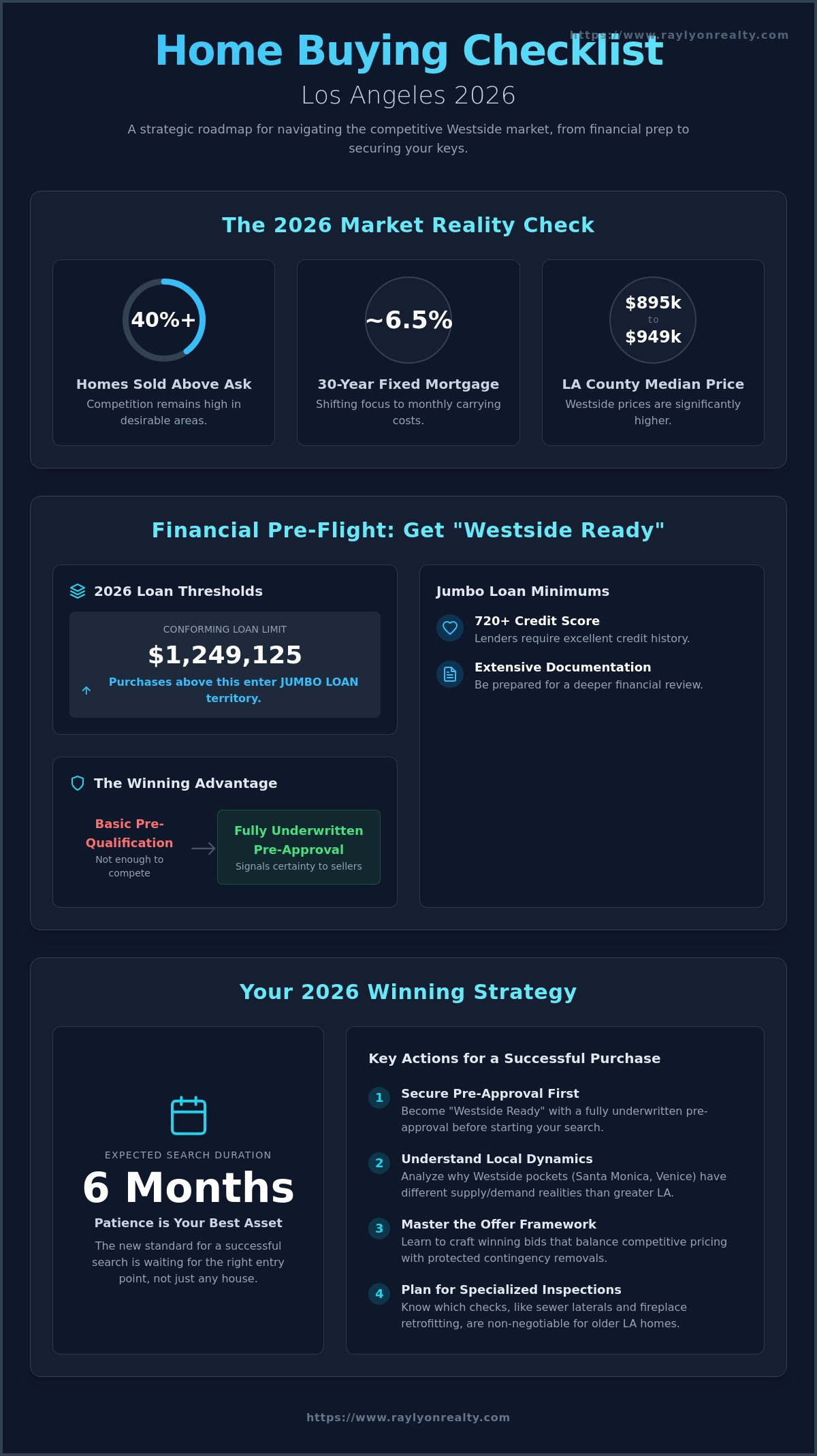
The 2026 market isn’t just about high prices; it’s about a fundamental lack of supply that keeps the Westside in a perpetual state of competition. While active listings have risen slightly to around 9,400 across the region, the most desirable pockets remain tightly held. This bottleneck is a direct result of California’s ongoing housing shortage, which continues to drive demand even as the market finds a more predictable rhythm. You’ll find that the median price for Los Angeles County currently sits between $895,000 and $949,000, but the Westside corridor operates on a different plane entirely.
Interest rates for a 30-year fixed mortgage are hovering near 6.5% in mid-2026. This has shifted the focus for many buyers from “how much can I borrow” to “how much can I actually carry month to month.” Even with these rates, over 40% of homes in the city sold above their asking price last month. Understanding this gap between list price and final sale price is the first essential step in your home buying checklist los angeles 2026. It’s about being tactical rather than just being hopeful.
To better understand how the rules of the game have shifted recently, watch this helpful guide for 2026 buyers:
Why the Westside Market Operates Differently
In neighborhoods like North of Montana or Venice, turnover is incredibly low. Families tend to stay for decades, and the influence of the tech and entertainment sectors keeps pricing resilient even when other areas cool off. You’ll notice that “days on market” stats, which currently average around 53 days, can be quite misleading here. A property might sit because of a specific seller’s price point, but anything that is “priced to move” will still see multiple offers within the first week. The Westside premium is real, and it’s driven by a lifestyle that remains the gold standard for LA living.
Defining Your 2026 Purchase Strategy
Patience is your best asset right now. The new standard for a successful search in the city is approximately six months. You aren’t just looking for a house; you’re waiting for the right entry point. Whether you’re hunting for a “fixer-upper” with sweat equity potential or a turnkey home, you need a strategy that accounts for the $1,249,125 conforming loan limit. If you’re looking above that, you’re in jumbo loan territory, which requires a higher level of financial readiness. Setting realistic expectations early on prevents burnout and ensures you’re ready to strike when the right opportunity appears.
Financial Pre-Flight: Getting “Westside Ready”
In the 2026 market, being “Westside Ready” is a specific status that separates serious contenders from casual lookers. It means you’ve completed the heavy lifting before you even step inside a Brentwood bungalow or a Santa Monica condo. In a landscape where 40% of homes still go for over the asking price, a basic pre-qualification letter isn’t enough to win. You need a fully underwritten pre-approval and a clear strategy for your liquid reserves. This financial preparation is the most critical item on your home buying checklist los angeles 2026 because it provides the certainty sellers crave.
Most Westside purchases now fall into jumbo loan territory because they exceed the 2026 conforming loan limit of $1,249,125. For these loans, lenders typically require a minimum credit score of 720 and significantly more documentation than a standard mortgage. You’ll also need to account for “The Hidden Three”: Measure ULA taxes, supplemental property taxes, and rising insurance premiums. While Measure ULA is a seller-paid transfer tax on sales over $5.4 million, its presence often shifts how luxury deals are structured. If you’re looking at entry-level options, you might find relief through specific Los Angeles First-Time Homebuyer Programs that can assist with down payments.
The Fully Underwritten Advantage
A fully underwritten pre-approval means a human underwriter has already verified your tax returns, assets, and income. It’s essentially a “cash-like” offer because the only remaining hurdle is the property itself. In 2026, Westside sellers prioritize certainty over the highest bid. If you can prove your loan is a sure thing, you might beat out a higher offer that hasn’t been through the underwriting gauntlet yet. To get the best 6.5% rates, keep your credit “frozen” during this time; don’t open new accounts or make large purchases that could spike your debt-to-income ratio.
Calculating Your Total Cash-to-Close
Your down payment is just the beginning of the story. You should budget between 2% and 5% of the purchase price for closing costs, which covers escrow fees, title insurance, and transfer taxes. There’s also the “Appraisal Gap Strategy” to consider. If you bid $1.3 million but the bank appraises the home at $1.25 million, you’ll need the cash to cover that $50,000 difference. Don’t forget the supplemental tax bill that arrives months after closing. It’s an often-overlooked expense based on the difference between the previous owner’s tax base and your new purchase price. If these numbers feel complex, consulting with a strategic Westside real estate expert can help you build a bulletproof financial plan before you start bidding.
Neighborhood Nuance: Finding Your Westside Pocket
Westside buying isn’t just about finding a house; it’s about identifying the specific micro-market that fits your lifestyle and financial goals. While broader resources like HUD’s guide to buying a home provide a solid foundation for any transaction, they can’t capture the street-level nuances of LA’s coast. In 2026, your home buying checklist los angeles 2026 must prioritize neighborhood-specific data like school ratings and ADU (Accessory Dwelling Unit) zoning potential. These factors don’t just dictate your quality of life; they are the primary drivers of long-term property value in a supply-constrained environment.
The “Walkability Factor” remains the biggest draw for Westside buyers. Comparing Santa Monica to Venice is a perfect example of how two adjacent areas can offer vastly different experiences. Venice provides an eclectic, high-energy environment with a unique architectural mix. Santa Monica offers a more structured, polished coastal standard. Both are highly walkable, but the choice between them often comes down to whether you prefer the grit and creativity of Abbot Kinney or the refined atmosphere of Montana Avenue. Understanding these distinctions is what helps you narrow your search from “the Westside” to a specific three-block radius.
Santa Monica: The Coastal Standard
Santa Monica remains the gold standard for coastal living, but it’s essential to understand the micro-neighborhoods. Sunset Park offers a classic neighborhood feel with slightly larger lots and a quiet atmosphere. Ocean Park is for those who want to be steps from the sand and the energy of Main Street. Because the inventory is so tight here, you’ll want to review our Santa Monica Real Estate: 2026 Home Buyer’s Guide. Successfully closing in this area often requires a seasoned Santa Monica realtor who can surface off-market opportunities before they hit the general market.
Mar Vista: The Westside’s Best Kept Secret
Mar Vista is the 2026 “sweet spot” for buyers. It’s the preferred alternative for those who want proximity to the beach without the premium price tag of Santa Monica. Check out our Mar Vista, Los Angeles: A Complete Neighborhood Guide to see why streets like Grandview or Mountain View are so coveted. The lots here are often perfectly sized for ADUs, which is a major trend in 2026 as owners look for ways to offset higher mortgage payments with rental income. If you’re looking in Mar Vista Los Angeles, pay close attention to school district boundaries; a one-block difference can impact your resale value significantly.
The 2026 Winning Bid Checklist
Winning a home in the current market requires more than just a high number on a page. Your home buying checklist los angeles 2026 must include a tactical offer framework that balances price with the seller’s need for speed and certainty. While over 40% of homes still see bids over the list price, the winner is often the buyer who makes the process easiest for the person on the other side of the table. This means looking beyond the purchase price and considering levers like escalation clauses and seller rent-backs. An escalation clause can keep you competitive without overpaying, but it’s the non-financial terms that often seal the deal in Westside multi-offer scenarios.
The “Seller Rent-Back” has become a powerful tool in 2026. Because inventory remains tight, many sellers are hesitant to list their homes because they haven’t secured their next property yet. By offering a 30 to 60-day rent-back, you give them the breathing room they need to find their next move. This often carries more weight than an extra $10,000 in the purchase price. It shows you’re a partner in the transaction, not just a buyer. Combined with a strategic approach to contingencies, this creates a compelling package that stands out in a crowded inbox.
Tactical Lever 1: Shortening the Escrow
In a multi-offer scenario, time is your best currency. While the typical financed escrow in Los Angeles takes 30 to 45 days, a 21-day close can be a game-changer. It signals to the seller that your financing is rock solid and you’re ready to move. This requires tight coordination with your lender for “express” processing, which is only possible if you’ve already completed the fully underwritten pre-approval we discussed earlier. The real estate agents in los angeles ca you choose to represent you make a massive difference here. A listing agent is much more likely to trust a 21-day timeline if it’s backed by a team with a reputation for closing on time.
Tactical Lever 2: Strategic Contingencies
Contingencies are meant to protect you, but they can also be roadblocks for sellers. In 2026, the “Inspection for Information Only” approach is a smart middle ground. It means you still perform your due diligence, but you agree not to ask for small repairs under a certain dollar amount. This gives the seller peace of mind that the deal won’t fall apart over a leaky faucet. Additionally, you must have a clear plan for the appraisal contingency. If you’re bidding above the list price, explicitly stating how much of an appraisal gap you’re willing to cover in cash can make your offer significantly more attractive than one that’s contingent on the full bank valuation. If you want to refine these tactics for a specific property, talk to our Westside strategy experts to build a custom bid that wins.
Escrow to Keys: The Final 30 Days
The final 30 days of escrow are where your theoretical purchase becomes a tangible reality. It’s often the most intense part of the home buying checklist los angeles 2026 because this is when you discover the true condition of the property. In Los Angeles, the “inspection gauntlet” is legendary. You aren’t just looking for leaky faucets; you’re diving into specialized reports for sewer laterals, fireplace retrofitting, and mold, as well as thorough assessments from HVAC Inspections Los Angeles to ensure the home’s climate systems are up to par. Los Angeles city ordinances are strict about things like low-flow toilets and seismic gas shut-off valves. Ensuring the seller has met these requirements before the final walk-through is essential for a smooth transition.
While the inspectors are crawling through the attic, you should be reviewing the Preliminary Title Report with a fine-tooth comb. Older Westside homes often come with decades of history that can manifest as “red flags” on your title. Look for unrecorded easements, old solar panel liens, or boundary disputes that might have been settled with a handshake forty years ago. Your goal during this period is to ensure that the “as-is” condition you agreed to in the contract matches what is actually being delivered. This is also the time to coordinate the “hand-off” of smart home systems and utility accounts. Transferring ownership of solar panels or smart irrigation systems can be a digital headache if not handled during the escrow period.
Inspection Red Flags Specific to LA
If you’re looking at hillside properties in Santa Monica Canyon or Topanga, foundation stability is your number one priority. The geological history of these areas means specialized drainage and retrofitting are often necessary to protect your investment. In flatter neighborhoods like Mar Vista, tree root intrusion into the main sewer line is a common and costly surprise. Always insist on a specialized 2026 termite and moisture report. Termites are a fact of life in Southern California, but you want to know exactly what you’re inheriting before you sign the final papers. Identifying these issues early gives you the leverage to ask for credits or repairs before your contingencies are removed.
Closing Day Logistics
Closing day involves more than just a signature. Wiring funds safely is the most critical step. Wire fraud scams have become increasingly sophisticated, so you should never trust wiring instructions sent via email without calling your escrow officer on a verified number to confirm. You’ll likely have the choice between a mobile notary or visiting the escrow office in person. Many Westside buyers prefer the convenience of a mobile notary who can meet at their office or current home. Remember, you don’t get the keys the second you sign. In California, the “moment of truth” happens only after the deed is officially recorded at the County Recorder’s office, which usually occurs late in the afternoon on your closing day once the county confirms the transfer.
Take the Next Step Toward Your Westside Home
Securing a home in the current climate requires more than just a high credit score; it demands a tactical approach to a market that rewards preparation and speed. By now, you’ve seen that the key to winning lies in becoming “Westside Ready” through fully underwritten pre-approvals and understanding the specific nuances of neighborhoods like Santa Monica and Mar Vista. This home buying checklist los angeles 2026 is your foundation, but the right partnership is what truly turns a bid into a closed escrow. You’ve learned how to navigate the inspection gauntlet and use tools like seller rent-backs to gain a competitive edge.
Once the papers are signed and you’ve officially joined the ranks of LA homeowners, the next step is often celebrating your new chapter. For those looking to host a high-end housewarming or milestone gathering, you can explore Main Event Hall at Serra On Vine for a sophisticated backdrop in Hollywood.
As a top 1% Westside brokerage, we bring deep expertise to every transaction. My personal history in property renovation and investment means we don’t just see a listing; we see the potential risks and the hidden value. We’re here to ensure you’re financially protected while securing exclusive opportunities in LA’s most resilient micro-markets. Ready to refine your search? Download our Exclusive 2026 Westside Buyer Strategy Guide and let’s get to work. Your dream home is within reach when you have the right roadmap in hand.
Frequently Asked Questions
How much cash do I really need for a down payment in Los Angeles in 2026?
You typically need between 3% and 20% of the purchase price for a down payment, depending on your loan type. For a median priced home of $900,000, a 20% down payment is $180,000. You must also budget for closing costs, which average 2% to 5% of the price. This means you should have approximately $200,000 to $225,000 in liquid reserves for a standard Westside purchase.
What is Measure ULA and how does it affect me as a buyer?
Measure ULA is a transfer tax on high value real estate sales that primarily impacts sellers of properties priced above $5.4 million. As a buyer, you don’t pay this tax directly, but it affects the local market’s inventory and pricing strategy. Some sellers may be less willing to negotiate on price to offset the 4% or 5.5% tax hit they take at the close of escrow.
Is it possible to buy a home in Santa Monica for under $1.5 million?
Yes, it is possible to find properties under $1.5 million in Santa Monica, but your options will mostly be limited to condos and townhomes. Single family homes at this price point are nearly non-existent in the 2026 market. To find value, focus your search on the eastern edges of the city or look for smaller units in the Sunset Park neighborhood where entry level options occasionally appear.
Should I get a 30-year fixed or an ARM in the 2026 LA market?
Most buyers in 2026 are choosing 30-year fixed mortgages to lock in rates that currently hover around 6.5%. While an Adjustable-Rate Mortgage (ARM) might offer a slightly lower introductory rate, the unpredictability of future adjustments makes the fixed option more attractive for long-term owners. Securing a stable monthly payment is a vital step in your home buying checklist los angeles 2026 to ensure financial protection.
What are the red flags to look for in a Mar Vista home inspection?
The most common red flags in Mar Vista involve aging sewer lines and unpermitted work. Many homes in this area feature original clay pipes that are susceptible to root intrusion from the neighborhood’s mature trees. You should also verify that any “bonus rooms” or garage conversions were completed with proper permits. This ensures the property meets current 2026 safety standards and won’t cause issues during a future resale.
How long does the average home buying process take in Los Angeles right now?
The total process usually takes about six months from your first showing to getting the keys. This includes a median search time of several months and a standard 30 to 45-day escrow period for financed buyers. Following a structured home buying checklist los angeles 2026 helps keep this timeline on track, especially when you need to act quickly in competitive Westside neighborhoods where homes sell fast.
Do I need a local Westside realtor, or can any LA agent help me?
A local Westside realtor is highly recommended because they possess granular knowledge of coastal micro-markets and access to off-market opportunities. Real estate in Santa Monica or Venice involves unique zoning and retrofitting rules that an agent from the Valley or Downtown might not know. Having an insider who understands the “street-level” demand gives you a significant advantage when crafting a winning bid.
What happens if the home appraises for less than my offer price?
If the appraisal comes in low, you’ll need to cover the “appraisal gap” with cash or negotiate a lower price with the seller. In a market where 40% of homes sell above asking, many buyers proactively include an appraisal gap clause in their offer. This tells the seller exactly how much extra cash you’re willing to bring to the table if the bank’s valuation doesn’t match your bid.