

You’ve spent months searching, and you finally found the perfect California home. But when you look at the monthly payment estimate, the numbers don’t add up. It’s hundreds of dollars higher than you expected based on the home’s price. This is the exact moment most buyers first ask: what are mello-roos taxes in california? It’s a frustrating surprise that can make a dream home feel like a financial trap if you aren’t prepared for the extra line item on your tax bill.
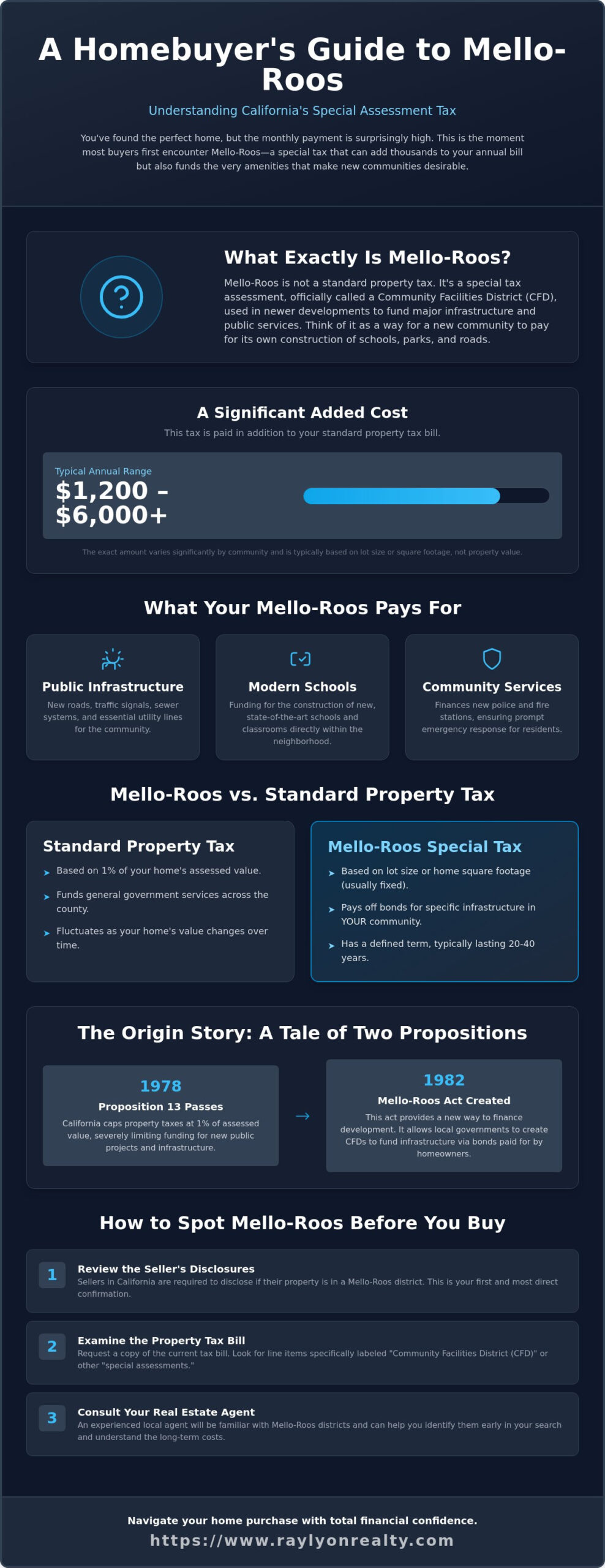
I understand how stressful it is to feel like you’re losing control of your housing budget. You deserve to know exactly where your money is going and whether that extra cost is actually buying you a better quality of life. In this 2026 guide, I’m going to demystify this misunderstood tax and show you how it impacts your home’s long term value. We’ll explore typical costs, which often range from $1,200 to $6,000 annually, and I’ll give you the tools to find this information before you ever make an offer. By the end, you’ll have the confidence to decide if a specific house is the right fit for your family and your wallet.
Key Takeaways
- Understand how Community Facilities Districts (CFDs) fund the modern schools, parks, and roads that define California’s newest neighborhoods.
- Learn exactly what are mello-roos taxes in california and why they’re a standard part of new construction after Proposition 13 limited traditional revenue.
- Evaluate the long-term impact on your home’s resale value by balancing modern community perks against increased monthly mortgage payments.
- Master the step-by-step process for spotting special assessments on a tax bill so you can bid with total financial confidence.
- Explore why specific Los Angeles developments rely on these bonds and how to determine if the extra tax is worth the investment.
Understanding Mello-Roos Taxes in California: The Basics
When you start browsing listings in newer neighborhoods, you’ll likely encounter a term that catches many buyers off guard. If you’re wondering what are mello-roos taxes in california, you’re looking at a special tax assessment district, officially known as a Community Facilities District (CFD). It’s a way for local governments and developers to fund the essential infrastructure that makes a new community livable. When you buy a home in one of these areas, you aren’t just paying for your house; you’re contributing to the collective cost of the surrounding amenities. Mello-Roos is a supplemental tax used by California developers and local governments to bypass traditional funding limits.
These funds don’t just disappear into a general government pot. They’re earmarked for specific, tangible improvements within your immediate neighborhood. This usually includes:
- Modern schools and classrooms
- Local parks and recreational trails
- New roads and traffic signals
- Police and fire stations
- Essential utility lines and sewer systems
To see how this works in a real-world setting, watch this helpful breakdown of local tax considerations:
The Legal Foundation: The 1982 Community Facilities Act
The formal name for this mechanism is the Mello-Roos Community Facilities Act. It was named after Senator Henry Mello and Assemblyman Mike Roos, who drafted the legislation in 1982. The act was born out of necessity. After Proposition 13 passed in 1978, local governments found themselves with a massive funding gap because property taxes were capped at 1% of assessed value. Without a way to pay for new infrastructure, development would have stalled. This law shifted the burden of infrastructure costs from the general public directly to the residents who benefit from those specific improvements.
Mello-Roos vs. Standard Property Taxes
If you’re asking what are mello-roos taxes in california, it’s likely because you noticed your tax bill is higher than the standard 1% you expected. In California, base property taxes are limited to 1% of the assessed value plus any local voter-approved bonds. A Mello-Roos assessment is an additional “special tax” that sits on top of that base rate. Unlike standard taxes that fluctuate with your home’s value, Mello-Roos is often based on lot size or square footage. These districts are typically formed through a two-thirds vote of landowners. In many cases, the landowner is actually the developer who owns the vacant land before homes are built. This allows them to establish the tax to fund the necessary sewers and roads for the upcoming housing tract before a single resident moves in.
The Origins and Mechanics: Why Does Mello-Roos Exist?
To understand the mechanics of these assessments, we have to look back at 1978. That was the year California voters passed Proposition 13. This landmark law capped property taxes and made it much harder for local governments to raise funds for public projects. As the state’s population boomed, cities faced a dilemma. They needed new schools and roads to support housing growth, but they didn’t have the cash to build them. This is where the Mello-Roos Community Facilities Act stepped in to fill the gap.
When a developer wants to build a new housing tract, they often don’t have the tens of millions of dollars required for sewers, parks, and utility lines. Instead of the developer paying these costs upfront and baking them into a much higher home price, they work with the local government to issue bonds. These bonds provide the immediate capital needed for construction. When you purchase a home in one of these districts, your “special tax” payments go toward paying off the principal and interest on those bonds.
This is precisely why you’ll find these charges in master-planned communities but rarely in established coastal cities. For example, when looking at Santa Monica real estate, you’ll notice Mello-Roos is almost non-existent because the infrastructure was built and paid for decades ago. If you’re currently weighing the benefits of a modern development versus a historic neighborhood, it’s helpful to consult with a local expert who can run a side-by-side cost analysis for you.
How Long Do You Have to Pay Mello-Roos?
A common fear among buyers is that this tax will last forever. In reality, these bonds have a defined lifespan, typically ranging from 20 to 40 years. This is the time required to repay the bondholders. Every district has a “Sunset Clause” that identifies the specific year the tax is scheduled to expire. Once the debt is fully retired, the tax should disappear from your bill. You should always verify if a small administrative fee remains for ongoing maintenance of the facilities after the bond is paid off.
Administrative Fees and Escalation Clauses
You should also be aware that your payment might not stay flat. Many districts include an escalation clause, which allows the tax rate to increase by up to 2% each year. This helps the district keep up with the rising costs of maintaining public spaces and schools. Before signing a contract, always check the “Maximum Tax” allowed for your specific parcel. This ensures you aren’t hit with payment shock if the district decides to levy the full authorized amount in the future. Gaining a clear understanding of what are mello-roos taxes in california requires looking at these fine-print details before you commit to a 30-year mortgage.
Evaluating the Impact: Pros, Cons, and Resale Value
Buying a home with special assessments is a balancing act between lifestyle and budget. While the extra monthly charge can be a shock, it’s helpful to look at what you’re getting in return. Many of California’s top-rated school districts and most meticulously maintained parks exist precisely because of these funds. When you ask what are mello-roos taxes in california, you have to consider if you’re willing to pay a premium for a “turnkey” neighborhood where the roads are smooth and the local elementary school is state-of-the-art.
The impact on your lifestyle is often immediate, but the financial trade-offs require a closer look. Here are the primary factors to weigh:
- Pro: Access to brand-new schools and modern parks that are often safer and better equipped than those in older areas.
- Con: Higher monthly “carrying costs” that don’t go toward your principal balance.
- Pro: Superior local infrastructure, meaning fewer “surprise” bond measures on future ballots for basic repairs.
- Con: Potential for slower equity growth if the tax burden is significantly higher than neighboring, non-taxed communities.
Appraisers are required to consider the total tax rate when valuing a property. If your home has a 1.7% effective tax rate due to Mello-Roos, but a similar home a mile away is at 1.2%, the appraiser may adjust your home’s value downward to account for that higher cost of ownership. However, this is often offset by “amenity value.” If the tax funds a prestigious school, buyers are usually happy to pay the extra amount, which keeps demand and resale prices high. If the amenities don’t stand out, a high tax can make the home harder to sell.
The Trade-off: Infrastructure vs. Expense
Think of Mello-Roos as an alternative to buying an older home that needs $100,000 in infrastructure repairs. In many older California neighborhoods, you might avoid the special tax but face crumbling sewer lines or outdated facilities. In new developments, you pay for that modernity through your tax bill instead of a massive renovation loan. You have to decide if the $300 to $500 monthly “amenity fee” fits your long-term financial goals.
Impact on Mortgage Qualification
Lenders don’t ignore these assessments. They include them in your PITI (Principal, Interest, Taxes, and Insurance) calculation, which directly impacts your Debt-to-Income (DTI) ratio. A $4,000 annual Mello-Roos tax can reduce a buyer’s purchasing power by roughly $50,000 because that money is diverted from your maximum allowable mortgage payment. To stay competitive, some buyers look for homes where the bond is nearing its sunset date or they negotiate a lower purchase price to offset the monthly tax burden.
How to Identify and Calculate Mello-Roos on Your Property Tax Bill
Finding out exactly how much you’ll owe doesn’t have to be a guessing game. While the base property tax in California is straightforward, the special assessments can be buried in the fine print. To get a clear picture of what are mello-roos taxes in california for a specific property, you need to look past the sales price and dive into the tax records. You can follow these five steps to ensure you aren’t surprised by a high bill after closing.
- Check the “Special Assessments” section: On a sample or actual tax bill, look for the section labeled “Direct Charges” or “Special Assessments.” This is where supplemental taxes live.
- Search for keywords: Look for acronyms like “CFD” (Community Facilities District) or names that include “Bond” or “Infrastructure.” These are the hallmarks of a Mello-Roos district.
- Review the Preliminary Title Report: During escrow, your title company will provide a report that lists every lien and special tax attached to the land. Read this document carefully.
- Use the County Auditor-Controller’s website: You can search by the Assessor’s Parcel Number (APN) on your county’s official website to see the exact breakdown of current charges.
- Consult a professional: Reach out to an experienced real estate broker in Los Angeles who can pull a detailed tax history for you.
If you want to move forward with total clarity on your monthly costs, request a custom tax analysis for your target neighborhood today.
Reading the Fine Print on a Property Listing
Don’t rely solely on the data you see on public real estate portals. Many MLS listings omit the Mello-Roos amount or list a generic figure that might be years out of date. You should always insist on seeing the Natural Hazard Disclosure (NHD) report early in the process. This report is legally required in California and will explicitly state if the property is within a Mello-Roos district. If you see the phrase “Buyer to verify taxes” in the agent remarks, take it as a red flag. It often means the agent knows there’s a special assessment but hasn’t done the legwork to find the exact amount.
Calculating the “Total Effective Tax Rate”
To understand your true carrying cost, you need to calculate the “effective tax rate.” This is the total percentage of the purchase price you’ll pay in taxes each year. Most people assume a 1.25% rate is safe, but in Mello-Roos districts, this can easily reach 1.5% to 1.7%. For instance, consider a case study comparing a Mar Vista Los Angeles home to a new build in nearby Playa Vista. The Mar Vista home, being an established neighborhood, likely stays near a 1.2% effective rate. The Playa Vista property, however, could have multiple CFDs that push your effective rate significantly higher. Knowing this difference helps you compare the true “apples-to-apples” cost of two different homes.
Navigating Mello-Roos Districts: A Strategic Guide for LA Buyers
In the Los Angeles market, your search for a home will eventually lead you to neighborhoods where the tax bill looks a bit different. If you’re looking at modern developments in the Santa Clarita Valley or tech-focused hubs like Playa Vista, you’ll find that special assessments are the norm. Understanding what are mello-roos taxes in california is vital in these areas because they fund the very amenities that draw people to these communities in the first place. My goal is to make sure you never experience “payment shock” after the keys are in your hand.
We use a strategic approach to protect your interests during the search. This starts with a deep dive into the tax records of every property you’re considering. If a home has a high Mello-Roos assessment, we use that data as leverage during negotiations. If your monthly carrying cost is $500 higher than a similar home nearby, that’s a powerful argument for a lower purchase price. We want the seller to offset that long-term tax burden so your total monthly payment remains competitive and fair.
You also have to think about your “exit strategy.” When you eventually decide to sell, the next buyer will be asking the same questions you are today. We help you buy at a price point that accounts for the tax, ensuring that your resale value remains protected even in high-assessment districts. It’s about finding the sweet spot where the quality of the neighborhood justifies the extra line item on your bill. A well-maintained community with modern schools can often command a higher price, even with the extra tax.
Local Expertise: Where We See Mello-Roos in Westside LA
Playa Vista is the most prominent example of modern CFD financing on the Westside. It’s a community built from the ground up with parks, schools, and infrastructure funded by bonds. In contrast, established areas like Beverly Hills California homes are typically exempt from these specific charges because their infrastructure has been in place for a century. However, we are seeing a trend of “infill” developments in older neighborhoods. Small clusters of new homes may carry new special assessments to pay for updated utility lines or street improvements required by the city.
How We Help You Make a Confident Decision
Our process is designed to give you total clarity. We pull property tax histories before you ever write an offer, so you know exactly what the “total effective tax rate” will be. We also connect you with specialized lenders who understand how to calculate Mello-Roos within your debt-to-income requirements. This ensures your loan approval is solid from the start. Don’t let the complexity of California taxes scare you away from a great home. When you have the right data, you can make a decision based on facts rather than fear. Contact Ray Lyon Realty today to get a custom tax analysis for any Westside property you’re eyeing.
Take the Next Step Toward Confident Homeownership
You now have the tools to look past the surface of a listing and understand the true cost of ownership. By recognizing that these assessments fund the very schools and parks that drive long term value, you can stop viewing them as a hurdle and start seeing them as a strategic investment. Most bonds eventually sunset after 20 to 40 years, meaning your monthly payment could drop significantly once the local infrastructure is fully paid off. Gaining a clear grasp of what are mello-roos taxes in california is the first step in avoiding expensive surprises during escrow.
I bring deep expertise in the Santa Monica and Mar Vista markets, backed by personal experience in property ownership and flipping. I provide every client with a strategic pricing and tax analysis to ensure your investment is sound from day one. Looking for a home in Westside LA? Let us help you navigate the taxes and find your dream home. Your perfect property is within reach, and with the right data in hand, you’ll have the confidence to make it yours.
Frequently Asked Questions
Is Mello-Roos tax tax-deductible on my federal returns?
Mello-Roos taxes are generally not deductible on your federal income tax returns. The IRS views these as assessments for local benefits that increase the value of your property rather than general taxes. For the 2026 tax year, the federal SALT cap has increased to $40,000. Even with this higher limit, these specific assessments usually don’t qualify for a deduction. You should always consult with a tax professional to see how these rules apply to your specific financial situation.
Does Mello-Roos ever go away or expire?
Yes, these assessments are designed to expire once the underlying bonds are fully repaid. Most districts have a lifespan of 20 to 40 years. You can find the specific sunset date in your property’s Natural Hazard Disclosure report. Once the debt is retired, the bond portion of the tax disappears from your bill. Some districts might keep a much smaller fee for ongoing maintenance of the facilities, but the heavy bond payment will eventually stop.
Can I pay off my Mello-Roos bond early in a lump sum?
Most districts allow you to pay off your portion of the Mello-Roos bond early in a single lump sum. This effectively removes the special tax from your annual property tax bill for as long as you own the home. You’ll need to contact the district administrator to request a payoff quote for your specific parcel. While it requires a significant upfront investment, it can lower your monthly carrying costs and make your home more attractive to future buyers.
What happens if I don’t pay my Mello-Roos taxes?
Failure to pay these taxes leads to a significantly faster foreclosure process than standard property tax delinquency. Mello-Roos districts have the legal authority to initiate judicial foreclosure within just a few months of a missed payment. Regular property taxes often have a multi-year grace period, but bondholders require timely payments to satisfy the debt. It’s critical to treat these assessments with the same priority as your primary mortgage payment to protect your home equity and ownership.
Is Mello-Roos the same thing as an HOA fee?
No, Mello-Roos is a public tax assessment, while an HOA fee is a private charge from a homeowners association. Mello-Roos funds large scale public infrastructure like schools, roads, and fire stations. HOA fees typically cover private amenities like community pools, clubhouses, and gate security. You might live in a neighborhood that has both, which can significantly increase your total monthly housing costs. Understanding what are mello-roos taxes in california helps you distinguish between these two different financial obligations.
How much is a typical Mello-Roos tax in California?
Typical annual costs for these assessments range from $1,200 to $6,000 for most California homeowners. In 2026, it isn’t uncommon for homes in high-end developments or areas with significant school bonds to see charges exceeding $10,000. The amount is usually based on factors like the square footage of your home or the size of your lot. It isn’t a percentage of the home’s value, so it won’t decrease if the market value of your house drops.
Why do some houses in the same neighborhood have Mello-Roos while others don’t?
This happens because Mello-Roos districts are often formed in phases as a community expands. A home built in the first phase of a neighborhood might have been funded through different means, while the second phase required bonds to build a new elementary school. This creates a situation where two houses on the same street have different tax burdens. When asking what are mello-roos taxes in california, it’s important to check the specific parcel number rather than assuming the neighbors pay the same.
Can the Mello-Roos tax amount increase over time?
Yes, the tax amount can increase annually, often by a maximum of 2% per year. This escalation clause is built into the district’s formation documents to account for inflation and the rising costs of maintaining public facilities. You should check your property’s Maximum Tax rate to understand the highest possible amount the district can legally charge. Knowing this cap helps you plan your long-term housing budget and ensures you aren’t caught off guard by steady increases over the years.