
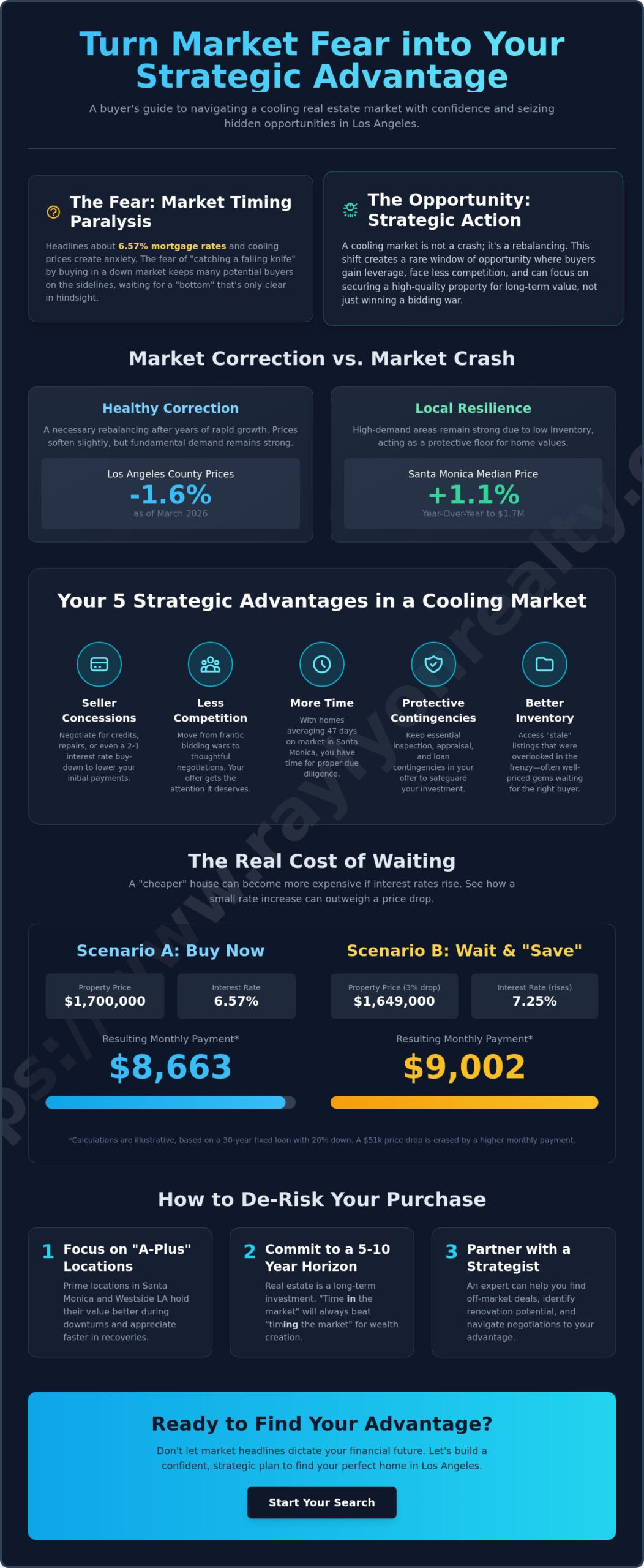
What if the market conditions currently causing you stress are actually your biggest competitive advantage? It’s completely normal to feel a sense of hesitation or even a genuine fear of buying a home in a down market when headlines are filled with talk of cooling prices and 6.57% mortgage rates. No one wants to feel like they’re catching a falling knife or making a financial error that they’ll regret in two years, especially with Santa Monica median prices still sitting around $1.7 million.
I understand that anxiety because I’ve seen it firsthand while helping clients navigate shifting landscapes across Los Angeles. We’re currently seeing a rebalancing where inventory is rising and buyers finally have some breathing room to negotiate. This guide will help you transform that market anxiety into a strategic plan by showing you how to identify real value in a cooling landscape. We’ll look at why “time in the market” beats “timing the market” and provide a clear framework to help you move forward with confidence when the right deal appears.
Key Takeaways
- Overcome the fear of buying a home in a down market by shifting your focus from timing the absolute bottom to securing a high-quality property while competition is low.
- Learn how to use increased buyer leverage to negotiate better terms and keep essential contingencies in place.
- De-risk your purchase by identifying “A-plus” locations and committing to a five-to-ten-year horizon to ensure long-term appreciation.
- Calculate the real cost of waiting, where even a slight interest rate increase can make a “cheaper” home more expensive in the long run.
- Discover the value of a strategic partner who can help you access off-market listings and spot renovation potential that others miss.
Understanding the Fear of Buying a Home in a Down Market
It’s natural to feel a knot in your stomach when considering a major purchase during a market shift. This “market timing paralysis” isn’t just for first-timers; even seasoned investors hesitate when the path forward isn’t a straight line up. The core fear of buying a home in a down market usually stems from the “falling knife” theory. This idea suggests that if you buy while prices are dipping, you’ll get cut by further losses immediately after closing. While that’s a valid concern for day traders, real estate is a different beast entirely.
In high-demand areas like Westside LA, this fear is often exaggerated by sensationalist media. National headlines might scream about a housing bubble, but the local reality in Santa Monica tells a more nuanced story. For instance, while national trends show a cooling period, the median sale price in Santa Monica actually rose 1.1% year-over-year to $1.7 million in May 2026. This disconnect between the “big picture” and your local neighborhood can create unnecessary anxiety that stalls your financial progress.
To better understand the psychological hurdles of entering the market, watch this helpful video:
The Psychology of “Waiting for the Bottom”
Many buyers convince themselves they’ll jump in once the market hits its absolute lowest point. The problem is that the “bottom” is only visible in the rearview mirror. By the time data confirms the market has turned, the best deals are usually gone. This often leads to the “Spring Bounce,” where a sudden surge of sidelined buyers returns to the market at once, reigniting bidding wars. When you let the fear of buying a home in a down market dictate your timing, you risk missing the window where you actually have the most leverage over sellers.
Market Correction vs. Market Crash
It’s essential to distinguish between a healthy price cooling and a systemic collapse. Most experts view the current shift as a necessary part of real estate market cycles rather than a 2008-style crash. In Los Angeles County, prices were down only 1.6% as of March 2026, which is a minor correction after years of record growth. Santa Monica and the Westside remain resilient because inventory stays incredibly low. With only 165 homes sold in Santa Monica in May 2026, the scarcity of available properties acts as a protective floor for home values, shielding your investment from broader economic volatility.
The Strategic Advantages of a Cooling Real Estate Market
While the fear of buying a home in a down market keeps many on the sidelines, it creates a unique opening for those who understand the shift. In a hot market, you’re competing against twenty other offers and often paying well over the asking price. Today, you’re likely sitting across a negotiation table rather than fighting a bidding war. In Santa Monica, homes are staying on the market for an average of 47 days, up from 43 last year. This extra time allows you to breathe. You can perform real due diligence without the pressure of a 24-hour deadline.
The lack of competition means you don’t have to waive every protection just to get a seller’s attention. You can keep your inspection and appraisal contingencies in place, which is vital for protecting your investment. This shift in power is your biggest asset. It allows you to focus on the long-term value of the property rather than just the stress of winning the bid.
Negotiating Seller Concessions
When competition drops, your leverage rises. Sellers who need to close are becoming more open to concessions that were unthinkable two years ago. One of the most effective strategies is asking for a 2-1 interest rate buy-down. This allows the seller to pay a fee that lowers your mortgage rate for the first two years of the loan. Since the national average for a 30-year fixed mortgage is currently 6.57%, this can save you thousands in the short term. You can also push for repair credits or upgrades. In a cooling market, the “as-is” sale becomes a rarity rather than the rule, giving you the chance to address property issues before you move in.
Access to Better Inventory
A cooling market reveals “stale listings” that are actually hidden goldmines. These are often great properties that were simply overpriced at the start. As days on market increase, reaching 53 days on average in Westside LA, sellers become more motivated. Experienced real estate agents in los angeles ca know how to spot these opportunities before they undergo a formal price cut. Identifying a seller who needs to move for non-economic reasons, like a job transfer or family change, can lead to a much better deal.
This environment also encourages “off-market” activity. Some sellers are hesitant to list publicly when they see headlines about a downturn. By working with a team that has deep local roots, you gain access to these quiet listings. This allows you to secure a deal without the pressure of a public clock. If you want to see what is currently available away from the public eye, you can explore our exclusive local listings to find your next home.
How to De-Risk Your Purchase in Santa Monica and Westside LA
Overcoming the fear of buying a home in a down market often comes down to narrowing your focus from the macro-economy to the specific street corner. While national news reports may paint a broad picture of cooling prices, Westside Los Angeles operates within its own set of rules. De-risking your purchase starts with targeting “A-plus” locations. In Santa Monica, neighborhoods like North of Wilshire have historically held their value even when other regions dipped. These areas are characterized by high demand and extremely limited land, which creates a natural price floor for your investment.
Another essential strategy is adopting a five-to-ten-year horizon. Real estate is a long-term wealth builder, not a day-trading vehicle. If you plan to hold the property for at least five years, short-term market fluctuations become minor noise rather than a financial crisis. You can also actively build equity through “forced appreciation.” By identifying homes that need cosmetic updates rather than structural overhauls, you can increase the property’s value immediately, regardless of what the broader market is doing. This proactive approach ensures you aren’t just waiting for the market to lift your home’s value.
Neighborhood Resilience: Santa Monica vs. Mar Vista
Santa Monica and Mar Vista are often considered “insulated” micro-markets because of their proximity to Silicon Beach. The steady influx of high-paying tech jobs provides a consistent pool of buyers and renters. When you look at mar vista los angeles, you see a neighborhood that has remained stable through multiple economic cycles due to its central location and community appeal. The land value on the Westside is so high that the actual structure often represents only a fraction of the total price. This means your investment is backed by one of the most desirable patches of earth in the country.
Investment Property Strategies in a Down Market
A cooling market is actually a prime time to execute a 1031 exchange. You can move out of a lower-performing asset and into a superior location while competition is thin. It’s also a great time to hunt for “Trust Sales” or estate sales. These sellers often prioritize a quick, clean transaction over squeezing out every last dollar, which can lead to significant savings. If you’re worried about mortgage payments, remember that rental demand in Los Angeles remains incredibly high. With the Los Angeles Rent Stabilization Ordinance setting allowable rent increases at 3% through June 2027, you have a predictable safety net that can help cover your carrying costs if your life plans change unexpectedly.
The Math of Waiting: Why the “Bottom” Can Be Expensive
Overcoming the fear of buying a home in a down market requires looking at the hard numbers rather than emotional headlines. Many buyers fixate on the purchase price, hoping it will drop another 5% or 10%. However, they often ignore the “holding cost” of waiting. In Santa Monica, where the median price sits at $1.7 million, waiting twelve months to find the absolute bottom could mean paying $60,000 or more in non-recoverable rent. That’s capital that could have gone toward your own principal pay-down and tax deductions instead of someone else’s mortgage.
History favors those who prioritize time in the market over timing the market. Those who waited for a “better deal” in 2012 or 2020 often found themselves priced out as the market surged unexpectedly. By the time the data confirms a market has hit the bottom, the best opportunities have usually already passed. Buying when competition is low allows you to secure the asset itself, which is the only part of the equation you can’t change later.
Rent vs. Buy in Los Angeles
Current rental trends in Westside LA show that housing costs aren’t cooling as fast as sale prices. With the Los Angeles Rent Stabilization Ordinance capping annual rent increases at 3% through June 2027, your monthly outflow as a tenant is guaranteed to climb. Homeownership allows you to lock in your largest monthly expense while benefiting from mortgage interest deductions that renters simply miss out on. Equity growth is a function of time spent in the property, not just short-term market fluctuation.
Interest Rates and Purchasing Power
The relationship between price and interest rates is the most critical math for any buyer to understand. A 1% drop in home price is frequently offset by a mere 0.5% rise in interest rates. For example, if you wait for a $100,000 price drop on a Westside home but mortgage rates move from 6.57% to 7.07%, your monthly payment stays nearly identical. You’ve essentially waited a year and paid significant rent for no actual monthly savings.
This is why many savvy investors choose to “marry the house and date the rate.” You buy the property at today’s lower competition price and plan to refinance when rates become more favorable. If you wait until rates drop to 5.5%, a new wave of buyers will likely flood the market, reigniting bidding wars and pushing prices back up. To see how these numbers apply to your specific financial goals, contact our team for a personalized market analysis.
Navigating the Los Angeles Market with a Strategic Partner
The math we discussed earlier proves that waiting is often a losing game, but executing a purchase requires more than just a calculator. You need a real estate broker los angeles who treats your residential purchase with the same analytical rigor as an multi-million dollar investment. When the fear of buying a home in a down market starts to creep in, a strategic partner provides the objective data and local context needed to quiet that noise. This isn’t about just finding a house; it’s about identifying an asset that will serve your financial future.
In a cooling market, the best opportunities are rarely found on the public MLS. With Santa Monica sales down to 165 homes in May 2026, the public inventory can feel stagnant. We bridge that gap by providing access to off-market “pocket listings” and quiet sales where competition is non-existent. Our approach combines hyper-local data with a deep understanding of property potential, ensuring you negotiate from a position of strength. We don’t just look at what a house is today; we look at what it can become through strategic improvements. To understand how professional teams analyze such opportunities, you can visit Steve Kooner & Associates and review their home evaluation criteria.
The Ray Lyon Advantage: Beyond the Transaction
Spotting a “good buy” goes beyond surface-level aesthetics. Because I have years of personal experience in property development and renovation, I look at homes through a builder’s lens. I can spot a structural red flag or a hidden renovation opportunity that a typical agent might miss. This investor-level analysis helps us identify “under-market” gems in neighborhoods like Venice and Santa Monica. We don’t just hand you a set of keys. We connect you with our vetted network of specialists, from structural engineers to 1031 exchange experts, ensuring every angle of your transaction is covered with professional care.
Your Next Steps: From Fear to Action
Moving from the fear of buying a home in a down market to taking action starts with a change in perspective. Instead of a generic search, we help you set up a “Value-Based” property search that prioritizes equity potential and neighborhood resilience. This process begins with a no-pressure consultation to assess your specific goals and financial timeline. Whether you’re looking for a luxury listing or a strategic investment, our goal is to provide the clarity you need to move forward. Contact Ray Lyon Realty today to begin your Westside LA journey with a partner who has been in your shoes as both an owner and an investor.
Turning Market Uncertainty Into Your Greatest Advantage
Success in real estate often requires moving when others are stationary. By understanding that a cooling market provides the leverage and due diligence time that a hot market denies, you can stop letting the fear of buying a home in a down market stall your financial future. We’ve seen that the math of waiting often costs more in rent and lost equity than any potential price drop could save you, especially in resilient micro-markets like Santa Monica and Mar Vista. The current shift isn’t a reason to wait; it’s an invitation to negotiate from a position of strength.
Taking action doesn’t mean going it alone. You deserve a partner who brings investor-level data and renovation expertise to your residential search. Whether we’re identifying hidden potential in a property or providing access to exclusive off-market listings on the Westside, our goal is to ensure your purchase is a sound long-term asset. It’s time to move past the headlines and look at the actual opportunities waiting for you right now.
Ready to build a plan tailored to your specific goals? Schedule a Strategic Consultation with Ray Lyon Realty today. We’re here to provide the clarity and confidence you need to secure your place in the Los Angeles market.
Frequently Asked Questions
Is it better to buy a house in a buyer’s market or a seller’s market?
A buyer’s market is generally the best time to secure a high-quality property because you have more selection and less competition. In this environment, you have the leverage to negotiate price and keep essential contingencies in place. While a seller’s market might see faster immediate appreciation, it often forces you into compromises or bidding wars that can lead to overpaying.
What happens if I buy a home and the price drops next year?
A price drop only impacts your finances if you’re forced to sell immediately. If you maintain a five-to-ten-year horizon, short-term fluctuations are just noise on a chart. Real estate wealth is built through time in the market, and your fear of buying a home in a down market shouldn’t overshadow the fact that your principal pay-down and tax benefits continue regardless of paper value.
How do I know if the housing market has reached the bottom?
You won’t know the market has hit the bottom until prices start rising again and the data is visible in the rearview mirror. Waiting for the absolute lowest point is a gamble that often results in missing the window of opportunity entirely. Instead of chasing the bottom, focus on finding a “good buy” where the property’s value and location justify the price in any economic climate.
Can I negotiate the price down if a house has been on the market for a long time?
Yes, houses with high “days on market” are excellent opportunities for significant price negotiation. Sellers often become more motivated as time passes and they see fewer showings or offers. This is the perfect time to address the fear of buying a home in a down market by making a strategic offer that reflects the current lack of competition and the seller’s desire to move on.
Is Santa Monica real estate a safe investment during a recession?
Santa Monica is considered a highly resilient micro-market because of its extreme scarcity and proximity to major tech and entertainment hubs. While no investment is completely recession-proof, the high land value and limited inventory on the Westside provide a much stronger safety net than most suburban markets. Demand for coastal property remains remarkably consistent even during broader economic shifts.
What are seller concessions and how do they help buyers in a down market?
Seller concessions are financial contributions that a seller makes toward your closing costs or mortgage terms. These can include interest rate buy-downs or credits for property repairs that might have been ignored in a hotter market. In a cooling landscape, these concessions help you reduce your monthly payment or preserve your cash reserves, making the purchase more affordable from day one.
Should I wait for interest rates to go down before buying a home in LA?
Waiting for rates to drop can be a costly mistake because lower rates often trigger a sudden surge in buyer demand. When rates fall, prices typically rise as more people enter the market, which can lead to the return of aggressive bidding wars. It’s often smarter to buy at a lower price now and plan to refinance your mortgage when rates eventually become more favorable.
How does a down market affect my ability to get a mortgage?
A cooling market can lead to more conservative appraisals from lenders, but it also gives you more time to compare loan products. You won’t feel pressured to waive financial contingencies or accept the first loan offer you receive. This slower pace allows you to ensure your financing is solid and that the property’s appraised value aligns with your loan requirements before you commit.