

Imagine watching a perfect Santa Monica bungalow hit the market at the $2.2 million Westside median price, but your agent won’t return your texts for two days. Since California’s AB 2992 went into effect on January 1, 2026, you’re legally required to have a signed buyer-broker agreement before even touring a home, which can make you feel trapped in a bad professional marriage. If you’re worried about being sued for a 2.8% buyer’s commission or missing out on the competitive Westside market, you aren’t alone. It’s incredibly stressful to realize the person meant to protect your interests is actually standing in your way.
You deserve a strategic partner who moves as fast as the Los Angeles market does. This guide teaches you exactly how to fire your real estate agent in California without legal headaches or financial liability. We’ll walk through the specific C.A.R. termination forms, explain the mandatory 90-day maximum contract limit, and show you how to navigate the “protection period” so you can start fresh with a dedicated expert like Ray Lyon.
Key Takeaways
- Understand that your legal contract is actually with the Brokerage rather than the individual agent, which provides a specific path for resolving disputes or requesting a new representative.
- Learn why documenting a lack of communication or a failure to explain contract contingencies is essential for proving a breach of fiduciary duty in the Westside LA market.
- Discover the exact C.A.R. forms and legal steps for how to fire your real estate agent in california while protecting yourself from future commission claims.
- Identify how to navigate “protection periods” and “broker involvement” clauses to ensure a clean break without any hidden financial liabilities.
- Get a checklist of what to look for in your next agent, including “block to block” neighborhood knowledge and a proven track record of finding off-market opportunities.
Understanding the California Real Estate Contract Landscape
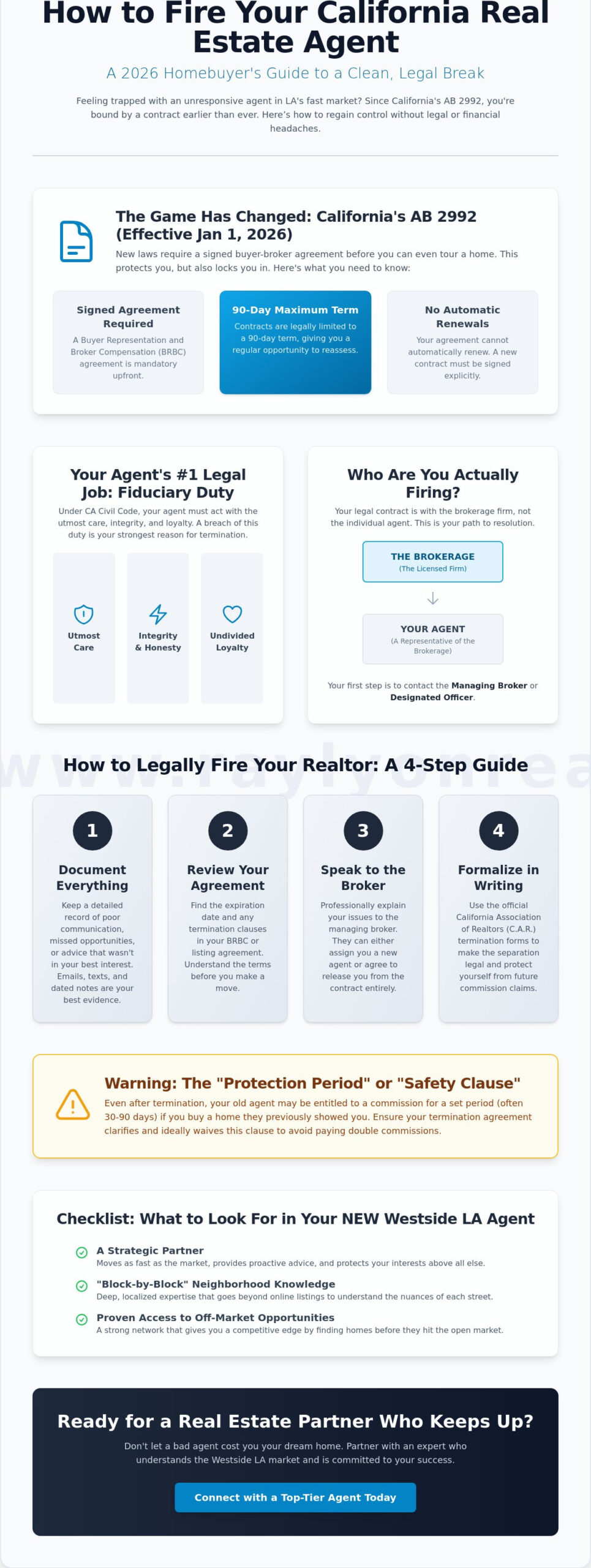
Since January 1, 2026, the California real estate market operates under strict transparency rules. You can’t even step inside a Westside open house with an agent anymore without a signed Buyer Representation and Broker Compensation Agreement (BRBC). This shift, codified by AB 2992, was designed to protect you, but it also means you’re legally bound to a professional much earlier in the process. Understanding the Law of Agency is the first step in regaining your freedom if that relationship isn’t working out.
When you sign that paperwork, you aren’t just hiring a person to show you homes. You’re entering a formal legal relationship where the agent acts as your proxy. If you’re wondering how to fire your real estate agent in california, you first need to look at the “Agency Disclosure” form you signed. This document outlines whether the agent represents you, the seller, or both. It’s the foundation of your rights as a consumer. Remember that as of 2026, these agreements are limited to a maximum 90-day term and cannot automatically renew. This gives you a natural “out” every three months if the service isn’t meeting your expectations.
To better understand this concept, watch this helpful video:
The Fiduciary Duty: Your Agent’s Legal Obligation
Under California Civil Code, your agent owes you a “fiduciary duty.” This isn’t just a suggestion; it’s a legal requirement to act with the utmost care, integrity, and loyalty. Think of it like the relationship you have with a lawyer or a doctor. If your agent is slow to respond, fails to disclose a property’s history of “thirdhand smoke” (a mandatory 2026 disclosure requirement), or pushes you toward a deal that isn’t in your best interest, they’ve breached this duty. A documented breach of fiduciary duty is often your strongest leverage for an immediate, penalty-free termination. It’s about protecting your equity and your peace of mind.
Agency vs. Brokerage: Who Are You Actually Firing?
One common misconception is that your contract is with the individual agent. In reality, your agreement is almost always with the Brokerage firm itself. The agent is simply a representative of that broker. If you’re unhappy, your first point of contact should be the “Designated Officer” or the Managing Broker. They have the authority to assign you a new agent within the same firm or release you from the contract entirely. The California Department of Real Estate (DRE) oversees these licenses, ensuring that brokers maintain professional standards across the state. Knowing how to fire your real estate agent in california often involves a professional conversation with the broker to explain why the current partnership isn’t a fit.
The 3 Main Types of California Buyer and Seller Agreements
Before you can plan your exit, you need to know exactly which document governs your relationship. In California, the forms provided by the California Association of Realtors (C.A.R.) are the industry standard. Whether you’re a buyer or a seller, your path to a clean break is written into the fine print of these agreements. Knowing which box was checked on your initial paperwork determines if you can walk away today or if you owe a 30-day notice period.
Most disputes arise because clients don’t realize the specific constraints of the “Safety Clause.” This clause protects the agent’s commission for a set period, often 30 to 90 days, after the contract ends. This is rooted in the California Civil Code on Termination of Agency, which outlines how and when an agency relationship officially concludes. If you’re learning how to fire your real estate agent in california, you must account for this period to avoid paying double commissions when you eventually close on a home.
Buyer Representation and Broker Compensation (BRBC)
The 2024 NAR settlement and the subsequent 2026 California mandates made the BRBC form a daily reality for buyers. You likely signed this before your first property tour. Look at Paragraph 2 to find your expiration date; remember that as of January 1, 2026, these cannot exceed 90 days. If your agreement is “Non-Exclusive,” you can typically terminate the relationship immediately with a written notice. However, “Exclusive” agreements usually require a 30-day window. If you’re unhappy with your current representation, it might be time to find a more responsive partner who prioritizes your search.
The Residential Listing Agreement (RLA) for Sellers
For sellers, the RLA is the primary contract. While the duration is negotiable, a six-month term is the standard in Los Angeles. If you’re frustrated by a lack of offers or poor marketing, check the “Termination of Agency” section. You should also understand the difference between “Withdrawal from Sale” and a full termination. Withdrawing your home from the market stops active showings, but the broker may still hold you to the contract until it expires. To get a fresh start with a new marketing strategy, you’ll need the agent to sign a “Cancellation of Listing” (COL) form, which officially releases the property from their brokerage.
Understanding these forms is the best way to ensure you don’t get stuck in a “zombie contract” that prevents you from moving forward. When you know the rules, you can make a clean break and focus on your next move with confidence. Knowing how to fire your real estate agent in california is simply a matter of following the contractual roadmap you’ve already signed.
Valid Reasons to Terminate Your Agent Relationship in 2026
Real estate transactions on the Westside of Los Angeles are high-stakes. With median home prices hitting $2.2 million in March 2026, you’re paying for a high level of expertise and responsiveness. If your agent isn’t delivering, you aren’t just dealing with a minor inconvenience; you’re risking a significant financial investment. Understanding how to fire your real estate agent in california starts with identifying whether their performance has fallen below the professional standards required by state law.
Common justifications for termination often involve a breach of fiduciary duty or a fundamental failure to execute the strategy you agreed upon. If you find yourself wondering how to fire your real estate agent in california, it’s usually because one of the following red flags has appeared:
- Undisclosed Dual Agency: If an agent represents both you and the seller without obtaining your explicit, written consent, they’ve violated California’s disclosure laws.
- Incompetence with Contingencies: Failing to explain the nuances of appraisal or loan contingencies can lead to a loss of your earnest money deposit.
- Ethical Breaches: Any lack of honesty regarding a property’s condition, such as the mandatory 2026 “thirdhand smoke” disclosures, is grounds for immediate termination.
Before making a final decision, it can be helpful to review a general guide on How to Fire Your Real Estate Agent to ensure you’re following industry best practices alongside your contractual obligations.
Communication Breakdowns and Missed Opportunities
In a market where homes sell in an average of 88 days but the best listings go in under 10, communication is everything. A “reasonable response time” in 2026 means getting a reply within a few hours, not a few days. If your agent is unresponsive, you’re likely missing out on off-market deals and “pocket listings” that never hit the MLS. Poor communication doesn’t just lose you homes; it creates chaos during escrow. When deadlines for inspections or disclosures are missed because your agent is silent, your deposit is at risk. This lack of resourcefulness is often the first sign that the relationship has reached its end.
Lack of Local Market Strategy
Westside Los Angeles requires “block-to-block” knowledge. An agent who doesn’t understand the price per square foot differences between Venice and Mar Vista isn’t providing the value you’re paying for. You need someone who knows how to spot a property with “deferred maintenance” versus one that just needs a little “lipstick” to shine. If your current agent’s strategy feels generic, it might be time to compare their approach against our Santa Monica Real Estate: 2026 Home Buyer’s Guide. Strategic misalignment is a perfectly valid reason to seek a partner who actually “practices what he preaches” through his own local investments.
Step-by-Step: How to Legally Fire Your Realtor Without Getting Sued
Firing a professional is never easy, but when you’re dealing with a $2.2 million Westside investment, you can’t afford to be sentimental. If you’re ready to learn how to fire your real estate agent in california, the process begins with a careful audit of your current agreement. You aren’t just making a phone call; you’re executing a contractual maneuver that requires paper trails and specific forms to protect your equity. Start by reviewing the “Termination” or “Cancellation” clause in your C.A.R. agreement. This section dictates whether you owe a 30-day notice or if you can walk away immediately based on non-performance.
Documentation is your best defense. Before you send a single email, gather your evidence. Note every time your agent missed a showing, failed to return a text within a reasonable four-hour window, or provided inaccurate data about a property’s “thirdhand smoke” history. If you’re learning how to fire your real estate agent in california because of a breach of fiduciary duty, these records are what will convince a Managing Broker to release you without a fight. Request a formal “Cancellation of Listing” (COL) form if you’re a seller, or the equivalent cancellation for buyer representation. Don’t settle for a verbal “it’s fine”; you need the broker’s signature to be legally free.
The ‘Procuring Cause’ Trap: Protecting Your Commission
The biggest risk in firing an agent is the “Procuring Cause” dispute. This happens when a fired agent claims they are the reason you found a specific home, and therefore, they deserve the 2.8% buyer’s commission. To avoid this, ask your outgoing agent for a written list of every property they showed you. This list defines their “protected properties.” If you buy a home that isn’t on that list, they have no claim to the commission. A formal “Termination of Agency” letter should explicitly state that the relationship is over and that no further broker involvement is authorized. This clarity prevents “zombie contracts” from haunting your next escrow.
Escalating to the Broker of Record
If your individual agent is being difficult, remember that your contract is actually with the brokerage. Send a professional email to the Managing Broker or the Broker of Record. Explain that the “strategic alignment” isn’t there and that you’re requesting an “Unconditional Release.” If the brokerage demands a “Cancellation Fee” to cover their marketing costs, you can often negotiate this down by highlighting the agent’s lack of performance. Most brokers would rather sign a release than risk a formal complaint with the DRE. If you’re ready to move forward with a team that values your time and provides a true competitive advantage, contact us to start your fresh search today.
Moving Forward: How to Find a Top-Tier Westside LA Agent
Once you’ve navigated the technicalities of how to fire your real estate agent in california, you’re finally free to find a partner who aligns with your financial goals. The Westside market is far too competitive for “generalist” agents who don’t live and breathe the local streets. You need a partner with block-to-block knowledge of neighborhoods like Mar Vista or Venice. In March 2026, where the median price per square foot on the Westside has reached $1,010, even a small neighborhood miscalculation can cost you six figures in equity. Look for a professional who treats your search with the same intensity they use for their own personal investments.
A top-tier agent in today’s market must be tech-forward and resourceful. Since homes on the Westside are currently selling in an average of 88 days, the best opportunities often happen behind the scenes. You want someone who has a proven system for finding off-market deals before they ever hit the MLS. For a deeper look at the local landscape, read our Real Estate Agents in Los Angeles CA: Your Ultimate 2026 Guide to see what standard of service you should expect.
Questions to Ask Your Next Realtor
Your next interview should be rigorous. Don’t settle for surface-level answers about sales volume. You need to know if they have the strategic depth to handle the complexities of the 2026 market. Ask these specific questions to gauge their expertise:
- What is your specific track record with 1031 exchanges or trust sales in the last 24 months?
- Can you explain your “off-market” networking strategy for finding pocket listings in Santa Monica?
- Do you have a vetted network of contractors who can quickly address deferred maintenance or maximize a property’s value before we list?
Why Ray Lyon Realty is the Strategic Choice
Ray Lyon brings a unique perspective to the table because he “practices what he preaches.” He isn’t just an agent; he’s a hands-on expert who has flipped properties, managed rentals, and built his own family home from the ground up. This personal experience means he knows exactly how to spot a “diamond in the rough” or when a property just needs a bit of “lipstick” to command top dollar. We believe in being approachable and down-to-earth while maintaining a highly successful, business-savvy edge for our clients. Now that you’ve learned how to fire your real estate agent in california, it’s time to work with a team that makes you their top priority.
Contact Ray Lyon Realty today for a confidential consultation and let’s get your real estate goals back on track.
Take Control of Your Westside Real Estate Strategy
You’ve done the hard work of navigating the legal landscape and the specific steps for how to fire your real estate agent in california. By auditing your C.A.R. forms and documenting performance gaps, you’ve protected your equity from unnecessary commission disputes. Now, you can focus on the goal that brought you here: finding a home in a market where the median price reached $2.2 million in March 2026. You deserve a partner who doesn’t just show houses but understands the structural integrity and investment potential of every property.
Ray Lyon brings a unique perspective as a local expert who has personally built homes and flipped properties across the Westside. His team provides the dedicated, results-oriented representation needed to win in competitive Santa Monica and Mar Vista micro-markets. Don’t let a poor professional fit stall your progress any longer. Ready for a better real estate experience? Connect with Ray Lyon Realty. We’re here to provide the patient, savvy guidance you need to secure your next investment with confidence.
Frequently Asked Questions
Can I fire my real estate agent before my contract expires in California?
Yes, you can terminate your relationship before the expiration date by following the cancellation procedures outlined in your C.A.R. agreement. For non-exclusive buyer agreements, this is often effective immediately upon receipt of written notice. Exclusive agreements usually require a 30-day notice period. Documenting a breach of fiduciary duty or a lack of communication can help speed up this process with the brokerage.
Do I have to pay my realtor if I cancel the contract and don’t buy?
In most cases, you don’t owe your realtor anything if you cancel and decide not to buy or sell. Real estate commissions are performance-based, meaning they are typically only paid out of escrow funds at the close of a successful transaction. Some listing agreements might include a specific fee to reimburse the broker for marketing costs, but these are negotiable and must be clearly stated in the signed contract.
What is the ‘Safety Clause’ in a California listing agreement?
The ‘Safety Clause’, also known as the protection period, is a section in the California Residential Listing Agreement that protects the agent’s commission after the contract ends. If you sell your home to a buyer whom the agent registered with you during the listing period, you may still owe them a commission. This period is negotiable but commonly lasts between 30 and 90 days after the official termination date.
How do I fire a buyer’s agent after signing a BRBC agreement?
To understand how to fire your real estate agent in california after signing a BRBC, you must provide formal written notice to the agent and their broker. Under AB 2992, which became law on January 1, 2026, these buyer agreements are limited to a maximum of 90 days and cannot automatically renew. Review your specific form to see if you are in an exclusive or non-exclusive arrangement, as this dictates your required notice period.
Can I switch real estate agents while I’m currently in escrow?
Switching agents while in escrow is technically possible but legally complicated. The agent who wrote the accepted offer is considered the “procuring cause” and is generally entitled to the commission once the deal closes. If you’re unhappy with your representation during escrow, your best move is to contact the Managing Broker to request a different agent within the same firm to finish the transaction.
What happens if my agent refuses to let me out of the contract?
If an individual agent refuses to release you, your next step is to contact the Broker of Record for their firm. Your legal contract is with the brokerage, not the individual person. Brokers are often willing to reassign you to a more compatible agent or sign an “Unconditional Release” to avoid a formal complaint with the California Department of Real Estate (DRE).
Is a text message sufficient to fire my real estate agent in CA?
A text message is rarely sufficient for the formal termination of a real estate contract in California. Standard C.A.R. forms require written notice delivered via email or a signed cancellation document to be legally binding. While a text can start the conversation, you should always follow up with a formal email to ensure you have a clear paper trail that protects you from future commission disputes.
How does ‘Procuring Cause’ affect me if I hire a new agent?
‘Procuring Cause’ determines which agent receives the commission based on who initiated the chain of events that led to the sale. If your former agent showed you a home that you later buy with a new agent, the first agent may claim the 2.80% buyer’s commission. To avoid this, always keep a record of every property your previous agent showed you and share that list with your new representative.