

On a Tuesday last October, a client of mine nearly closed on a stunning Brentwood unit before we uncovered a massive special assessment hidden in the HOA’s long term capital plan. It’s a stressful realization that many buyers face. Knowing exactly what to look for when buying a condo in LA is the only way to protect your savings and your sanity. You want the Westside lifestyle without the constant upkeep of a house, but you don’t want to be blindsided by noise issues or sudden fees.
I’ve built my own homes and managed rentals across the city, so I know that a fresh coat of paint can hide a lot of history. I’m going to show you how to look past the “lipstick” and evaluate a property like a seasoned investor. I promise to give you the tools to audit HOA financials and identify structural red flags, such as those related to the city’s mandatory 2015 soft story retrofitting ordinance. We will explore how to secure a stable investment while ensuring your new home actually fits your daily life in 2026.
Key Takeaways
- Learn why condos remain the premier entry point for the Westside market and how to evaluate an HOA as a micro-corporation you are investing in.
- Discover how to audit the “Big Three” financial documents—CC&Rs, Bylaws, and Reserve Studies—to ensure the building’s long-term fiscal health.
- Master exactly what to look for when buying a condo in LA by identifying structural red flags like soft-story retrofitting and mandatory balcony safety certifications.
- Gain a competitive edge with “block-to-block” neighborhood knowledge, including how micro-climates like the Marine Layer impact your daily lifestyle.
- Understand how to navigate the LA escrow process using strategic offer writing and essential contingencies to protect your investment in a high-stakes market.
Understanding the Los Angeles Condo Market in 2026
In the 2026 Los Angeles real estate landscape, a condo represents more than just a home; it’s a strategic entry into the city’s most high-demand neighborhoods. By understanding condominium ownership, you’ll see it involves owning your specific unit while sharing an undivided interest in common areas like lobbies, roofs, and pools. This structure remains the primary way many buyers secure a footprint on the Westside without the maintenance burden of a traditional house.
If you are researching what to look for when buying a condo in LA, you must first distinguish between property types. Unlike a single-family home, a condo simplifies your life, but it comes with specific rules. You’ll also encounter Tenancy in Common (TIC) units, which are popular in Silver Lake and Echo Park. TICs involve owning a fraction of a whole building rather than a specific parcel, often requiring specialized 20% down payment loans. Townhomes offer a middle ground, usually including the land beneath the structure, but condos remain the backbone of LA’s dense, urban corridors.
To better understand the fundamentals of this process, watch this helpful guide:
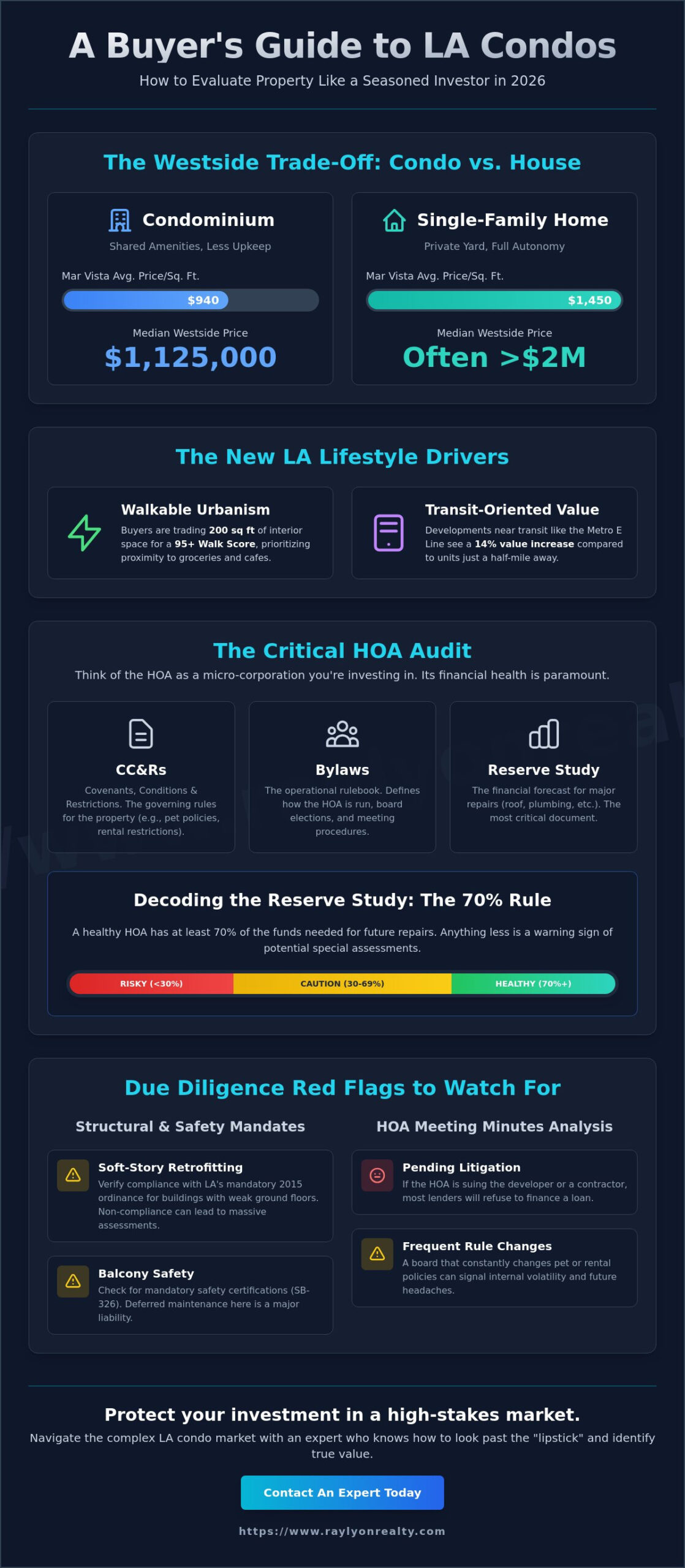
By 2026, we’ve seen a massive shift toward “walkable urbanism.” Modern buyers are consistently trading 200 square feet of interior space for a 95+ walk score. In neighborhoods like Culver City and West Hollywood, the proximity to high-end grocery stores and transit hubs is now a larger driver of appreciation than a second parking spot or a private yard.
Condo vs. Single-Family Home: The Westside Trade-off
Choosing a condo in neighborhoods like Mar Vista or Santa Monica often comes down to the lifestyle dividend. You trade the autonomy of a private yard for shared amenities like fitness centers and rooftop decks. In Mar Vista, the price-per-square-foot for condos in early 2026 averages $940, while single-family homes in the same ZIP code often exceed $1,450. According to data from the 2026 regional market report, the median price for a Westside condo has reached $1,125,000.
The Rise of Mixed-Use Developments
Silicon Beach has perfected the Live-Work-Play model through mixed-use developments. Living above retail spaces in Playa Vista or Venice offers instant access to coworking hubs and coffee shops. Transit-oriented developments (TODs) near the Metro E Line have seen a 14% value increase compared to units just half a mile further away. While living above a commercial space is convenient, always check the commercial lease terms in your building’s fine print. You don’t want to find out a quiet boutique is turning into a late-night lounge after you move in. Knowing what to look for when buying a condo in LA requires looking at the building’s entire ecosystem, not just your front door.
The HOA Audit: Evaluating the Building’s Financial Health
Think of an HOA as a micro-corporation where you’re becoming a shareholder. You aren’t just buying a kitchen and a bedroom; you’re buying into a business partnership with every other owner in the building. When you’re determining what to look for when buying a condo in LA, the financial stability of this “corporation” is paramount. You need to review the “Big Three” documents: the CC&Rs, the Bylaws, and the Reserve Study. These tell you how the building is run, what the rules are, and most importantly, if the association is broke.
Reviewing the last 12 months of meeting minutes is a non-negotiable step. Look for mentions of “pending litigation” or “construction defects.” If the HOA is currently suing a developer or a contractor, many traditional lenders will refuse to issue a mortgage for the unit. You should also watch for frequent, sudden rule changes. A board that changes pet policies or rental restrictions every six months can be a sign of internal volatility that might make your life difficult later on.
Decoding the Reserve Study
The Reserve Study is the most critical document in your due diligence. It’s a professional analysis of the building’s long-term components and the funds set aside to fix them. A healthy building usually follows the 70% rule, meaning they have at least 70% of the cash needed for projected repairs. If the funding level sits below 30%, you’re almost guaranteed a massive fee hike or a special assessment soon. Look for big-ticket items like elevator modernization or roof replacement scheduled within the next 24 to 36 months. If those projects are coming up and the cash isn’t there, you’ll be the one writing the check.
Special Assessments and Dues
Monthly dues cover the day-to-day bills like water, trash, and landscaping. Special assessments are one-time, often five-figure charges for major repairs. In older Los Angeles buildings, these are frequently triggered by outdated plumbing or mandatory safety upgrades required by Los Angeles building codes. For example, many buildings are currently grappling with SB 326 balcony inspections, which must be completed by January 1, 2025. If the seller mentions a “planned” vote for an assessment, assume it’s going to pass. Asking the right questions now prevents a $20,000 surprise after you move in. If this feels like a lot to track, working with an experienced local expert can help you spot these financial landmines before you sign.
LA-Specific Structural Red Flags and Safety Mandates
Buying a condo in Los Angeles requires a specialized lens. You aren’t just looking at the kitchen counters; you’re looking at the bones of the building and its compliance with strict local laws. Knowing what to look for when buying a condo in LA means understanding the specific mandates that protect your investment and your safety. In 2026, two specific safety requirements dominate the conversation: soft-story retrofitting and SB 326 balcony inspections.
The City of Los Angeles Mandatory Retrofit Program, under Ordinances 183893 and 184081, targets wood-frame buildings with “soft” first stories, typically where parking sits under the units. If a building hasn’t completed this work, you might face a massive special assessment shortly after closing. Similarly, Senate Bill 326 required all HOAs to complete their first elevated element inspections by January 1, 2025. When you tour a property, ask for the “Balcony Inspection Report.” If the building hasn’t addressed repairs flagged in that report, it’s a major red flag for both safety and future costs.
Parking is another structural factor that dictates resale value. In LA, side-by-side parking is the gold standard. Tandem spots, where one car blocks the other, often decrease a unit’s value by $15,000 to $25,000. Additionally, California’s “Right to Charge” laws mean HOAs can’t unreasonably prohibit EV charger installations, but you should check if the building’s electrical panel has the capacity for it. Modern buyers in 2026 view EV readiness as a necessity rather than a luxury.
Earthquake Readiness and Insurance
Don’t assume your building is covered for the “Big One.” Most LA condo associations don’t carry earthquake insurance because the premiums are incredibly high and the deductibles often hover around 10% to 20% of the building’s value. I always recommend that clients seek expert advice on buying a condo to understand how loss assessment coverage on an individual policy can fill this gap.
- Verify Compliance: Use the LA Department of Building and Safety (LADBS) website to search the property address for retrofit compliance certificates.
- Cost Sharing: Review the HOA meeting minutes to see if there’s a plan for sharing retrofitting costs. These are typically split based on unit square footage.
- Individual Policies: Ensure your personal HO-6 policy includes a high loss assessment limit to cover your portion of a building-wide earthquake deductible.
The Utilities and Systems Check
The LA climate is getting warmer, making your cooling system a top priority. Many older builds in neighborhoods like West Hollywood or Santa Monica still rely on wall units or “swamp coolers,” which are less efficient and noisier than central HVAC. If a unit lacks central air, investigate if the HOA allows for the installation of a modern heat pump system. It’s a significant upgrade for both comfort and property value.
Plumbing is the silent budget killer in buildings older than 30 years. If the building hasn’t undergone a full copper re-piping, it’s likely on the horizon. Ask the listing agent specifically about the history of leaks in the “stacks” or common area lines. Finally, for those working from home in the Westside or Silicon Beach, verify that the building is wired for high-speed fiber. Older buildings often have outdated copper wiring that limits internet speeds to levels that won’t support a modern professional’s needs.
The Westside Lifestyle Radius: Location Strategy
Success in the Westside market requires more than just a zip code. You need block to block knowledge. In neighborhoods like Mar Vista, the vibe changes completely within 500 feet. One condo building might face a quiet, tree-lined street while another sits right on a noisy corridor. This granular detail is a top priority for what to look for when buying a condo in LA. You should also consider the Marine Layer. This coastal fog doesn’t just block the sun; it naturally cools buildings within three miles of the ocean, potentially saving you 15 percent on summer cooling costs compared to inland units. However, it also means checking for moisture-resistant materials during your inspection to prevent mold issues common in high-humidity zones.
Focus on Mar Vista and Santa Monica
Mar Vista has become the residential sweet spot for buyers who want a community feel without the Santa Monica price tag. It offers a balanced mix of mid-century modern units and newer developments. For a deep dive into the specific pockets of this area, check out this Mar Vista, Los Angeles: A Complete Neighborhood Guide. Santa Monica remains the gold standard for luxury, but it comes with complex regulations. As of 2024, the city has strict seismic retrofit requirements. If you’re looking at an older Santa Monica condo, ask if the building has already completed its mandatory soft-story retrofitting to avoid surprise assessments that can cost owners $20,000 to $50,000 per unit.
Walkability and Transit Access
The Expo Line (E Line) changed the math for Westside real estate. Condos within a half-mile radius of stations like 26th St/Bergamot or Bundy Drive often see higher resale demand and faster appreciation. When evaluating what to look for when buying a condo in LA, don’t just trust a Walk Score. Walk the route to the nearest grocery store or coffee shop yourself at 7:00 PM to gauge safety and lighting. You also need to verify local short-term rental laws. Santa Monica’s 2015 Home-Sharing Ordinance essentially bans unhosted Airbnb stays under 30 days. If you plan to travel and rent out your unit, Mar Vista (under City of LA jurisdiction) offers slightly more flexibility, though it still requires a primary residency permit and a $92 annual fee.
Traffic remains the ultimate Westside variable. A commute from Santa Monica to Century City might only be 4 miles, but at 8:15 AM, it takes 25 to 35 minutes. Always check the Los Angeles ZIMAS portal for pending “Transit Oriented Communities” (TOC) projects nearby. A vacant lot or a single-story commercial building next door could become a five-story apartment complex by 2027, potentially erasing your sunset view and reducing your property value. I always tell my clients to look at the zoning of adjacent lots before they fall in love with a view.
Ready to find a Westside home that fits your daily routine? Contact us today to work with a local expert who knows the nuances of every Westside block.
Navigating the LA Escrow Process with an Expert
Once you find a unit that hits every mark on your wishlist, the real work begins. Escrow in Los Angeles is a fast-paced environment where a single missed deadline can cost you the deal. This is where you need a local realtor who practices what they preach. I’ve spent years flipping properties, building my own home, and managing rentals. That personal experience means I don’t just see a condo; I see the potential for deferred maintenance or structural red flags that others might miss.
Knowing what to look for when buying a condo in LA involves more than checking the view. It requires strategic offer writing. In a competitive 2026 market, you need to balance speed with protection. We often look at shortening appraisal and loan contingencies to 10 or 14 days to make your offer stand out. It’s about showing the seller you’re serious while still keeping your deposit safe.
The inspection period is your most powerful tool. A general home inspector is just the starting point. For an LA condo, you should hire specialists to look at the chimney (especially in older Westside buildings), the sewer line, and potential mold issues. If a building is 30 years old, those clay sewer pipes are likely reaching the end of their lifespan. Identifying these issues during your 10-day due diligence window is the difference between a smart investment and a money pit.
Negotiating Credits and Repairs
We use every piece of data available to protect your bottom line. This includes a deep dive into the HOA documents. If the reserve study shows the association is only 40% funded, we use that as leverage for a price reduction or a closing cost credit. I often recommend the “lipstick” strategy for savvy buyers. This means looking for condos with “good bones” but dated finishes. You can often get these for a better price, and with a few cosmetic updates, you’ll see immediate equity growth. To ensure you have the right team behind you, check out our guide on Real Estate Agents in Los Angeles CA: Your Ultimate 2026 Guide.
Final Walkthrough and Move-in Logistics
The final 48 hours of escrow are a whirlwind. During the final walkthrough, we verify that every agreed-upon repair is complete and the unit is in “broom clean” condition. We don’t sign off until we’re certain the seller has met their obligations. Beyond the paperwork, condo living has unique logistics. You’ll need to coordinate with building management at least a week in advance to book the freight elevator and pay any required move-in deposits. These small details ensure your first day in your new home is seamless. Ready to find your Westside oasis? Contact Ray Lyon Realty today.
Mastering the Los Angeles Condo Market in 2026
Buying a condo in 2026 requires more than just picking a view; it demands a deep dive into the building’s structural integrity and financial backbone. You’ve seen why auditing the HOA reserves and verifying compliance with California’s SB 326 balcony inspection mandates are non-negotiable steps. Understanding what to look for when buying a condo in LA means balancing the Westside lifestyle with a rigorous evaluation of the property’s bones. My personal experience flipping properties and building homes from the ground up gives me a perspective most agents simply don’t have. I look past the staging to find the real value or the hidden risks.
Success in this market relies on block to block knowledge and access to off-market condo opportunities that never reach the major search portals. We’ll navigate the complexities of the 2026 escrow process together, using my background to protect your interests at every turn. Whether you’re targeting Santa Monica or Century City, you need a strategy backed by real-world construction and investment expertise. Start your Westside condo search with Ray Lyon Realty to find a home that fits your life and your portfolio. Let’s make your Los Angeles real estate goals a reality today.
Frequently Asked Questions
Is buying a condo in LA a good investment in 2026?
Buying a condo in Los Angeles remains a strong investment because housing inventory continues to stay below a 3 month supply. The California Association of Realtors reported in late 2025 that demand for urban density is rising again. When you’re researching what to look for when buying a condo in LA, focus on areas with high walkability scores like West Hollywood or Silver Lake to ensure the best long term appreciation.
What is a “healthy” HOA fee for a Westside condo?
A healthy monthly fee typically ranges from $0.60 to $1.00 per square foot for a standard building. For a 1,000 square foot unit in Santa Monica, you should expect to pay between $600 and $1,000. If the fee is under $400, it often indicates the building is neglecting its reserve fund. High fees aren’t always a red flag if they include earthquake insurance or 24 hour security services.
How do I check if a building has completed its soft-story retrofitting?
You can verify a building’s status by searching the Los Angeles Department of Building and Safety (LADBS) online portal. Enter the property address into the “Property Activity Report” to see if the Mandatory Retrofit Program requirements are marked as “finaled.” Under Ordinance 183893, most vulnerable wood frame buildings had to complete these structural upgrades by 2025. It’s vital to confirm this so you don’t get hit with a surprise special assessment.
What is the difference between a condo and a TIC in Los Angeles?
A condo gives you a grant deed for a specific unit, while a Tenants in Common (TIC) purchase means you own a percentage of the entire building. TICs are popular in neighborhoods like Echo Park and usually cost 15% less than traditional condos. You’ll need a fractional loan from a specialized lender like Sterling Bank; most major national banks don’t offer financing for this specific ownership structure yet.
Are pets usually allowed in LA condo buildings?
Most LA condos allow pets because California Civil Code Section 4760 prevents HOAs from completely banning them. Associations can still limit the number of pets, often to two per unit, or set weight restrictions for dogs. Always review the building’s specific Rules and Regulations during your 10 day contingency period. It’s the only way to be 100% sure your specific breed is welcome in the common areas.
How much should I budget for closing costs when buying a condo in California?
You should budget between 1% and 3% of the total purchase price for your closing costs. If you’re closing on an $850,000 unit, expect to pay between $8,500 and $25,500 at the end of escrow. These fees cover your title insurance, escrow services, and initial HOA pro-rations. Understanding these numbers is a critical part of what to look for when buying a condo in LA so your cash reserves stay intact.
Can I rent out my condo immediately after buying it in LA?
You can usually rent your unit out, but California law AB 3182 allows HOAs to cap the total number of rentals at 25% of the units. While the association can’t stop you from leasing your property, they can put you on a waitlist if the building has already hit that 25% limit. Ask for the “Rental Roster” during escrow to see how many owners are currently leasing their units to tenants.
What happens if the HOA is sued while I am in escrow?
A pending lawsuit can stop your loan from being approved if it involves structural integrity or “construction defects.” Most lenders follow Fannie Mae guidelines which restrict funding for buildings with active litigation that exceeds the association’s insurance coverage. You’ll need your attorney or agent to review the “Litigation Disclosure” immediately. If the suit is a minor personal injury claim covered by insurance, your mortgage should still move forward.