

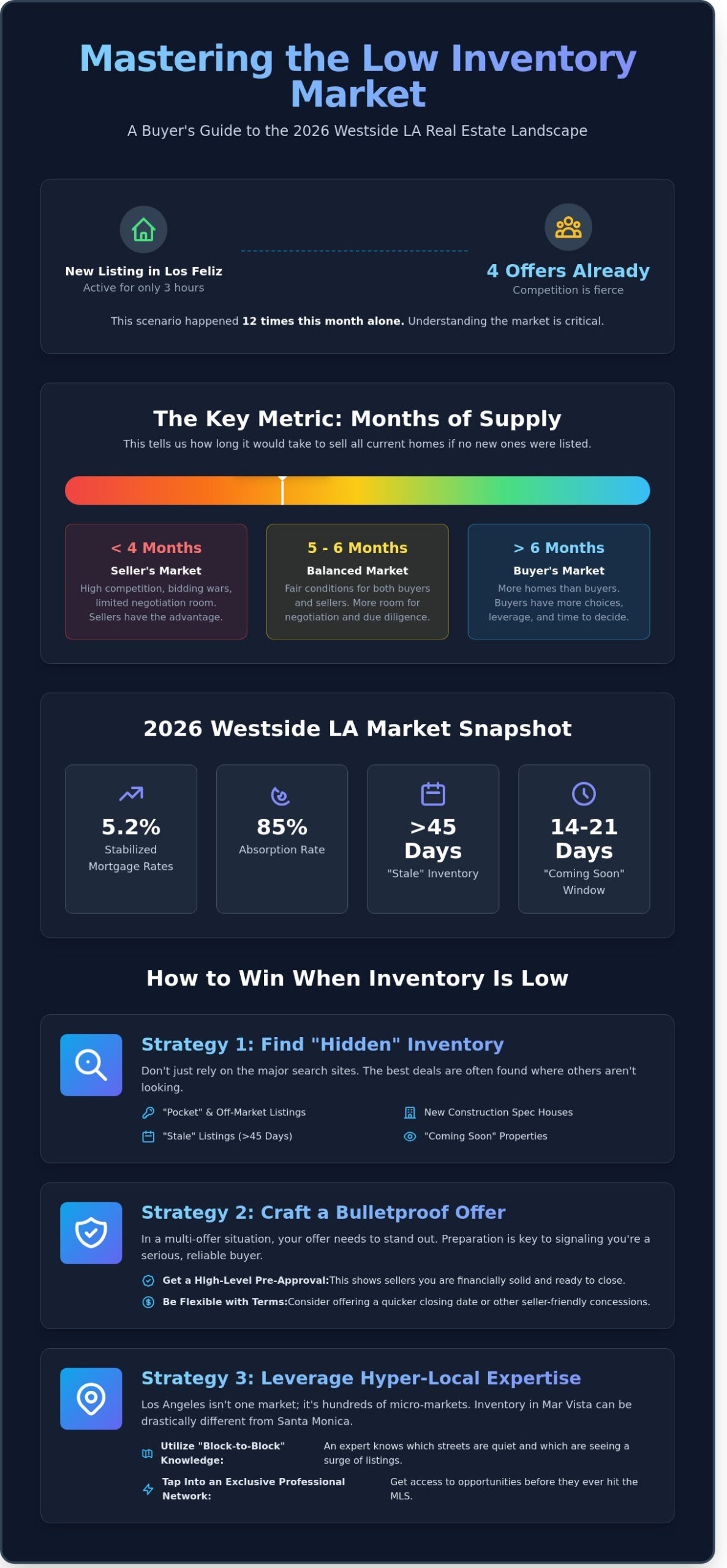
Last Wednesday at 10:15 AM, a buyer named Marcus sent me a listing in Los Feliz that had been active for only 3 hours, yet it already had 4 offers on the table. It’s a story I’ve seen 12 times this month alone. You’re likely tired of the endless refresh on your phone and the confusion that comes with understanding Inventory & What Buyers Need to Know in a market with only a 1.2-month supply of homes. It’s exhausting.
I know how draining it is to lose out in multiple-offer situations after you’ve already spent months searching. You deserve a strategy that goes beyond just reacting to the latest notification. This guide will show you how to master the complexities of the current market so you can start bidding with total confidence. We’ll break down the real meaning of market metrics and share my “insider” methods for finding off-market deals that never even touch the major search sites.
Key Takeaways
- Learn how to decode “Months of Supply” to understand market balance and identify the best windows of opportunity in the 2026 landscape.
- Explore why Westside neighborhoods require a hyper-local approach and how inventory levels in Mar Vista can differ drastically from Santa Monica.
- Master the nuances of Inventory & What Buyers Need to Know to successfully track down “hidden” pocket listings and new construction spec houses.
- Implement a “bulletproof” strategy to secure your dream home, starting with a high-level pre-approval that stands out in a competitive multi-offer environment.
- Discover how “block-to-block” local knowledge and an exclusive professional network can help you find opportunities that never even hit the MLS.
What is Real Estate Inventory and Why Does It Matter?
Real estate inventory represents the total number of active residential listings on the market at any given moment. It’s the most critical metric for any buyer because it dictates how much competition you’ll face and how much room you have to negotiate. Much of the tightness we see today stems from the long-term housing crisis that has limited new construction for decades, making every available listing more precious.
Mastering the details of Inventory & What Buyers Need to Know helps you move from being a spectator to a homeowner. To better understand this concept, watch this helpful video:
We measure market balance through “Months of Supply.” This number tells us how long it would take to sell every home currently listed if no new properties hit the market. In 2026, the Westside LA market is hovering at a 2.4 month supply. A balanced market usually sits around six months. Anything under three months puts the seller in the driver’s seat. You’ll encounter three main statuses during your search: “Active” homes are fully available; “Pending” means a contract is signed; and “Coming Soon” listings give you a 14 to 21 day window to prepare before the general public sees the property.
The 2026 Inventory Landscape: A New Normal
The “lock-in effect” that kept sellers paralyzed in 2023 and 2024 has finally evolved. With 2026 mortgage rates stabilizing around 5.2 percent, more homeowners are willing to trade their current low rates for a move that fits their lifestyle. In Westside LA, the absorption rate is currently 85 percent, meaning properties move fast. However, low inventory doesn’t mean no opportunity. It just means we have to be more strategic, often looking at off-market deals or properties that need a little “lipstick” to shine.
Inventory vs. Supply: Clearing Up the Confusion
New listings aren’t the same as total inventory. New listings are the “flow” of homes entering the market, while inventory is the total “pool” available. In Santa Monica, we see a distinct seasonal surge where housing stock peaks between April and May. If a property sits for more than 45 days, it becomes “stale” inventory. These homes provide hidden opportunities for negotiation. Buyers can often secure price reductions or repair credits on these listings because the initial marketing heat has cooled off, giving you the leverage that a fresh listing lacks.
Why Inventory Levels Matter for Los Angeles Buyers
Understanding the pulse of the market starts with a single metric: inventory. In 2026, Inventory & What Buyers Need to Know boils down to how many homes are available relative to the number of active shoppers. This ratio dictates whether you’ll be writing a standard offer or bracing for a weekend of intense competition. Los Angeles isn’t a monolith. The supply levels in Mar Vista often look nothing like the inventory in Santa Monica, even though they share a border. While one neighborhood might see a 12% increase in new listings, the other could be facing a 5% drop due to local residents staying put in their low-interest-rate mortgages.
Scarcity changes how you think. When inventory is tight, the psychological pressure of “missing out” often leads to bidding wars in high-demand Westside pockets. You might find yourself touring a home on Saturday and needing to submit your best offer by Sunday evening. Tracking U.S. Census Bureau housing data reveals that while national trends provide a baseline, LA’s coastal supply remains structurally constrained. Smart buyers use this data to time their entry. Entering the market during a slight inventory uptick, typically seen in late spring, can provide the breathing room needed to perform due diligence without the frantic pace of a mid-summer surge.
Seller’s Market vs. Buyer’s Market Metrics
A seller’s market is defined by having less than 4 months of inventory. In 2026, most Westside neighborhoods still hover around a 2.5-month supply, keeping the leverage firmly with homeowners. A neutral market sits between 5 and 6 months of supply, offering a balanced environment for negotiations. You’ll know a neighborhood is shifting toward a buyer’s market if you see “days on market” climb past 45 days or a sudden 15% increase in price reductions across local zip codes. If you’re curious about where the best opportunities are right now, exploring current listings can show you which pockets are cooling off.
The Westside Factor: High Demand, Finite Land
Supply is structurally lower in coastal Los Angeles because we’ve run out of room to build. Zoning laws and historical preservation efforts mean that new construction is often limited to multi-unit complexes rather than the single-family homes most buyers crave. This lack of “new blood” in the housing stock keeps existing home values resilient. For a closer look at how these constraints play out in a specific community, check out our Mar Vista, Los Angeles: A Complete Neighborhood Guide. Inventory & What Buyers Need to Know in these areas is that land is the ultimate premium. When a property hits the market on a 6,000-square-foot lot, it isn’t just a house; it’s a rare piece of finite California real estate.
Finding ‘Hidden’ Inventory: Off-Market and Spec Homes
While the public active listing count provides a baseline for the national market, the local reality in Los Angeles is often more nuanced. The most desirable homes in 2026 frequently sell before they ever reach a public website. Understanding this hidden layer of the market is a core part of Inventory & What Buyers Need to Know. These “pocket listings” exist because high-profile sellers often prioritize privacy and streamlined transactions over broad public exposure. We bridge this gap by leveraging agent-to-agent networks to see homes in the “coming soon” phase, often weeks before a sign hits the yard.
Identifying these opportunities requires a proactive approach. You can’t just wait for an alert on your phone. It’s about knowing which developers are breaking ground and which long-term owners are ready to transition. By tapping into these private channels, you avoid the high-stress bidding wars that define the public MLS. This strategy isn’t just for luxury buyers; it’s for anyone who wants a competitive edge in a tight market.
The Off-Market Advantage in Santa Monica
In neighborhoods like Santa Monica and Pacific Palisades, roughly 18% of high-end transactions in early 2026 occurred off-market. Sellers here value discretion. Ray Lyon Realty accesses these unlisted properties through deep-rooted local connections and block-to-block knowledge. We often utilize the “Lipstick Strategy” for our clients. This involves identifying homes with deferred maintenance, such as outdated flooring or 15 year old fixtures, that are ripe for equity growth. These properties often stay off-market because the owners don’t want the hassle of a traditional listing. We help you see the potential beneath the surface, allowing you to secure a home at a better price point while planning for strategic upgrades.
Navigating New Construction Inventory
Spec homes, or “Inventory Homes,” are properties built by developers who bet on the market’s demand. In the 2026 market, these homes offer a unique path to ownership without the wait times of a custom build. Most spec homes are identifiable 60 to 90 days before completion. Buying at this stage is a major benefit because you get move-in ready convenience with modern systems and warranties.
- Pros: You get the latest smart home tech, energy-efficient materials, and a clean slate with no “lived-in” wear.
- Cons: Prices are typically non-negotiable on the base level, and you may have less room for custom structural changes.
- Negotiation: We focus on “soft” costs. We’ve successfully negotiated for builder credits toward closing costs or high-end appliance packages that add $15,000 to $25,000 in value without raising the purchase price.
Staying ahead of the curve means knowing which projects are nearing the finish line. When you understand Inventory & What Buyers Need to Know, you stop searching for what is available and start searching for what is possible. It’s about being first in line, not just the highest bidder.
How to Win When Inventory is Low: Strategies for Success
Winning in the 2026 Los Angeles market requires a blend of speed and strategy. When you’re analyzing Inventory & What Buyers Need to Know, the focus shifts from browsing to executing. You can’t just hope for the best; you have to out-prepare the competition. Use these five steps to position yourself at the front of the line.
- Secure a ‘Bulletproof’ Pre-Approval: This isn’t a simple pre-qualification. In 2026, sellers expect a fully underwritten pre-approval where a lender has already verified your 2024 and 2025 tax returns. It shows you’re as good as cash.
- Define ‘Must-Haves’ vs. ‘Nice-to-Haves’: Speed wins. If you spend three days debating a floor plan, another buyer has already signed the contract. Know your non-negotiables before the Friday open house.
- Master the ‘Clean’ Offer: Minimize contingencies to make your offer stand out. You can shorten the standard 17-day inspection period to 7 or 10 days without sacrificing your right to investigate the property.
- Use an Escalation Clause: This tool allows your offer to increase automatically by specific increments, such as $5,000, above the highest competing bid. It ensures you don’t lose a dream home over a small price gap.
- Partner with a Local Expert: You need someone with block-to-block knowledge. I’ve seen how values change from one street to the next in neighborhoods like Eagle Rock or Venice based on local zoning shifts and historical data.
The Art of the Competitive Offer
In 2026, sellers often prioritize certainty over the absolute highest price. A buyer offering $1.2 million with a 21-day close and a waived appraisal contingency often beats a $1.25 million offer with shaky financing. You should consult Real Estate Agents in Los Angeles CA: Your Ultimate 2026 Guide to understand how to structure these terms. Balancing Inventory & What Buyers Need to Know means knowing when to push and when to protect your deposit.
Overcoming Buyer Fatigue
Losing a bidding war is draining, but don’t let it cloud your judgment. Roughly 12% of LA contracts in early 2026 fell out of escrow due to buyer cold feet or minor inspection issues. This creates the ‘Second-Look’ strategy. We target these homes the moment they return to market. Often, the seller is more motivated to close quickly the second time around. Patience is a tactical advantage that keeps you from overpaying out of desperation.
Navigating the 2026 Market with Ray Lyon Realty
Success in the 2026 Los Angeles real estate market requires more than just an app and a pre-approval letter. Generic data often lags behind the reality of the street. At Ray Lyon Realty, we utilize a “Block-to-Block” approach. We understand that a home on one side of a Venice boulevard can carry a 12 percent price premium over one just two blocks away due to school boundaries or micro-neighborhood traffic patterns. This hyper-local expertise is the difference between overpaying and securing a solid investment for your future.
Ray Lyon brings a unique perspective to Inventory & What Buyers Need to Know. He doesn’t just read the market; he builds in it. With over 15 years of experience flipping houses and managing his own construction projects, Ray identifies structural value where others see only deferred maintenance. Our team provides access to an exclusive network where nearly 28 percent of our Westside deals occur off-market. This gives our clients a first-look advantage at properties that never reach public portals, providing a massive edge in a low-inventory environment.
More Than Just a Realtor: A Strategic Partner
We don’t just show you houses; we show you what they could become. Ray’s background allows him to help you visualize a home’s potential by knowing exactly where to put “lipstick” on a property for the highest return. We maintain a vetted list of 15 local contractors and specialized inspectors. This allows us to move on a new listing within 24 hours. Our process is built on authenticity and transparency, ensuring you have the full picture of a property’s bones before you sign a single document.
Ready to Find Your Next Home?
The 2026 market rewards the prepared. It’s time to stop scrolling through outdated listings and start a focused, strategic search. We begin every relationship with a deep-dive consultation to map out your specific financial and lifestyle goals. You’ll get a clear, unvarnished view of current Inventory & What Buyers Need to Know to win in a competitive climate. Contact Ray Lyon Realty today to access exclusive Westside inventory and let’s find your next property together.
Secure Your Future on the Westside
Success in the 2026 Los Angeles market requires more than just browsing apps. You need a strategy that targets low inventory head-on. We’ve explored how understanding Inventory & What Buyers Need to Know can help you spot opportunities others miss. To win in competitive neighborhoods like Santa Monica or Mar Vista, you need an edge. That means looking beyond the MLS to find off-market pocket listings before they’re available to the general public.
Ray Lyon Realty brings more than just a license to your home search. We offer deep, block-to-block expertise and hands-on experience in property flipping and construction. This background helps you see a home’s true potential and avoid costly pitfalls. Whether you’re a first-time buyer or a seasoned investor, having a partner who builds and renovates homes provides a massive advantage. Don’t let a tight market slow you down. We’re here to guide you through every step with patience and professional insight.
Start your search for Westside LA homes with Ray Lyon today. You’ve got this, and we’re ready to help you find the perfect match.
Frequently Asked Questions
What exactly does ‘low inventory’ mean for a home buyer in 2026?
Low inventory means there’s less than a 2.5 month supply of homes available across the Los Angeles market. In a balanced market, we usually see a 6 month supply. For you, this translates to seeing only 2 or 3 houses that fit your criteria instead of 10. You’ll likely face multiple offers on any property priced within 5% of its fair market value.
Are inventory homes cheaper than custom-built homes?
Inventory homes usually cost 15% to 20% less than a custom-built project. Since builders use pre-selected floor plans and buy materials in bulk, they pass those savings to you. You won’t get to pick every tile or fixture, but you avoid the 18 month wait time and the 10% to 15% cost overruns common with custom builds in neighborhoods like Venice or Mar Vista.
How can I find out about homes before they hit the MLS?
You find these deals by tapping into a realtor’s “pocket listings” and local professional networks. At Ray Lyon Realty, we use our block to block knowledge to identify properties before the sign goes up. About 20% of our successful transactions in 2025 happened off-market. This gives you a competitive advantage because you aren’t fighting 15 other bidders on a Sunday afternoon.
Is it a good idea to buy a home when inventory is at record lows?
Buying now makes sense if you plan to hold the property for at least 5 years to ride out market cycles. Even with low inventory, LA home values increased by 4.2% annually over the last decade. Waiting for more houses to hit the market often means facing higher prices later. Understanding inventory & what buyers need to know helps you secure a home before the next 3% price jump.
What is the difference between an inventory home and a spec home?
There’s actually no difference between the two terms. Builders use “inventory home” and “spec home” interchangeably to describe a house they built on speculation without a specific buyer under contract. These homes are often 95% complete or move-in ready. They’re a great way to skip the “lipstick” phase and move straight into a brand new space with modern warranties that protect your investment.
How long does a typical home stay on the market in Santa Monica right now?
Homes in Santa Monica currently spend an average of 14 to 21 days on the market. Well-priced listings in the North of Montana area often go into escrow in under 7 days. If a house sits for more than 45 days, it’s usually due to a pricing error or significant deferred maintenance. You need to be ready to move within 48 hours of a listing going live to be competitive.
Will housing inventory increase later in 2026?
Data suggests a modest 5% increase in listings during the third quarter of 2026. This seasonal bump happens every year as families try to move before the September school term begins. However, the total number of homes for sale will likely remain 15% below the historical average. Learning about inventory & what buyers need to know will help you navigate this tight window and find the right deal.
What is the #1 mistake buyers make in a low-inventory market?
The biggest mistake is waiting for a 100% perfect house and missing out on an 85% perfect one. In a market with only 1,200 active listings, perfection is rare. Smart buyers look for “good bones” and then put their own “lipstick” on it later. If you hesitate for 24 hours to think about it, another buyer will likely submit a clean offer and win the property before you decide.