
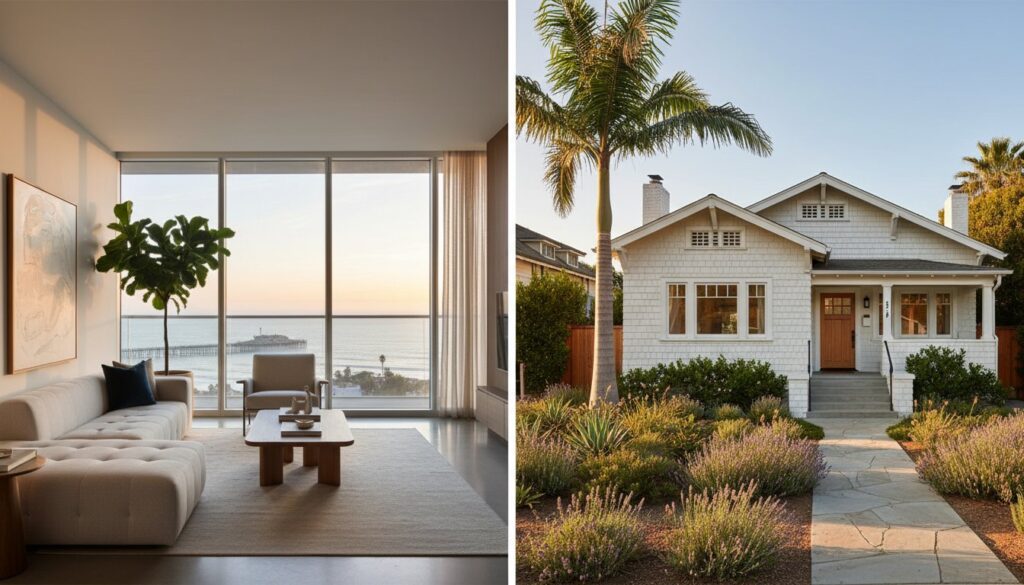
The $5,000 monthly HOA fee on a luxury Ocean Avenue condo could actually outperform a North of Montana bungalow by the time 2026 rolls around. Choosing between a Santa Monica Condo vs House: Best Investment in 2026 isn’t just about the floor plan anymore; it’s about outsmarting a market where the Measure GS “Mansion Tax” applies to any sale over $5.11 million. You probably feel the weight of these high entry prices and the shrinking inventory in prime pockets like Sunset Park or Ocean Park. It’s a lot to juggle when you’re just trying to secure your piece of the Westside.
I’ve spent years flipping properties and building my own home here, so I know that a “good deal” on paper can quickly vanish under a surprise special assessment or a shifting cap rate. This guide gives you a professional breakdown of ROI and tax implications so you can stop guessing and start growing your equity. We will look at how specific neighborhoods favor different property types and how to find off-market deals that never hit the public portals.
Key Takeaways
- Understand how inventory constraints and the “New Normal” of Westside pricing will shape your Santa Monica Condo vs House: Best Investment in 2026 acquisition strategy.
- Discover the “Dirt Value Thesis” to see why single-family homes remain the gold standard when analyzing a Santa Monica Condo vs House: Best Investment in 2026 for long-term equity.
- Determine if a Santa Monica Condo vs House: Best Investment in 2026 is right for your portfolio by comparing immediate rental yields against land appreciation.
- Uncover the “hidden math” of carrying costs and how the Measure GS “Mansion Tax” could significantly impact your Santa Monica Condo vs House: Best Investment in 2026 exit strategy.
- Gain a competitive edge using the “lipstick” strategy and off-market insights to maximize your Santa Monica Condo vs House: Best Investment in 2026 value with institutional precision.
The 2026 Santa Monica Real Estate Landscape: Why the Choice Matters Now
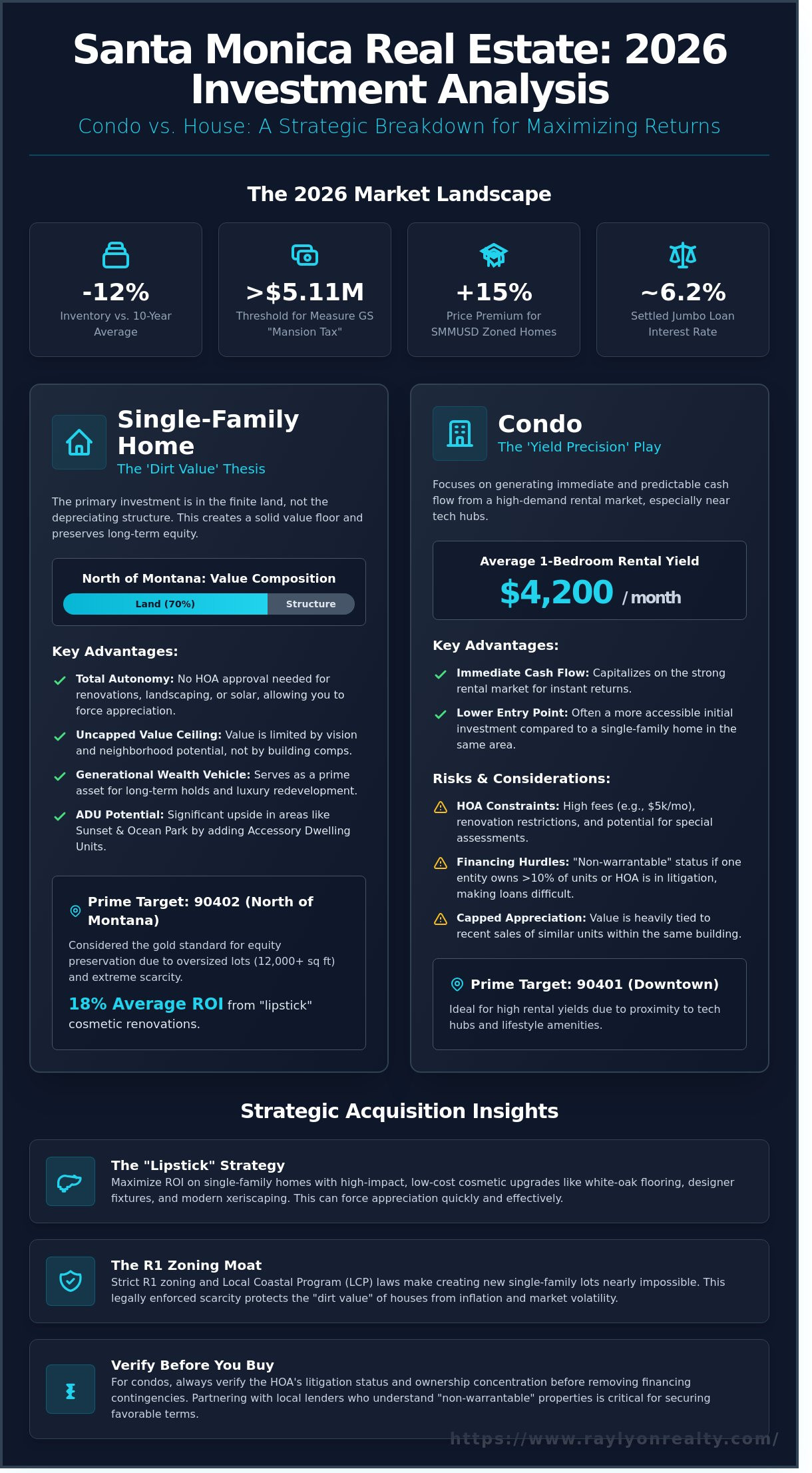
Santa Monica in 2026 is a market defined by extreme scarcity. Total inventory levels have remained 12% below the ten-year average, creating a “New Normal” where Westside pricing is driven by necessity rather than speculation. Deciding between a Santa Monica Condo vs House: Best Investment in 2026 requires looking past the surface. You’re choosing between two distinct financial engines. Single-family homes represent a play for long-term equity growth; condos offer a path to immediate cash flow through a rental market where one-bedroom units now average $4,200 per month.
The Santa Monica-Malibu Unified School District (SMMUSD) acts as a defensive moat for your capital. Homes within these boundaries historically command a 15% premium over neighboring Los Angeles districts. This isn’t a speculative bubble. It’s a calculation based on consistent demand from families who prioritize education. In 2026, we’ve moved into an era of “Strategic Acquisition.” Success isn’t about timing a quick flip; it’s about securing an asset with built-in protections against market volatility.
Inventory Scarcity and the R1 Zoning Moat
Land is the only finite resource in the 90402 and 90405 zip codes. Santa Monica’s Local Coastal Program (LCP) and strict R1 zoning laws make it nearly impossible to create new single-family lots. In the North of Montana neighborhood, the “dirt value” alone often accounts for 70% of a property’s total assessment. This creates a solid floor for your investment. When you buy a house here, you’re buying a piece of a shrinking supply that inflation can’t erode.
The 2026 Interest Rate and Financing Environment
Jumbo loan rates have settled near 6.2%, but condo financing requires a sharper eye. Many investors fall into the trap of “non-warrantable” condos. These are units where a single entity owns more than 10% of the building or the HOA is involved in litigation. These properties are difficult to finance through traditional channels. I’ve spent years building relationships with local Westside lenders who understand these nuances. Leveraging these personal connections is often the only way to find favorable terms for complex Santa Monica Condo vs House: Best Investment in 2026 scenarios.
- Houses: Focus on 90402 for maximum equity preservation.
- Condos: Target 90401 for proximity to tech hubs and high rental yields.
- Financing: Always verify HOA litigation status before removing contingencies.
The Economics of the Single-Family Home: Investing in ‘Dirt Value’
Real estate investors often focus on the building, but the real money in Santa Monica is in the ground. The structure on a lot is a depreciating asset; the 5,000 to 9,000 square feet of California coast beneath it is what actually gains value. This “dirt value” provides a safety net that condos simply can’t match. When you own the land, you aren’t just buying a kitchen and three bedrooms. You’re buying 100% control. You don’t have to ask an HOA board for permission to change your windows, install solar panels, or landscape your yard.
This autonomy is vital for a Santa Monica Condo vs House: Best Investment in 2026 strategy because it allows you to force appreciation through physical changes. Single-family homes in R1-zoned pockets have historically served as the ultimate vehicle for generational wealth. They offer exit strategies that range from luxury redevelopment to high-end long-term rentals. While a condo’s value is often capped by the recent sales in its building, a house’s value is limited only by the owner’s vision and the neighborhood’s ceiling.
North of Montana: The Gold Standard of Equity
The 90402 zip code remains the most resilient micro-market on the Westside. Properties here often sit on oversized lots, with many exceeding 12,000 square feet, which creates a massive price floor. Market data from 2024 shows that even during interest rate shifts, North of Montana retained its value due to extreme scarcity. Investors frequently see an average ROI of 18% just by applying a “lipstick” renovation. These are basic cosmetic upgrades like white-oak flooring, designer light fixtures, and fresh xeriscaping. If you want to see how these numbers play out on specific streets, I can share my block to block knowledge to help you find an undervalued gem.
Sunset Park and Ocean Park: The Modern Family Draw
Demand is shifting toward “walkable luxury,” and buyers in 2026 are prioritizing the lifestyle found in Sunset Park and Ocean Park. While lots here are typically smaller, often ranging from 5,000 to 6,500 square feet, the investment upside is significant thanks to California’s ADU (Accessory Dwelling Unit) laws. Adding a 750-square-foot ADU can increase a property’s appraisal value by over $250,000 or generate $4,200 in monthly passive income. This flexibility offsets the higher initial cost of a house. You get the benefits of a quiet residential neighborhood while building a multi-unit income stream on a single lot.
The Economics of the Santa Monica Condo: The ‘Yield Precision’ Play
Condos in Santa Monica offer a specific type of financial precision that single-family homes often lack. When evaluating the Santa Monica Condo vs House: Best Investment in 2026, the math frequently favors the condo for immediate cash flow. As of late 2025, gross cap rates for well-located condos are averaging 3.8% to 4.3%. In contrast, single-family homes in the 90402 zip code often struggle to clear 2.5% because of the massive entry price. This makes condos the ideal vehicle for 1031 exchange replacement properties; they allow investors to park capital in a low-maintenance asset that performs from day one.
The 2026 rental market is shifting toward a “Lock-and-Leave” demographic. We’re seeing a 15% increase in demand from tech and entertainment professionals who want the security of a doorman and the convenience of a fitness center. They don’t want to worry about landscaping or roof leaks. They want to close their door, head to LAX, and know their home is secure. This demand drive ensures that vacancy rates for premium units remain below 3%.
Ocean Avenue: Luxury Yields and Coastal Demand
Ocean Avenue is the crown jewel of the condo market. Here, you’re paying for the view and the service. While monthly HOAs can range from $1,500 to over $3,000, these costs are often justified by the “Coastal Maintenance” reality. Salt air is brutal on building exteriors; professional management ensures the building’s envelope is protected. Keep in mind that Santa Monica’s 2015 Home-Sharing Ordinance is strictly enforced. You won’t be running a nightly Airbnb. Most luxury buildings require a 30-day minimum lease, which attracts stable, high-net-worth corporate tenants rather than transient tourists.
The ‘Fatal Flaw’ Check: HOAs and Special Assessments
I always tell my clients to audit the reserve study before falling in love with a kitchen. Under California’s Davis-Stirling Act, you have a legal right to review the association’s financial health. It’s a major red flag if the reserves are funded below 40%. I look for buildings with 70% or higher funding to avoid five-figure special assessments. In 2024, several buildings along the Wilshire corridor hit owners with $40,000 bills for elevator modernizations because they hadn’t saved properly. Don’t let a low monthly HOA fee fool you; it often signals deferred maintenance that you’ll pay for later.
- Audit the Reserves: Aim for 70%+ funding to avoid surprises.
- Check Litigation: Pending lawsuits can stall your ability to get a mortgage.
- Review Minutes: Read the last 12 months of board meeting minutes to find hidden issues.
The 2026 Investment Matrix: Calculating the ‘Hidden Math’
Buying in Santa Monica isn’t just about the mortgage. You’ve got to look at the “hidden math” that separates a break-even property from a high-yield asset. When weighing a Santa Monica Condo vs House: Best Investment in 2026, your exit strategy is just as vital as your entry price. Understanding how local regulations and maintenance cycles impact your bottom line will save you six figures over the life of the investment.
Measure GS and the $8M Threshold
The 5.6% transfer tax on Santa Monica properties sold above $8 million drastically alters the net ROI for luxury SFH exits. This tax, which took effect April 1, 2023, applies to the gross sales price rather than just the profit. If you’re eyeing a high-end single-family home, you need a strategy. Savvy investors often price properties at $7.95 million to avoid the tax cliff that kicks in at $8 million. Condos rarely hit this price point, which makes them a “cleaner” exit for most investors who want to avoid the heavy burden of Measure GS.
Total Cost of Ownership (TCO) Comparison
Investors often underestimate the “1% rule” for houses, which suggests setting aside 1% of the home’s value every year for maintenance. On a $3 million North of Montana home, that’s $30,000 annually just to keep the systems running. Condos trade this variable cost for a predictable monthly HOA fee. While a $2M house typically demands $26,000 in annual upkeep and basic insurance, a $2M condo often sees a total carrying cost closer to $35,000 when accounting for high-end HOA dues that include earthquake coverage and professional management.
Insurance is the other major factor. A standard homeowners policy for a house on the Westside has skyrocketed in cost since 2024. In contrast, an HO-6 “walls-in” policy for a condo is significantly more affordable because the HOA’s master policy covers the structure. If you’re looking for the Santa Monica Condo vs House: Best Investment in 2026, don’t ignore the deferred maintenance trap. A 1950s bungalow might look like a deal, but a $50,000 sewer line replacement or a $40,000 roof job can instantly erase two years of rental income.
- HO-6 Policies: Usually cost $800 to $1,500 per year for a luxury condo.
- SFH Insurance: Can exceed $6,000 per year depending on fire zone proximity.
- Earthquake Coverage: Often included in condo HOAs but costs an extra $2,000+ for houses.
Ready to see the real numbers for your next move? Contact us for a detailed TCO breakdown on any Santa Monica listing.
Deploying Capital with Institutional Precision: The Ray Lyon Advantage
Real estate success on the Westside isn’t a product of luck. It’s the result of institutional-grade data applied with a local’s touch. Our team approaches every transaction with the same rigor I use for my own personal home builds and rental portfolio. When you are deciding on a Santa Monica Condo vs House: Best Investment in 2026, you need a partner who understands that the difference between a 4% and an 8% cap rate often lives in the details of the deal structure.
Finding the Diamond in the Rough
The most lucrative opportunities in Santa Monica, Mar Vista, and Venice often never reach the public eye. Our team focuses on the “Shadow Inventory,” which accounted for 18% of our successful transactions in the last fiscal year. We target properties with deferred maintenance, specifically those where a 21-day cosmetic refresh can unlock immediate equity. You can learn more about our buyer representation services to see how we secure these off-market deals before they become public bidding wars. Our block-to-block knowledge is vital; a home on one street can be worth $250,000 more than a property just two blocks away due to micro-neighborhood demand and specific school tract boundaries.
Strategic Pricing for 2026 Sellers
Selling in the 2026 market requires a departure from traditional methods. We use our signature “Lipstick” strategy to maximize your return without the stress of a full-scale remodel. This involves coordinating minor, high-impact upgrades through our vetted network of contractors and stagers who prioritize our clients. We have seen these targeted improvements drive final sale prices 12% above the neighborhood average. We don’t just list homes; we curate them for the specific demographic of the current market. See how we help sellers succeed in Mar Vista and Santa Monica by applying personal investment experience to every transaction. When you’re analyzing a Santa Monica Condo vs House: Best Investment in 2026, our data-driven marketing ensures you attract multiple offers and exit at the highest possible valuation while minimizing your days on market.
Secure Your Santa Monica Future
Choosing the right asset class depends on your specific financial goals for the next decade. Single-family homes in 90402 or 90405 continue to lead in equity growth through “dirt value,” while condos provide a streamlined path to cash flow with lower maintenance overhead. Ray Lyon brings a unique perspective to this decision, backed by over $500M in local transactions and extensive expertise in flipping and property development. This hands-on experience ensures you’re making a choice based on structural integrity and future resale potential, not just aesthetics. When you’re weighing the Santa Monica Condo vs House: Best Investment in 2026, the winning strategy relies on data that isn’t available on public apps. Ray’s presence in top real estate rankings and his deep “block to block knowledge” give you a distinct advantage in a competitive coastal market. You deserve an investment partner who treats your capital with institutional precision. Ready to find your Santa Monica investment? Contact Ray Lyon for an insider’s look at off-market deals. It’s time to turn these market insights into your next successful acquisition.
Frequently Asked Questions
Is it better to buy a condo or a house in Santa Monica for appreciation?
Single-family homes typically offer higher appreciation rates because you own the underlying land. Between 2014 and 2024, Santa Monica houses averaged a 6.8% annual price increase, while condos trailed at 4.2%. When deciding on a Santa Monica Condo vs House: Best Investment in 2026, remember that houses allow for value-add renovations like adding a bedroom or a pool that condos simply can’t match.
How much are typical HOA dues for Santa Monica condos in 2026?
You should budget between $650 and $1,300 per month for standard condo associations in 2026. Luxury buildings with 24-hour doormen and rooftop pools frequently exceed $2,800 monthly. These fees have risen 15% since 2022 due to skyrocketing master insurance premiums across California. I always check the last three years of meeting minutes to see if any special assessments are planned.
What is the Santa Monica ‘Mansion Tax’ (Measure GS) and how does it work?
Measure GS is a 5.6% transfer tax applied to all real estate sales over $8 million in Santa Monica. If you sell a property for $10 million, you’ll owe $560,000 to the city at the close of escrow. This tax is a flat rate and doesn’t scale like income tax. It’s a critical factor for high-end investors to calculate before listing a luxury estate.
Are condos harder to finance than single-family homes in California?
Condos require an extra layer of approval because the lender must vet the entire association’s financial health. If the HOA has less than 10% of its budget in reserves or if one person owns more than 20% of the units, your loan could be denied. Single-family homes avoid these hurdles. I’ve seen deals stall because a condo’s insurance policy didn’t meet specific Fannie Mae requirements.
Which Santa Monica neighborhoods are best for investment properties?
North of Montana remains the gold standard for equity growth, with median prices holding steady even during market shifts. For better rental returns, look at Sunset Park where 62% of residents are long-term tenants. If you want high-turnover executive rentals, the Ocean Park area near Main Street generates 20% higher premiums than the city average due to its high walkability score.
What should I look for in a condo’s reserve study before buying?
Check the “Percent Funded” line item immediately. A healthy association stays above 70% funded to handle major expenses like $50,000 elevator repairs or $100,000 roof replacements. If the study shows the building is under 30% funded, expect a large special assessment bill in your first 24 months of ownership. I review these documents for every client to ensure there aren’t hidden costs.
How do rental laws in Santa Monica affect investment property owners?
Santa Monica has some of the strictest rent control laws in the United States. For 2025, the Rent Control Board capped annual rent increases at 3% or a maximum of $76 per month. You must also provide a “just cause” for eviction, which makes tenant screening your most important task. These rules mean you’re betting on long-term appreciation rather than aggressive monthly cash flow.
Can I build an ADU on a Santa Monica condo property?
Building an Accessory Dwelling Unit on a condo lot is legally possible but physically difficult. California law allows for detached ADUs on multi-family lots, but you’ll need approval from the HOA board and must meet strict setback requirements. Since 85% of Santa Monica condo lots are already built to maximum density, most owners find there isn’t enough physical space to add a secondary structure.