
What if the most exclusive beachfront property in Los Angeles wasn’t a celebrity enclave in Malibu, but a fenced-off wasteland where only butterflies and jet engines live today? If you’ve ever driven past the dunes near LAX and wondered why those streetlights still stand in the middle of nowhere, you aren’t alone. It’s easy to confuse these ruins with neighboring Playa del Rey, but the truth behind surfridge ca is much more haunting than a simple zoning change. Many people hear conflicting rumors about why the neighborhood vanished, yet the reality is etched into the very pavement that still sits behind those chain-link fences.
We’re here to clear up the mystery. You’ll learn the exact timeline of how this 1920s luxury oasis turned into a ghost town, including the specific 1960s eminent domain battles that displaced over 800 families. We will show you what remains of the 1925 estates today and provide the latest info on legal access and local conservation. Whether you’re a history buff or looking for a home in the thriving Playa del Rey market, this look at LA’s forgotten coast gives you the block to block knowledge you won’t find anywhere else.
Key Takeaways
- Uncover the evolution of a 1920s luxury “Malibu of the South” into a haunting grid of empty streets hidden behind the fences of LAX.
- Learn how the abandoned ruins of surfridge ca transitioned from a high-society neighborhood into a critical nature preserve for endangered species.
- Analyze the impact of infrastructure encroachment on long-term property values and the importance of “buffer zones” in modern urban planning.
- Discover how “block-to-block” historical knowledge provides a competitive advantage when navigating the nuances of the Westside real estate market.
- Gain expert insights into identifying resilient investment opportunities by understanding the local history and long-term trajectory of coastal neighborhoods.
What is Surfridge, CA? The Mystery of the Fenced-Off Coastline
If you drive along Vista del Mar today, you’ll see a sight that feels out of place in the high-stakes Los Angeles real estate market. Behind a tall chain-link fence topped with barbed wire lies a massive grid of empty streets. This is surfridge ca, a place that once represented the peak of Southern California luxury. Developed in the 1920s, it was an exclusive enclave where the wealthy built custom homes on the dunes, enjoying unobstructed views of the Pacific Ocean. It wasn’t just a neighborhood; it was a statement of success for Hollywood elites and business tycoons alike.
The community thrived for decades, but its proximity to the growing Los Angeles International Airport (LAX) eventually sealed its fate. By the 1960s, the transition from quiet propeller planes to deafening jet engines made life in the dunes impossible. The noise was so intense it would rattle dishes off shelves and make conversation impossible. The city began a massive relocation project in the late 1960s, using eminent domain to clear the land. By 1972, the last residents were gone, and the homes were either moved or demolished. Today, it stands as a silent sentinel of a bygone era, often confused with the broader Surfridge history of the Palisades del Rey development. While Palisades del Rey was the larger master-planned community, Surfridge was the specific, prestigious subdivision that sat directly in the flight path.
Where Exactly is Surfridge Located?
The site occupies a prime piece of coastal land that would be worth billions in today’s market. Its western boundary is defined by Vista del Mar and the beach, while the eastern edge stops abruptly at the heavy machinery and runways of LAX. It sits tucked between the modern, upscale homes of Playa del Rey to the north and the industrial landscape of El Segundo to the south. You can’t miss it when driving the coast; it’s the only place where the houses suddenly disappear. As of 2026, the fenced-off remains of the Surfridge site encompass exactly 430 acres of restricted coastal land.
The Visual Identity of a Ghost Town
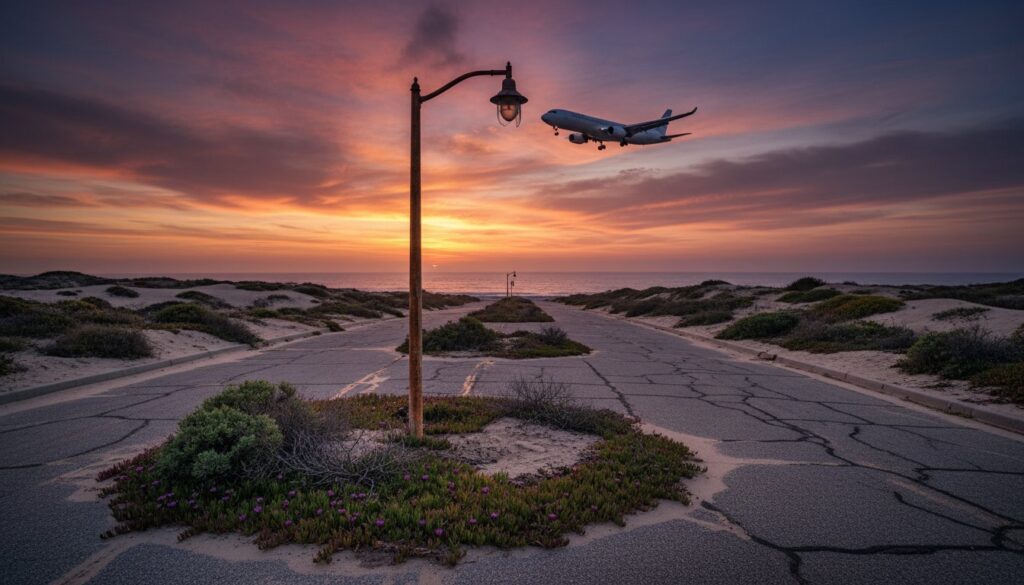
Walking or biking past the perimeter provides a haunting glimpse into the past. You’ll see cracked asphalt roads that still follow the original 1920s grid, leading to empty lots where mansions once stood. Nature has reclaimed much of the space. Overgrown bougainvillea and hardy palm trees mark former front yards, and coastal scrub covers the foundations. It’s a surreal landscape that feels frozen in time. One of the most striking features is the network of 1950s-style streetlights. Despite the lack of residents, these lights still turn on every night, casting a lonely glow over the abandoned sidewalks.
Local real estate experts often refer to surfridge ca as the “most expensive vacant lot in LA.” If those 430 acres were available for residential development today, the land value would be astronomical. However, the area serves a different purpose now. It’s a protected habitat for the endangered El Segundo Blue Butterfly. This transition from a luxury neighborhood to a noise-polluted liability, and finally to a nature preserve, is a unique chapter in California’s land-use history. It’s a reminder of how quickly “paradise” can change when urban infrastructure expands. My team and I often look at these maps to understand how local zoning and airport noise contours still affect property values in the surrounding blocks of Playa del Rey today.
The Rise and Fall: From 1920s Glamour to Eminent Domain
Surfridge didn’t start as a ghost town; it began as a dream for the Southern California elite. In the early 1920s, this stretch of coastline was known as the “Malibu of the South.” It was a place where the wealthy built custom estates on the dunes, far from the growing noise of downtown Los Angeles. The surfridge ca area represented the peak of coastal living, offering a sense of isolation that’s nearly impossible to find in modern California real estate. The community was a symbol of success, perched high above the Pacific with unobstructed views that stretched for miles.
Palisades del Rey: The Original Vision
Real estate developer Fritz Burns launched the development in 1921 under the name Palisades del Rey. His marketing was brilliant. He pitched it as the “last of the beaches,” a final opportunity to own a piece of the pristine California shore. The neighborhood wasn’t for everyone. It was designed to be exclusive and physically isolated, tucked away on the El Segundo blue butterfly dunes. Hollywood stars like Cecil B. DeMille and Charles Farrell moved in, drawn by the privacy and the stunning Spanish Colonial Revival architecture. These weren’t just houses; they were masterpieces featuring white stucco, heavy wrought iron, and red clay tile roofs. You can read more about this era in The Rise and Fall of Surfridge, which details how the community briefly became a cultural hub for the university’s neighbors.
The Noise That Ended Everything
The decline didn’t happen overnight. It started in 1928 when a small airstrip called Mines Field opened nearby. For decades, the small prop planes were just a minor nuisance to the high-society residents. Everything changed in 1959 with the arrival of the “Jet Age.” When the Boeing 707 began regular flights from the newly renamed Los Angeles International Airport, the peace of surfridge ca vanished. The roar of jet engines, often exceeding 120 decibels, made normal conversation impossible and literally shook the foundations of these luxury homes. It wasn’t just a matter of sound; the soot and smell of jet fuel began to coat the once-pristine gardens.
The City of Los Angeles realized the area was no longer fit for human habitation. Starting in the mid-1960s, the city used eminent domain to force residents out. It was a massive, decades-long undertaking that involved several key phases:
- The condemnation and purchase of over 800 individual homes.
- Relocating families who had lived on the dunes for generations and seen their property values plummet.
- Systematically bulldozing every structure to leave only the street grids and sidewalks behind.
While most residents left by the late 1960s, a few “last holdouts” refused to sell. They stayed in their increasingly lonely homes until 1972, surrounded by vacant lots and the constant scream of overhead turbines. By 1973, the final residents were gone, leaving a ghost town behind a chain-link fence. While this neighborhood is gone, I still help clients find gems in the surrounding areas that offer that same coastal magic. If you want to explore modern options that aren’t under a flight path, feel free to browse our local market guides.
Surfridge Today: The El Segundo Blue Butterfly Nature Preserve
What was once a high-end neighborhood is now a 302-acre ecological fortress. When you look at surfridge ca today, you aren’t seeing a typical coastal development. Instead, you’re looking at one of the most successful, albeit accidental, conservation stories in Southern California. After the city removed the last of the 800 homes in the mid-1970s, the land sat vacant. This isolation allowed the El Segundo Blue Butterfly, a species added to the federal endangered list in 1976, to find its final stronghold. Without the constant presence of humans, the native ecosystem began to heal itself.
A strange irony defines this landscape. The deafening jet noise from LAX that drove residents away is the very thing that saved this species from extinction. If the noise hadn’t made the land uninhabitable for people, developers would have covered these dunes with luxury condos decades ago. Los Angeles World Airports (LAWA) now manages the site alongside environmental groups like the Urban Wildlands Group. Since the late 1980s, these teams have worked to undo the damage caused by decades of residential landscaping. They’ve systematically removed invasive ice plant and mustard to make room for the coast buckwheat, the only plant the El Segundo Blue Butterfly uses for food and egg-laying.
The Return of the Coastal Dunes
Coastal dune systems are incredibly rare; less than 1% of the original Southern California dune habitat remains today. This preserve serves as a living laboratory where biologists from the Santa Monica Bay Restoration Commission study how native flora reacts to a changing climate. The surfridge ca site has seen a massive resurgence of native plants that were nearly wiped out by 20th-century development. You’ll find these species thriving across the rolling hills:
- Coast Buckwheat: The essential host plant for the El Segundo Blue.
- Beach Evening Primrose: A low-growing floral species that stabilizes the sand.
- California Poppy: The state flower that adds vibrant orange hues during the spring.
- Lupine: A hardy native that supports various local pollinators.
Can You Visit Surfridge? Legal Access and Viewing Spots
You can’t walk through the streets of Surfridge. The entire 302-acre perimeter is strictly fenced off, and trespassing is a federal offense because it sits on airport property. Security patrols are frequent, and they don’t take kindly to explorers. However, you can still get a great look at the “ghost town” from specific legal vantage points. The best spot is the public sidewalk along Vista del Mar, where several park benches offer a clear view over the fence. Another excellent location is the top of the hill at Sand Dune Park in El Segundo, located at the end of Bell Avenue.
If you’re bringing binoculars, here is a checklist of what to look for from the perimeter:
- Old Foundations: Look for the flat concrete pads where luxury living rooms once stood.
- Rusted Gates: You can still see the remains of wrought-iron garden gates standing in the middle of the brush.
- The Street Grid: Notice the cracked asphalt roads that still wind through the dunes, leading to nowhere.
- Fire Hydrants: A few vintage yellow hydrants still peek out from the native scrub.
It’s a haunting sight. Seeing nature reclaim a million-dollar neighborhood reminds us how quickly the landscape can shift. For locals and real estate enthusiasts, it’s a powerful lesson in the history of South Bay land use and the unexpected ways that conservation can win.
Real Estate Lessons from the Ghost of the Westside
History leaves clues for modern investors, and the story of surfridge ca serves as a masterclass in how massive infrastructure projects reshape entire zip codes. When LAX began its jet-age expansion in the 1960s, property values in the immediate vicinity didn’t just dip; they vanished along with the neighborhood itself. This teaches us that proximity to major hubs is a gamble if there isn’t a designated “buffer zone” in place. Infrastructure encroachment is often a silent value killer that happens over decades, not days.
Modern urban planning now uses the empty dunes of the former surfridge ca site as a 200-acre ecological shield. This protected space, known as the El Segundo Blue Butterfly Preserve, acts as a permanent barrier between the airport and the residential streets of Playa del Rey. It creates a hard stop for airport growth. For a buyer, identifying these permanent greenbelts or protected zones is the best way to ensure that a “quiet” street stays that way for the next thirty years.
The removal of more than 800 homes during the 1960s and 1970s actually boosted the long-term exclusivity of its neighbor, Playa del Rey. By permanently reducing the available housing supply on the coast, the city turned Playa del Rey into a land-locked, high-demand pocket. It’s one of the few places in Los Angeles where you can still find a secluded beach vibe without the overwhelming tourist crowds found in Santa Monica. This scarcity drives price appreciation even when interest rates fluctuate.
I always tell my clients that “block-to-block knowledge” is your most valuable asset when buying near a hub like LAX. You can’t just look at a map and assume two houses 500 feet apart are equal. One home might be shielded by a natural ridge that deflects engine blast, while the house one street over catches the full force of a departing flight. We look at the specific topography and historical noise data to ensure you aren’t buying a property that will be impossible to resell later.
Playa del Rey: The Modern Alternative
Playa del Rey feels like a residential time capsule. It captures the quiet, community-focused energy that residents loved about the area before the airport expanded. While many buyers focus on Venice or Manhattan Beach, Playa remains a hidden gem for those who want a slower pace. If you’re looking for a similar community feel but prefer to be slightly more inland, check out Ray Lyon Realty’s guide to Mar Vista to see how these neighboring markets compare in terms of value and lifestyle.
Understanding Noise Contours and Disclosures
Modern buyers have tools that the original residents of the 1960s never imagined. You can now access 65 dB CNEL (Community Noise Equivalent Level) noise contour maps to see exactly how flight paths affect a specific lot. California Civil Code Section 1102.6 now requires strict disclosures regarding airport proximity, a legal framework that was largely built on the lessons learned from the displacement of families in the 1970s. Real estate agents are legally obligated to disclose if a home sits within an “airport influence area,” which protects your investment from unexpected noise surprises. This legacy of transparency ensures that what happened decades ago won’t happen to you.
If you want to ensure your next coastal investment is protected by the right data and local insight, reach out to Ray Lyon Realty today to start your search.
Navigating the Westside Market with Local Expertise
Ray Lyon doesn’t just work the Westside; he lives it every single day. His “block-to-block” knowledge isn’t something learned from a map or a database. It comes from the grit of building his own home from the ground up and managing personal rental properties in these exact neighborhoods. When Ray walks a property, he isn’t just looking at the floor plan. He’s evaluating the foundation, the neighborhood’s growth trajectory, and the subtle details that only a local resident would notice. This hands-on experience allows him to tell you exactly why a home on one street in Playa del Rey might hold its value better than one just two blocks away.
Understanding the history of surfridge ca is a perfect example of how local context drives smart investment. What remains of the old Surfridge neighborhood serves as a reminder of how coastal land use and zoning can shift over decades. For modern investors, the story of surfridge ca highlights the importance of understanding noise contours and environmental protections near LAX. Ray uses this historical perspective to help clients navigate current market valuations. He ensures they don’t just buy a house, but rather invest in a piece of land with a clear understanding of its past and its future potential.
There is immense value in working with a realtor who “practices what he preaches.” Ray has spent years in the trenches of Westside residential sales, but he’s also been the buyer and the seller in his own personal deals. He has navigated the same “deferred maintenance” headaches and appraisal contingencies that his clients face. Because he uses his own capital for flips and investments, his advice is grounded in reality, not just sales tactics. He knows how to spot a “diamond in the rough” and, more importantly, he knows when a property is a money pit that will drain a client’s resources.
Why Local Knowledge Matters in Playa del Rey and Beyond
Beach-adjacent properties come with a unique set of rules. In 2024, navigating Coastal Commission regulations is more complex than ever; these rules can delay a simple remodel by 8 to 12 months if you don’t have the right guidance. Ray Lyon Realty identifies off-market opportunities in high-demand pockets where inventory often stays below a 2-month supply. By leveraging deep local ties, the team finds deals before they ever hit the MLS. Reach out today for a personalized market analysis to see where the best opportunities currently hide.
Ready to Find Your Own Piece of the Coast?
The team is dedicated to a stress-free transaction from the first showing to the final signature. For sellers, Ray utilizes a trusted network of contractors and professional stagers to maximize property value. He often suggests putting a little “lipstick” on a listing, a strategy that helped his clients in 2023 secure offers 7% higher than the initial neighborhood average. Whether you are looking for a coastal retreat or a strategic investment, the goal is to preserve the Westside’s unique past while building your future. Contact Ray Lyon Realty today to start your Westside search and find your place in the Los Angeles sun.
Secure Your Piece of Westside History
The story of surfridge ca reminds us that the Westside landscape is always evolving. What began as a 1920s playground for the elite eventually became a 200-acre sanctuary for the El Segundo Blue Butterfly after the city cleared over 800 homes via eminent domain during the 1960s and 70s. These historical shifts prove why understanding local land use is vital for any homeowner. You need an advocate who knows the difference between a stable investment and a changing coastal zone.
Our team has served as local Westside experts since 2004. We bring personal experience in coastal property development and deep, block-to-block knowledge that you won’t find on a standard listing site. We help you spot off-market opportunities and navigate the complexities of beachside real estate. Whether you’re looking for a modern retreat or a classic home in Playa del Rey, we’re here to guide your search with strategy and genuine care.
Looking for a home on the Westside? Explore Playa del Rey with Ray Lyon
Let’s find a place where you can build your own lasting history today.
Frequently Asked Questions
Is Surfridge, CA, still a ghost town in 2026?
Yes, Surfridge remains a restricted ghost town in 2026. Los Angeles World Airports (LAWA) continues to manage the 430-acre site as a protected buffer zone for LAX. While the 1920s street grid is visible, the last of the 800 original homes were removed by 1975. It’s likely to stay this way for decades to protect the flight path and local wildlife.
Can I buy property in Surfridge today?
You can’t buy property within the historic Surfridge fences today. The City of Los Angeles owns the entire 430-acre tract and has no plans to sell it for private development. If you want to live nearby, I suggest looking at Playa del Rey. Median home prices there reached $1.8 million in early 2024, reflecting the high demand for coastal land in the 90293 zip code.
Why was Surfridge demolished?
Surfridge was demolished because the expansion of LAX and the arrival of jet engines in 1959 made the area too loud for residents. The city used eminent domain to clear the neighborhood between 1966 and 1975. Over 800 families were forced to relocate after noise levels consistently topped 85 decibels. This move created a permanent noise buffer for the airport’s north runways.
What is the El Segundo Blue Butterfly Preserve?
The El Segundo Blue Butterfly Preserve is a 200-acre habitat located on the dunes of the former Surfridge site. It was established in 1986 to protect a species that nearly went extinct due to urban development. Since the preserve began, the butterfly population has rebounded from just 500 insects to more than 120,000. It’s one of the most successful conservation efforts in Southern California.
Where is the best place to see the Surfridge remains?
The best place to see the surfridge ca remains is from the public sidewalk on Vista del Mar or the Sandpiper Street overlook. From these vantage points, you can see the original 1920s streetlights and cracked asphalt roads through the fence. You can’t go inside the perimeter because LAX police patrol the area 24 hours a day to protect the endangered butterfly habitat.
Does the history of Surfridge affect home prices in Playa del Rey?
The history of surfridge ca keeps home prices in Playa del Rey elevated by creating artificial land scarcity. Because 430 acres of prime coastal land are off-limits for new housing, the existing inventory is extremely valuable. I’ve seen buyers pay over $1,200 per square foot for homes bordering the preserve. They’re willing to pay a premium for the guaranteed, unobstructed ocean views.
Are there any houses still standing in Surfridge?
No houses are still standing in Surfridge today. The city finished clearing the last structures in 1975 to make way for the airport buffer zone. However, several homes were saved from the bulldozer by being moved on trailers to nearby streets in Westchester and El Segundo. You can still find these 1930s-era Spanish Colonials if you know which specific blocks to check.
What is the difference between Surfridge and Palisades del Rey?
Palisades del Rey was the original name given to the 1921 development, while Surfridge was the specific name for the southern portion of the bluffs. By 1925, marketing shifted almost entirely to the Surfridge name to attract Hollywood elites to the beach. Today, both names have been replaced by Playa del Rey, though the Surfridge title remains famous for the ghost town history.