

The glitziest billboard in West Hollywood won’t tell you if a foundation is cracking or if a neighborhood’s block to block value is about to shift. In a city where over 25,000 agents compete for your attention, finding a real estate agent I can trust feels more like a gamble than a business decision. You’ve likely felt that nagging anxiety that you’re about to overpay for a property with hidden defects, or worse, that your agent sees you as just another transaction to close before their next luxury car payment. It’s frustrating when you realize that many people in this industry don’t actually practice what they preach.
I understand that stress because I’ve been in your shoes as a builder, an investor, and a neighbor. You deserve a partner who protects your interests with the same intensity they’d use for their own family. This 2026 guide will teach you how to vet a Realtor’s actual track record and identify the red flags that shiny marketing tries to hide. We’ll explore how to gain a competitive advantage through off-market deals and ensure you have complete peace of mind during escrow. Let’s move past the sales pitches and find you a genuine expert who knows how to win in the current LA market.
Key Takeaways
- Discover why navigating the high stakes of Santa Monica and Venice real estate requires a partner who offers more than just polished marketing and generic bios.
- Learn how to verify “block-to-block” expertise so you can feel confident finding a real estate agent I can trust who knows the specific zoning and noise nuances of every Westside street.
- Identify the critical difference between a “paper agent” and a practitioner who has their own “skin in the game” through personal building and flipping experience.
- Master a specific five-question vetting framework designed to cut through scripted answers and reveal an agent’s true level of professional transparency.
- Understand how a commitment to local Westside roots and genuine care can turn a stressful transaction into a strategic, successful investment.
The Trust Deficit in Real Estate: Why Finding the Right Partner Matters
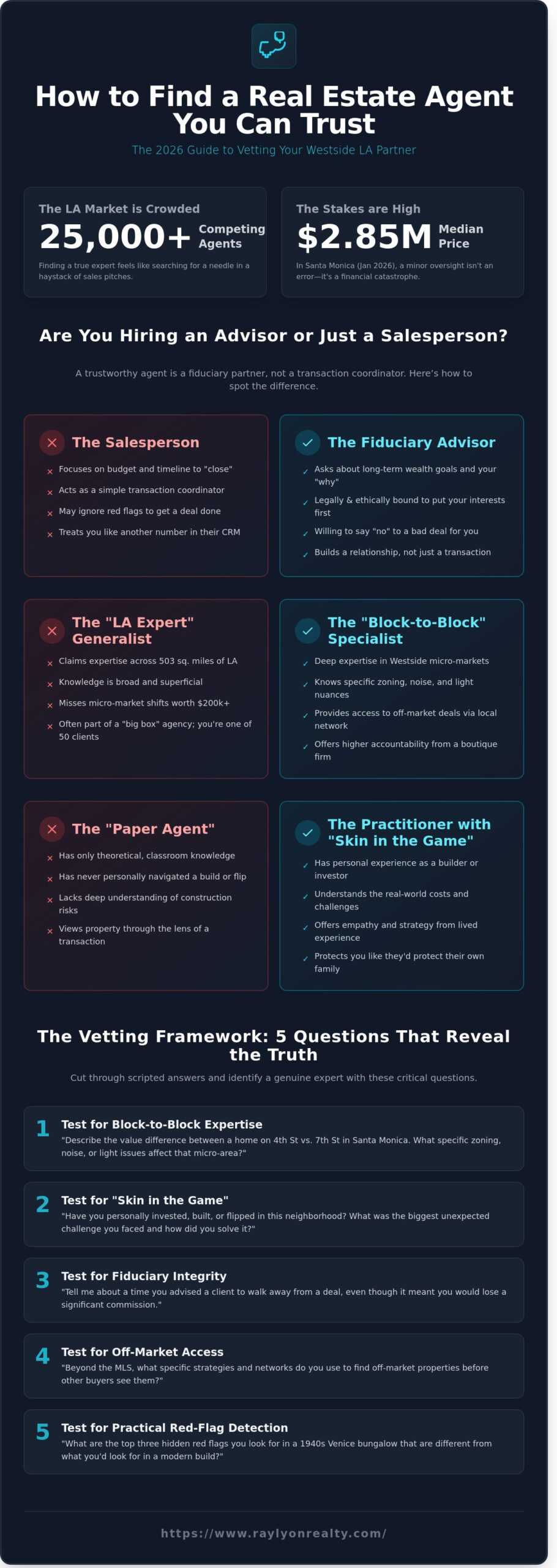
In the 2026 Westside LA market, the stakes for a single transaction have reached unprecedented levels. With the median sales price for a single-family home in Santa Monica hitting $2.85 million in January 2026, a minor oversight in a contract isn’t just a clerical error. It’s a financial catastrophe. Most buyers and sellers feel a natural, healthy skepticism when they start their search. You’ve likely seen the billboards and Instagram ads where every professional claims to be in the “Top 1%.” This marketing noise makes finding a real estate agent I can trust feel like searching for a needle in a haystack of sales pitches.
A truly trustworthy agent in today’s Venice or Santa Monica landscape doesn’t just show up to open a door. They possess “block to block” knowledge of the area, understanding why a property on 4th Street carries a different risk profile than one on 7th. They act as a fiduciary partner rather than a mere transaction coordinator. While a coordinator simply moves paperwork from point A to point B to collect a check, a fiduciary is legally and ethically bound to put your financial interests above their own. If you are curious about the baseline requirements of the role, What is a Real Estate Agent? provides a neutral look at the legal framework they operate within, but the best partners go far beyond those basic definitions.
The Difference Between a Salesperson and an Advisor
You can usually spot the difference between a salesperson and an advisor in the first five minutes of a conversation. A salesperson asks about your budget and your timeline because they’re focused on the “close.” An advisor asks about your long-term wealth goals and your “why.” They’re willing to tell you “no” if a Venice cottage has hidden foundation issues or unpermitted ADU construction that could trigger a city inspection. An advisor knows that a house might just need a little “lipstick” to shine, but they’ll never let you ignore a structural red flag just to get a deal done. This relationship-based approach ensures you aren’t just buying a house; you’re making a calculated investment.
Why “Big Box” Agencies Aren’t Always the Answer
Massive national brokerages often treat clients like data points in a CRM. It’s easy to feel lost in the shuffle when your agent is juggling 50 other listings across the entire county. Boutique firms with deep local roots offer a distinct competitive advantage. In a localized firm, personal accountability is significantly higher because the agent’s reputation is tied directly to the community where they live and work. They have the “insider” access to off-market deals that never hit the public portals. When you’re finding a real estate agent I can trust, look for someone who has skin in the game. You want a partner who has built their own home or managed their own rentals in the same neighborhoods where you’re looking to plant roots. That hands-on experience creates a level of empathy and strategy that a corporate office simply can’t match.
Beyond the Bio: Identifying “Block-to-Block” Local Expertise
When you browse agent profiles, don’t get distracted by massive “lifetime sales” numbers that span the entire county. Los Angeles covers 503 square miles. An agent who claims to be an expert in every corner of the city is usually a master of none. If you are looking at the Westside, a “Los Angeles expert” is too broad. You need someone who understands the micro-markets where values can shift by $200,000 just by crossing a single intersection.
A bio claiming “local knowledge” should mean block-to-block expertise. This level of detail involves knowing which streets in Mar Vista are subject to specific R1V2 coastal zone height limits or which pockets of Santa Monica face increased noise from the airport flight path changes. While general guides on How to Find a Realtor emphasize checking licenses and basic reviews, they often miss the importance of hyper-local nuances. Finding a real estate agent I can trust means finding someone who knows that a house on the north side of a street might get three hours more sunlight than the south side, directly impacting its resale value.
For sellers, this knowledge translates to better pricing. If an agent doesn’t know that a specific pocket near Clover Park saw a 14 percent price jump in the last 120 days, they might underprice your home. Conversely, an expert knows when a neighbor’s “record sale” was actually an outlier due to a double-lot size, preventing you from overpricing and sitting on the market for 60 days. This granular data is the only way to build a strategy that actually wins in a competitive market.
The Mar Vista and Santa Monica Nuance
Local expertise isn’t just about data; it’s about the “feel” of the neighborhood. An agent who lives and works here knows that the marine layer stays longer in Sunset Park than it does in Mar Vista Hilltop. They understand that being one block inside the Santa Monica-Malibu Unified School District boundary adds roughly 15 percent to a property’s value compared to the LAUSD side. I often use the strategy of putting “lipstick” on a property. This means hiring a specific local crew to handle 14 days of cosmetic updates like organic modern finishes that we know 2024 Westside buyers are specifically hunting for.
Accessing Off-Market Deals Through Trust
The most desirable homes in Venice or Mar Vista often never hit the MLS. In fact, roughly 18 percent of high-end Westside transactions happen off-market. These “pocket listings” are only accessible if your agent has a deep, trusted network with other local brokers. When agents respect each other, they share upcoming listings before they go live. This gives you a 48 hour head start to see a property without 50 other people at an open house. Finding a real estate agent I can trust is about hiring someone whose reputation makes other agents want to work with them. If you want to see what’s currently moving behind the scenes, you can browse our local Westside listings to see how we position homes for success.
Practitioner vs. Paper Agent: Why Personal Investment Experience Is a Trust Signal
Most agents spend their days looking at the MLS and filling out standard forms. They understand the theory of a transaction, but they’ve never actually had their own capital at risk. A “paper agent” can tell you what a house is worth based on a spreadsheet. A practitioner, however, knows what a house is worth because they’ve spent their own weekends scraping popcorn ceilings or negotiating with plumbers. This distinction is the foundation of finding a real estate agent I can trust. When an agent has skin in the game, their advice shifts from academic to tactical.
Personal investment experience transforms an agent’s perspective on risk. If an agent has personally managed a $55,000 kitchen remodel or navigated a difficult foundation repair in a 1920s craftsman, they won’t gloss over the red flags in a home inspection. They understand the visceral anxiety of a closing date. Forbes provides a useful guide on how to find a real estate professional who possesses this level of practical depth. This hands-on background allows them to spot “deferred maintenance” that a standard agent might miss, such as a water heater from 2012 that is nearing the end of its 12-year lifespan.
The “Practices What They Preach” Framework
You should always ask an agent about their personal real estate portfolio. An agent who owns five rental properties or has successfully flipped three homes in the last 24 months brings a massive competitive advantage. They know how to put “lipstick” on a property, using strategic upgrades like $1,500 in designer lighting or fresh neutral paint to trigger multiple offers. They also understand the permit process, such as the specific 2024 local requirements for Accessory Dwelling Units (ADUs), which can add six figures of value to a listing.
- Renovation ROI: They can estimate repair costs within a 10% margin on the fly.
- Vendor Networks: They have a “gold list” of contractors who actually show up on time.
- Tactical Staging: They know which 20% of the house drives 80% of the buyer’s emotional connection.
Navigating 1031 Exchanges and Trust Sales
Specialized transactions require more than just a license; they require a history of personal execution. A 1031 exchange, for example, is a high-stakes tax maneuver with a strict 45-day identification period and a 180-day completion window. Missing a single deadline can result in a massive capital gains tax bill, sometimes exceeding $75,000 for a typical mid-market property. An agent who has personally executed these exchanges knows how to coordinate with qualified intermediaries to protect your financial ROI.
Trust sales and probate transactions add layers of legal and emotional complexity. These often involve multiple stakeholders and specific court-mandated timelines. Finding a real estate agent I can trust means identifying someone who has sat in those same meetings and managed those same spreadsheets for their own family or business. This level of empathy and technical proficiency ensures that your equity is protected throughout the entire process. They don’t just see a commission; they see a legacy that needs to be handled with precision and care.
Ultimately, a practitioner’s experience acts as a shield for the client. They have already made the mistakes on their own dime so that you don’t have to make them on yours. This creates a level of confidence that a “paper agent” simply cannot replicate.
The Vetting Framework: 5 Questions That Reveal an Agents True Integrity
Finding a real estate agent I can trust starts with a shift in perspective. You aren’t just hiring a salesperson; you’re interviewing a fiduciary partner who will manage your largest financial asset. Most agents use the same three scripts to handle objections, so you have to throw them a curveball. Genuine integrity shows up in the details they’re willing to share, especially when those details don’t lead to an immediate commission. You need to see past the polished headshot and look for “block to block knowledge” that only comes from years of local experience.
Questions to Ask Every Potential Realtor
Ask: “Can you tell me about a time you advised a client NOT to buy a house?” A scripted agent says they always prioritize the client. A trusted pro gives you a specific date, like October 14th, and a concrete reason, such as a $45,000 foundation issue they spotted during a walkthrough. Next, ask about off-market deals. If they haven’t closed at least 4 off-market transactions in your target zip code in the last 180 days, they likely lack the deep local network required to find hidden gems. Finally, ask about their personal portfolio. Someone who has managed 6 of their own renovations or investment properties understands the difference between “lipstick on a house” and actual structural value. A good answer is granular and data-heavy; a scripted answer is emotional and vague.
Verifying “top producer” status requires more than looking at a trophy in an office. Ask for a printout of their MLS production from the last 12 months. A true expert should show a consistent track record of at least 15 to 20 closed sides per year in your specific price point. When checking testimonials, ignore the five-star rating and look at the dates. You want to see at least 5 reviews from the last 90 days. These reviews should mention specific wins, like “negotiating a $12,500 repair credit” or “selling for 8% over asking price in just 4 days.” If the testimonials are all from three years ago, their market knowledge is likely outdated.
Red Flags to Watch For
Watch out for “buying the listing.” This happens when an agent agrees with your suggested high price without showing you 5 comparable sales from the last 21 days. They do this just to get your signature, only to demand a price drop 14 days later. Another red flag is the immediate hand-off. If you interview the lead agent but get shifted to a junior assistant within 24 hours of signing, your “top producer” is actually a ghost. This lack of responsiveness is a primary reason why 68% of sellers report dissatisfaction with their agent communication. Lastly, listen for vague market answers. If they can’t tell you that the current inventory in your neighborhood is at a 1.2 month supply, they aren’t the local expert you need for finding a real estate agent I can trust.
Integrity is found in the willingness to tell you the truth, even when it’s uncomfortable. If an agent promises you a “guaranteed quick sale” without discussing the 12 items on your deferred maintenance list, they’re prioritizing their win over your long-term success. Trusted agents focus on the strategy, not just the sale.
The Ray Lyon Realty Standard: Building Trust Through Transparency
Ray Lyon Realty operates on a simple but powerful philosophy: block-to-block knowledge combined with genuine care. In a city as vast as Los Angeles, general expertise isn’t enough. Ray focuses his energy on the Westside, specifically the micro-markets of Santa Monica, Mar Vista, and Venice. He understands that the value of a home can shift significantly from one street to the next. When you are finding a real estate agent I can trust, you need someone who recognizes these nuances. Ray’s deep roots in these neighborhoods allow him to provide insights that go far beyond what any algorithm or standard market report can offer.
Ray’s background gives his clients a distinct competitive advantage. He isn’t just a salesman; he is a builder and an investor who has personally flipped properties and constructed his own family home from the ground up. This hands-on history means he knows the actual cost of a kitchen remodel or the red flags of a failing foundation. When walking through a listing, Ray identifies “deferred maintenance” issues that others might miss. For sellers, he knows exactly how to put “lipstick” on a property, a term he uses for strategic staging and cosmetic updates. These minor investments often lead to sale prices 15% higher than un-staged homes in the same zip code.
The firm also excels in uncovering off-market deals. In Westside neighborhoods where inventory often stays below a 45-day supply, finding a home before it hits the MLS is vital. Ray leverages a vast network of local contacts and contractors to find these “hidden” gems. This proactive strategy ensures that his buyers aren’t always stuck in a 20-person bidding war. Whether he is negotiating a complex deal or coordinating a pre-sale renovation, Ray remains personally involved in every step of the process.
A Client-Centric Approach to LA Real Estate
Testimonials from past clients frequently highlight an approachable and down-to-earth tone that sets Ray Lyon Realty apart. The team prioritizes responsiveness and patience over securing a quick sale. They understand that finding a real estate agent I can trust involves finding a partner who listens. Whether you are a first-time buyer looking for a starter condo or a seasoned investor seeking a multi-million dollar estate, you are treated as a top priority. Ray’s team typically returns calls and texts within 30 minutes; they believe that clear communication is the bedrock of a stress-free transaction. They don’t push; they guide.
Your Next Steps on the Westside
Building a relationship based on trust starts with a conversation. Ray Lyon Realty invites you to a no-pressure consultation to discuss your real estate goals and the current state of the Westside market. You can request a free Home Value check or a comprehensive neighborhood market report tailored to your specific area of interest. These tools provide the data you need to make informed decisions without any immediate obligation. Contact Ray Lyon Realty to start your search with a partner you can trust and experience a more transparent way to navigate the Los Angeles real estate market.
Take the Lead on Your Next Westside Move
Success in the 2026 Los Angeles market requires more than a standard search. You need an advocate who understands why one block in Santa Monica commands a 15% premium over the next. Look for a practitioner who has personally managed 20+ home flips or built their own residence from the ground up. This hands-on experience ensures they can spot structural red flags or hidden equity opportunities that a “paper agent” would miss. Finding a real estate agent I can trust is about verifying their track record with off-market inventory and their ability to navigate complex appraisal contingencies.
Ray Lyon Realty stands as a top-ranked Santa Monica brokerage because we treat your investment like our own. We’ve spent 12 years building a network that secures access to 30+ off-market Westside deals annually before they ever hit the MLS. Whether you’re buying your first home or scaling a portfolio, you deserve a partner who practices what they preach. Find a partner who knows the Westside block-to-block; contact Ray Lyon today. We’re ready to help you win in this competitive landscape.
Frequently Asked Questions
How do I know if a real estate agent is lying about their experience?
Check their license status on the California Department of Real Estate (DRE) website and review their publicly available sales history. Real data doesn’t lie. A trustworthy agent should show at least 10 to 15 closed transactions in the last 12 months to prove they’re active. If their DRE record shows disciplinary actions or if their sales history is blank, they aren’t being honest about their volume.
Is it better to work with a solo agent or a large real estate team?
Solo agents often provide a more direct line of communication than large groups. When finding a real estate agent I can trust, you want to know exactly who is handling your 3:00 PM inspection or negotiating your counteroffer. Large teams might pass you off to a junior assistant after the first meeting. Small boutique teams ensure you get 100% of their focus rather than 20% of a busy lead agent’s time.
What is the most important quality in a real estate agent for a first-time buyer?
Patience and a willingness to explain the 10-page California Residential Purchase Agreement are the most vital traits. First-time buyers often view 12 to 15 homes before making an offer. You need someone who views themselves as a consultant rather than a salesperson. Look for an agent who takes the time to walk you through appraisal and loan contingencies so you don’t lose your 3% earnest money deposit.
How can I verify an agents track record in a specific neighborhood like Mar Vista?
Search the Multiple Listing Service (MLS) for “Sold” listings in the 90066 zip code over the last 24 months. An agent with “block to block” knowledge will have represented at least 5 clients within a 2 mile radius of your target street. Ask for the addresses of the last 3 homes they sold in Mar Vista. This helps you see if they understand local nuances like the “North West” pocket versus the “Wooded” area.
Should I sign an exclusive buyers agency agreement right away?
You should wait until you’ve toured at least 2 or 3 homes together to ensure the chemistry is right. These agreements are legal contracts that usually last 3 to 6 months. It’s okay to ask for a “trial period” or a 24 hour cancellation clause. Finding a real estate agent I can trust means finding someone who earns your loyalty through their work, not just a signed piece of paper.
What should I do if I feel my current agent is pressuring me into a sale?
You should immediately request a face-to-face meeting to reset expectations or contact their managing broker to terminate your agreement. A 2023 survey by the National Association of Realtors found that 67% of buyers value honesty above all else. If an agent pushes you to waive a home inspection or ignore a $10,000 roof repair just to close the deal, they aren’t acting in your best interest.
How does an agents personal investment experience help me as a seller?
An agent who flips houses or manages 5 rental units knows exactly where to spend money to get a 2x return on investment. They can spot “deferred maintenance” issues before a buyer’s inspector finds them. I often suggest putting “lipstick” on a property with a $2,500 paint job and fresh mulch because I’ve seen it drive 5 additional offers in my own projects.
What are the benefits of a boutique real estate brokerage over a national chain?
Boutique firms offer specialized local marketing and a 1-to-1 client-to-agent ratio that big box brands can’t match. National chains often charge a $500 admin fee on top of commission, while local experts focus their resources on high-end photography and off-market deals. At a boutique firm, you aren’t just a number in a 500-person office; you’re a priority for the entire team.