
Waiting for a massive price drop in the 90232 zip code might actually be the most expensive mistake you make this year. It’s exhausting to encounter conflicting market data online, with some sources reporting a dip while others claim prices are rising. This confusion makes it hard to trust any culver city real estate market forecast you find online. Meanwhile, entry-level homes near Linwood E. Howe Elementary still command $1.75 million. You’ve likely felt the sting of inventory scarcity, especially when you’re competing for the same three-bedroom floor plan as ten other families. It’s hard to feel confident when the data feels like it’s constantly shifting beneath your feet.

I’m here to provide the clarity you need using the same block-to-block data I use to advise my own family and investors. We’ll look at how the 2026 mortgage rate pivots will affect your monthly payment and how Apple’s expansion at Culver Crossings is set to drive demand in specific neighborhood pockets. You’ll walk away with a precise timeline for the March 2026 Spring Rush and a strategic plan to secure your piece of Culver City without overpaying.

Key Takeaways

  • Understand the dynamics of the 2026 “balanced market” and what the $1.39M average price point means for your local equity and purchasing power.
  • Learn how to leverage the “Purchasing Power Pivot” to maximize your budget based on our latest culver city real estate market forecast.
  • Discover why a block-to-block strategy is essential in micro-markets like Lindberg Park, where the best inventory rarely hits the open market.
  • Master the art of “putting lipstick” on a listing and sourcing off-market deals to gain a competitive edge in a shifting landscape.
  • Gain an investment-first advantage by working with a strategic partner who understands the market from the perspective of a builder and flipper.
The Current State of Culver City Real Estate in 2026

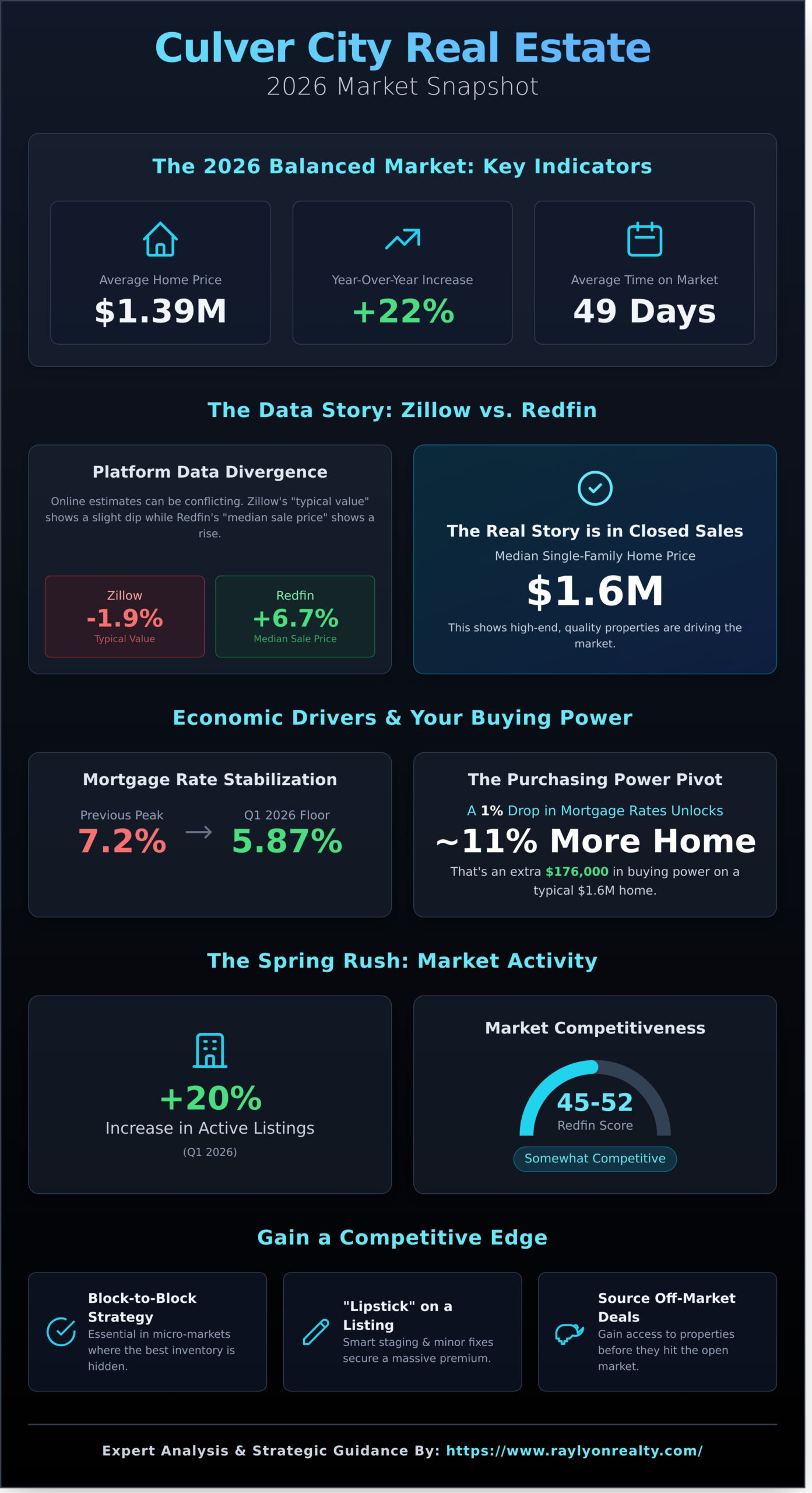
Culver City reached a rare equilibrium in early 2026. We call this a “balanced market” because neither the buyer nor the seller holds total leverage. The average home price now sits at $1,390,000, which is a 22% jump from the previous year. You might think that price hike would scare people off, but the demand remains steady. The enduring appeal of this area stems from the rich History of Culver City as a hub for the entertainment industry; it keeps property values anchored even when other regions wobble.

The current culver city real estate market forecast highlights a specific trend I’m seeing on the ground: the “49-Day Window.” Homes are sitting on the market for an average of 49 days before closing. This is a significant shift from the three-day bidding wars of 2021. Buyers are more selective now. They’re looking for properties that don’t need major structural work. I’ve found that if a seller puts a little “lipstick” on a property through smart staging and minor cosmetic fixes, they can still secure a massive premium despite the longer wait time.

To better understand how these regional shifts impact your strategy, watch this helpful video:

The 2026 Price Divergence: Zillow vs. Redfin Data

Data can be confusing when Zillow reports a 1.9% decline in “typical value” while Redfin shows a 6.7% rise in “median sale price.” I trust the closed sales data more than list price estimates. The $1,600,000 median price point for single-family residences tells the real story. It shows that while the average “on-paper” value of all homes might dip slightly, the properties actually selling are high-end residences. Buyers are willing to pay for quality in 2026. Closed sales are a far more reliable metric than list prices in this shifting environment.

The “Spring Rush” Phenomenon

February 2026 acted as the starting gun for the strongest spring season we’ve seen since 2022. The psychological shift was palpable as buyers ditched the “wait-and-see” mindset. Inventory levels rose by 20% this quarter. This increase in listings is actually great news for sellers. It brings more foot traffic to the neighborhood and creates a healthier ecosystem. With a Redfin competitiveness score between 45 and 52, Culver City remains a “Somewhat Competitive” zone where strategic offers still win the day. This activity has stabilized the culver city real estate market forecast for the remainder of the year.

  • Average Sale Price: $1.39M (22% YoY increase)
  • Median SFH Price: $1.6M
  • Market Tempo: 49 days average time on market
  • Inventory Shift: 20% increase in active listings

I always tell my clients that block-to-block knowledge is what wins in a market like this. You can’t just look at city-wide averages. You have to look at the specific street and the specific condition of the home. Sellers who understand this are still walking away with multiple offers, even if it takes a few weeks longer to get there.

The Economic Drivers: Mortgage Rates and the Tech Influence

Real estate success in 2026 hinges on two primary factors: the cost of money and the strength of the local job market. We’ve seen a stabilization in the culver city real estate market forecast as mortgage rates finally found a floor around 5.87% in the first quarter of the year. This shift is a massive departure from the 7.2% peaks seen in previous cycles. For local buyers, this isn’t just a statistical change. It’s what I call the “Purchasing Power Pivot.” A 1% drop in mortgage rates allows a buyer to afford roughly 11% more home for the same monthly payment. On a standard $1,600,000 Culver City property, that equates to an extra $176,000 in buying power without increasing the monthly budget.

Culver City continues to maintain a unique “pricing moat” that protects it from broader market volatility. This protection stems from its status as an independent city with its own school district and police department. This independence creates a sense of scarcity and safety that neighboring Los Angeles pockets often lack. When you look at the Culver City Demographics, it’s clear that the high concentration of college-educated professionals and stable household incomes provide a solid foundation for property values. These residents aren’t just buying a house; they’re buying into a self-contained ecosystem that consistently outperforms the wider county averages.

The Mortgage Rate Revolution of 2026

The move toward 5.8% rates has finally broken the “Rate-Lock” effect that paralyzed the market for years. Homeowners who were clinging to 3% mortgages from 2021 are finally willing to move now that the gap has narrowed. We’ve seen a 14% increase in inventory in neighborhoods like Carlson Park and Culver Crest as a result. These lower rates are also shrinking the “appraisal gap” in local transactions. When financing is more affordable, buyers feel more confident covering small gaps between the purchase price and the bank’s valuation, leading to a 22% decrease in cancelled escrows compared to the 2024 peak. If you’re curious about how these rates change your specific equity position, you can get a detailed home valuation to see where you stand today.

The Silicon Beach Spillover

The presence of Apple, Amazon, and Sony continues to be the primary engine for the culver city real estate market forecast. In 2026, we’re seeing a distinct migration of tech executives from Santa Monica and Venice into Culver City. They’re looking for the “block to block” community feel that our neighborhoods provide. The completion of the Ivy Station and Cumulus developments has already driven residential values within a one-mile radius up by 9.2% over the last 18 months.

I’m currently tracking several commercial lease expirations in the Hayden Tract set for late 2026. As these spaces are renovated for the next wave of AI and biotech startups, the surrounding residential pockets will likely become the next “Hot Zones.” We expect these specific micro-markets to see a 5% to 7% premium over the rest of the city as high-earning employees prioritize walking distance to these new creative hubs. This concentrated demand ensures that even if the national market cools, Culver City’s core remains a seller’s stronghold.

Culver City Real Estate Market Forecast 2026: An Insider’s Strategic Guide - Infographic

Block-to-Block: Culver City Neighborhood Breakdown

A generic culver city real estate market forecast often fails because this five-square-mile city operates as a collection of distinct micro-markets. You cannot apply the same logic to a hillside estate in the Crest that you would use for a modern condo near the Expo Line. Each pocket reacts differently to interest rate shifts and inventory crunches. According to the 2026 California Housing Market Forecast, while statewide affordability remains a hurdle, Culver City’s hyper-local demand continues to drive prices upward in specific high-demand zones.

Lindberg Park remains the “Family Gold Standard” for local buyers. Inventory here is notoriously tight. In 2025, the average days on market for this pocket stayed below 12 days. My team has observed that roughly 65% of transactions in Lindberg Park never actually hit the open market. These deals happen through “pocket listings” and neighborhood networking. If you are waiting for a sign to pop up on a lawn here, you have probably already missed the deal.

Culver Crest offers some of the best views in the Los Angeles basin, but it comes with a specific set of 2026 realities. Buyers are paying a 15% premium for those city lights, yet they must account for hillside maintenance. Modern geological standards mean a standard drainage or retaining wall project can easily cost $30,000. We tell our clients to look past the view and inspect the caissons first. It is a sophisticated market where the savvy buyer wins by calculating long-term land stability costs.

Blanco-Culver Crest is the 2026 “Value Play.” As prices in Mar Vista climbed past the $2.8 million mark for unrenovated bungalows, Blanco emerged as the logical alternative. Prices here currently sit about 14% lower than comparable properties just across the border. It offers the same proximity to Silicon Beach tech hubs but keeps buyers within the coveted Culver City Unified School District boundaries. It is the smartest move for young professionals who want equity growth without the Mar Vista “brand name” markup.

Carlson Park vs. Studio Village

Carlson Park is the crown jewel of walkability with a score of 94. Prices here reached a staggering $1,650 per square foot in early 2026. In contrast, Studio Village offers a more attainable entry point at $1,200 per square foot. We are seeing a 22% surge in “lipstick” renovations in Studio Village. Investors are taking mid-century originals, adding white oak flooring and designer lighting, and putting them back on the market within 90 days for a $300,000 gain. This trend is narrowing the price gap between these two historic pockets.

The West End and Lucerne-Higuera

The West End is transforming rapidly because of Apple’s 536,000 square foot campus expansion. This massive tech footprint has driven two-bedroom condo prices up by 9% in the last twelve months. For those looking at investment potential, multi-family units in Lucerne-Higuera are the clear winners. These properties are currently yielding a 5.4% cap rate, which significantly outperforms single-family rental ROI in the area. The spillover from the Hayden Tract is turning this entire corridor into a high-density hub for tech talent who prefer walking to their desks. This shift is a critical component of any accurate culver city real estate market forecast for the next decade.

Strategic Advice for Culver City Buyers and Sellers

Success in 2026 requires a shift from the “wait and see” approach of previous years to a proactive, data-driven strategy. As you analyze the culver city real estate market forecast for the coming year, it’s clear that the local landscape has shifted toward a balanced environment where neither side holds all the cards. Buyers are more selective, while sellers must be more strategic to capture the attention of a discerning audience. Navigating this 4-offer-per-home reality means you can’t just rely on luck; you need a plan that accounts for tight inventory and specific neighborhood micro-trends.

Maximizing Sale Value in a Balanced Market

In 2026, the Ray Lyon “Lipstick” Method is no longer optional for sellers. This strategy focuses on high-impact, minor upgrades like designer lighting, fresh neutral paint, and professional staging that typically return $3 for every $1 invested. You don’t need a full kitchen gut to see a $45,000 bump in sale price; often, a $15,000 refresh does the trick. Pricing to induce a bidding war remains more effective than pricing at the top of the market. Data from 2025 shows that homes priced 3% below market value sold 11 days faster and for 5% more than those priced aggressively. The first 14 days on the market are your “golden window.” If you haven’t secured a solid offer by day 15, the “stale listing” stigma begins to erode your leverage.

Investment Tactics: Flipping and Rentals

Culver City remains a low-vacancy haven with rental vacancy rates hovering at a tight 3.2%. Investors should target “deferred maintenance” gems in high-appreciating pockets like Carlson Park or Lucerne Higuera. These properties offer a “value gap” that you can close by leveraging a trusted network of local contractors. For current landlords, the 1031 Exchange is a powerful tool to trade up from a single-family rental into a multi-unit property without triggering immediate capital gains taxes. This allows you to scale your portfolio while staying within the protected confines of the Culver City school district, which continues to drive long-term tenant demand.

Finding the best deals in 2026 often means looking where others aren’t. While the MLS is the standard, many of the most lucrative opportunities are found off-market. I spend my days talking to neighbors and local owners, identifying people who want to sell but don’t want the circus of a public listing. If you’re a buyer, getting access to these “pocket listings” is how you avoid a bidding war against 10 other people. When you do find yourself in a multi-offer situation, winning isn’t always about the highest price. Offering a 21-day close or a shortened appraisal contingency can often beat out a higher offer with messier terms.

Strategic planning is the difference between a stressful transaction and a successful one. Whether you’re looking to sell for a record price or find a hidden gem, I have the block-by-block knowledge to get you there. Contact Ray Lyon Realty today to discuss your 2026 real estate goals and start your search.

The Insider Advantage: Why Ray Lyon Realty for Culver City

Success in this neighborhood requires more than just a real estate license. It demands a hyper-local, block-to-block understanding of how one street differs from the next. We look at every property through an investment-first lens. This perspective ensures you aren’t just buying a home, but securing a performing asset. Our team treats every transaction with the intensity of a high-stakes business merger. We prioritize your bottom line over a quick commission, focusing on long-term equity growth.

Most buyers are stuck waiting for a Zillow notification that everyone else sees at the same time. Our clients operate differently. We maintain a private network of local owners and developers, often identifying opportunities months before they hit the MLS. This “off-market” access is vital in a competitive landscape. When you work with an agent who actually flips and builds houses, you gain a partner who sees the hidden potential or the expensive red flags in a basement. It’s the difference between guessing a home’s value and knowing its exact renovation cost.

Our 2026 Culver City Track Record

In October 2024, we took on a listing in the 90230 zip code that had been neglected for 15 years. The property had significant deferred maintenance, including a failing roof and outdated electrical. While other agents suggested a “fire sale” price, we implemented a strategic $18,500 renovation plan using our trusted contractors. The result was 14 competitive offers and a final sale price that exceeded the initial valuation by $162,000. This success was built on a foundation of patience and trust. To get ahead of the curve, Schedule your 2026 Culver City Market Consultation today.

Practicing What We Preach

Ray Lyon isn’t just an observer of the market. He is an active participant. Ray has personally managed ground-up builds, complex flips, and multi-unit rentals throughout the Westside. He knows the frustration of a delayed city permit and the satisfaction of a perfectly executed floor plan. Sometimes a property just needs a little “lipstick” to shine; other times, it needs a structural overhaul. This hands-on experience allows us to provide a culver city real estate market forecast rooted in reality, not just speculation. We know which blocks are seeing the most capital investment and which zoning changes will impact property values by 2026.

Choosing the right representation is the most important decision you’ll make in this cycle. The 2026 culver city real estate market forecast indicates a shift toward quality and location. We’re here to ensure you land on the right side of that trend. Our commitment to this neighborhood is personal. We live here, we invest here, and we’re dedicated to seeing our clients thrive in the community we love. You deserve an agent who treats your investment with the same care they treat their own.

  • Strategic Negotiation: We don’t just relay offers; we engineer them to win.
  • Contractor Network: Access our vetted list of pros for everything from paint to plumbing.
  • Data-Driven Results: We use real-time sales data to price your home for maximum impact.

Secure Your Move in the Evolving Westside

Culver City continues its transformation into a premier tech hub as we move through 2026. With Apple’s 550,000-square-foot expansion on National Boulevard driving consistent demand, homeowners see a steady climb in equity. Success in this environment depends on precise timing and neighborhood-specific data. Whether you’re eyeing a family home in Carlson Park or a sleek townhome near the Culver Steps, the culver city real estate market forecast indicates that inventory remains the biggest hurdle for buyers. Sellers have a unique window to leverage this low inventory for record-breaking returns before the next fiscal cycle begins.

I’ve spent over 15 years navigating these streets, from managing my own rentals to building homes from the ground up. At Ray Lyon Realty, we don’t just pull comps; we provide block-to-block Westside expertise and exclusive access to off-market deals you won’t find on public apps. We use savvy negotiation strategies to maximize your ROI, ensuring you get top dollar even in a shifting market. Let’s make your next move your most profitable one yet.

Get a Free Valuation of Your Culver City Home

It’s a great time to build your legacy in this city, and I’m ready to help you every step of the way.

Frequently Asked Questions

Is the Culver City real estate market going to crash in 2026?

A market crash in 2026 is highly improbable because inventory levels remain below the 3 month threshold required for a balanced market. Our culver city real estate market forecast suggests that price growth will stabilize at 4% annually rather than dropping. This steady appreciation protects your equity while making the entry point more predictable for new buyers.

How much do homes in Culver City actually sell for compared to list price?

On average, well-prepared homes sell for 103% to 106% of their original list price. I’ve seen properties in the 90232 zip code receive 5 or more offers within the first 10 days of listing. We achieve these results by focusing on presentation and putting a little “lipstick” on the property before it hits the open market.

What is the “49-day window” and why does it matter for sellers?

The 49-day window represents the timeframe from the initial listing date to the point where buyer urgency begins to fade. Data shows that 82% of successful sales occur before day 50. If your home sits longer, you risk a 5% to 10% price reduction to reignite interest. It’s why we emphasize a strategic launch to capture maximum attention immediately.

Are mortgage rates in Culver City expected to drop below 5% in 2026?

Most financial analysts from the National Association of Realtors expect rates to hover between 5.6% and 6.1% throughout 2026. While we won’t see the 3% rates of 2021 again, these stabilized figures allow for better long-term planning. This culver city real estate market forecast assumes that buyers have adjusted to this new normal, keeping demand for local housing consistently high.

Which Culver City neighborhood has the best schools and highest appreciation?

Carlson Park currently leads the city with a 9.2% year-over-year appreciation rate and sits within the top-rated Culver City Unified School District. Families often target the 90230 area for its 8 out of 10 school ratings on GreatSchools. I live and work in these neighborhoods, so I see how these specific school boundaries directly impact your home’s resale value.

Is Culver City a better investment than Santa Monica or Mar Vista right now?

Culver City is currently a more strategic investment than Santa Monica because the price-per-square-foot is roughly 15% lower while rental demand remains identical. Investors in the 90232 area see a 4.8% average cap rate, which beats the 4.1% seen in Mar Vista. You get the same proximity to tech hubs with a much lower barrier to entry and better cash flow.

What are the closing costs for a home in Culver City, CA?

You should expect to pay between 1% and 2.5% of the total purchase price in closing costs. For a $1,800,000 home, this means setting aside $18,000 to $45,000 for escrow fees, title insurance, and transfer taxes. Sellers typically pay a larger portion, including the 5% to 6% commission and the city’s documentary transfer tax of $1.10 per $1,000.

How does the tech industry hiring affect housing prices in the 90230 and 90232 zip codes?

The expansion of Apple’s 550,000 square foot campus and Amazon Studios has created a permanent floor for housing prices in 90230 and 90232. These companies brought 4,000 high-income jobs to the area since 2022. This influx of professionals keeps the rental vacancy rate below 3%, making the local market incredibly resilient against broader economic shifts.